



You’ve been eating less. You’ve been trying to move more. But the weight around your belly just won’t move.
It’s not your metabolism. It’s not a thyroid problem. And it’s almost certainly not a lack of willpower. What’s actually working against you might be something you’ve been told is just “stress” — a thing you’re supposed to manage and push through.
But stress doesn’t just feel bad. It changes your body chemistry in ways that make fat storage unavoidable. And until you understand what’s happening hormonally, no diet or workout plan will give you the results you’re working for.
Why So Many People Gain Weight From Stress
A review published in Obesity Reviews found that chronic stress is one of the most underrecognized drivers of abdominal weight gain in adults. Nearly 1 in 3 people who report persistent daily stress also report unexplained weight gain — even when their eating habits haven’t changed significantly.
The problem is that most people treat belly fat as a food issue. So they cut calories, skip meals, try intermittent fasting. And then wonder why the scale barely moves. Sound familiar? Here’s what might actually be going on:
- Your belly stays soft and puffy even when the rest of your body gets leaner
- You eat well for days, then have one stressful week — and undo two weeks of progress
- You carry weight specifically around your midsection, not your arms or legs
- You’re always tired, always slightly anxious, and sleep never feels quite enough
- You crave sugar or salty snacks most intensely during or after stressful periods
If that list made you uncomfortable, good. It means we’re looking at the right problem. And this is fixable — once you understand what’s actually driving it.

What’s Actually Happening Inside Your Body
Your body has a stress response system that’s been doing its job for thousands of years. The problem is it evolved to handle short, intense threats — not a difficult manager, a financial deadline, or a three-hour commute. Here’s what happens when that system stays on too long.
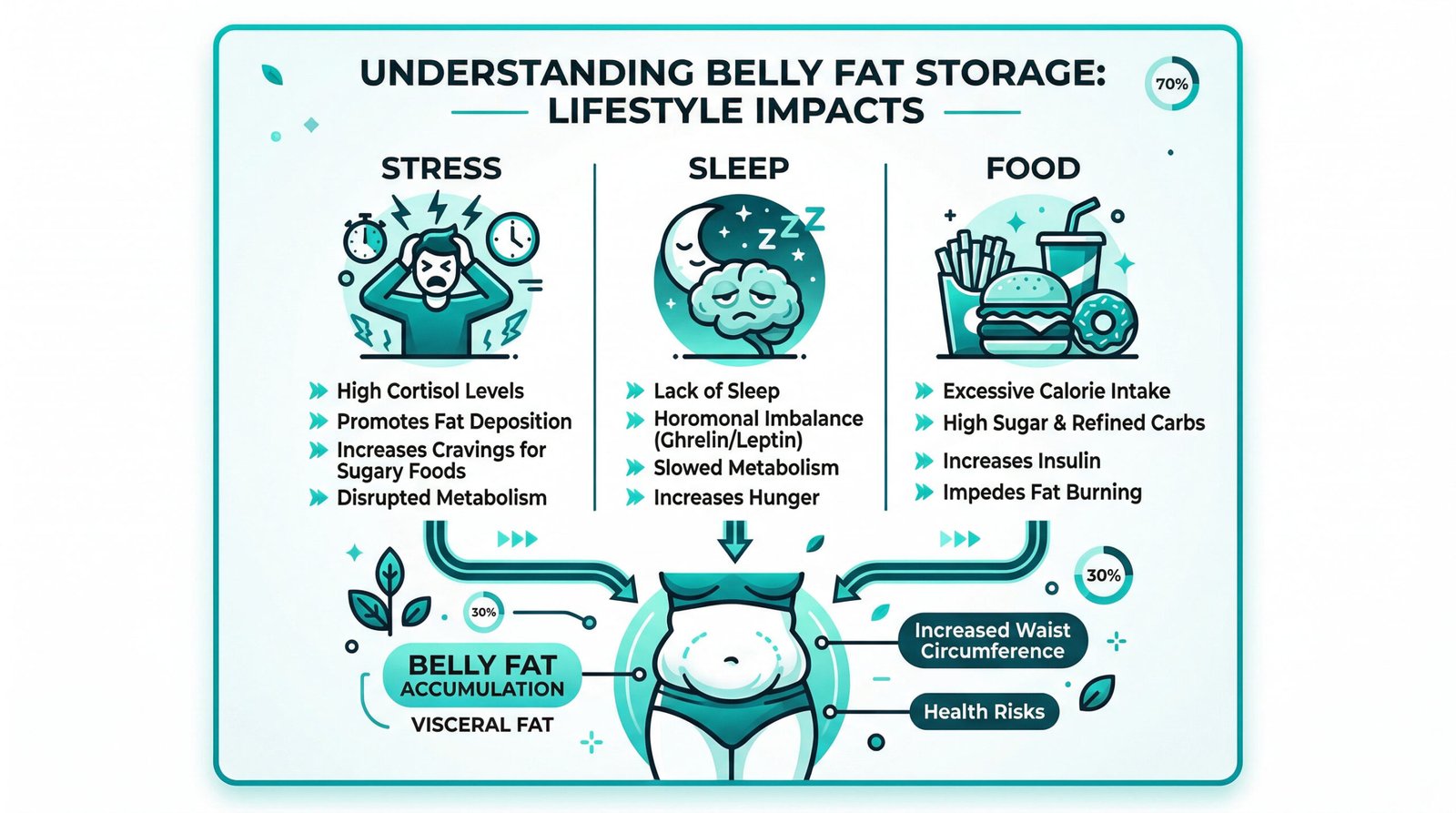
Cortisol tells your body to store fat — especially around your belly
When you’re stressed, your adrenal glands release cortisol. This hormone does something clever: it redirects energy to your muscles and brain so you can deal with the threat. Part of that process involves pulling fatty acids and glucose out of storage and flooding your bloodstream with them.
But here’s where the problem starts. If the threat doesn’t go away — if the stress is chronic — your body keeps cortisol elevated. And cortisol has another, less helpful function: it actively promotes fat storage, particularly in the visceral area around your organs and midsection. That’s the stubborn belly fat that doesn’t respond to crunches.
A 2018 study in Psychoneuroendocrinology confirmed that people with consistently elevated cortisol have significantly higher rates of abdominal fat accumulation compared to people with normal cortisol levels — regardless of diet.
Chronic stress hijacks your hunger signals
Cortisol increases the production of ghrelin, the hormone that tells your brain you’re hungry. At the same time, it blunts the signal from leptin, the hormone that tells you you’re full. So not only do you feel hungrier under stress — you also feel less satisfied after eating.
This is why stress eating is not a character flaw. It’s a physiological response. Your body is literally asking you for more food because it interprets the ongoing stress as physical danger. And what does it ask for? Dense, calorie-rich foods — sugar, fat, salt. The ones most likely to contribute to weight gain.
Poor sleep from stress compounds the fat storage cycle
Cortisol and sleep are deeply connected. High cortisol at night — which is common in people under chronic stress — disrupts the natural fall in cortisol that should happen as you wind down. You get less deep sleep. You wake up more. And when you don’t sleep enough, cortisol rises again the next morning, starting the whole cycle over.
I’m not 100% sure why some people seem more resistant to this cycle than others, but the research is consistent: poor sleep and high cortisol form a loop that makes fat loss increasingly difficult. Breaking one helps break the other. NCBI study on cortisol, sleep, and abdominal fat
The Fix: 5 Habits That Actually Lower Cortisol
These aren’t meditation retreats or life overhauls. They’re small daily changes that work with your body’s chemistry, not against it.
1. Walk outside for 20 minutes every morning
A 20-minute walk in natural light does three things simultaneously: it lowers cortisol, raises serotonin, and resets your circadian clock so your body knows it’s daytime. You don’t need intensity. You need movement and natural light — the combination is what does the work.
Common mistake: using the gym instead of going outside. A treadmill doesn’t provide natural light exposure, which is a critical part of the cortisol reset.
2. Eat enough protein at every meal
Protein stabilizes blood sugar. Stable blood sugar means lower cortisol spikes throughout the day. Aim for at least 25-30g of protein at every meal — eggs, chicken, legumes, Greek yogurt. This single change can reduce the cortisol-driven hunger cycle more than any supplement.
Common mistake: eating light during the day and a heavy dinner. This pattern keeps cortisol elevated in the morning when it should be falling.
3. Cut your caffeine after 12pm
Caffeine raises cortisol directly. Most people are drinking their third coffee at 3pm and wondering why they can’t sleep. Cut caffeine after noon and within 2 weeks most people notice measurably better sleep, less anxiety, and reduced afternoon food cravings. Honestly, this one surprised me the most.
Common mistake: switching to “half-caf” or energy drinks. Both still contain cortisol-raising stimulants. Herbal tea or water is the actual alternative.
4. Do 5 minutes of slow breathing before bed
Slow breathing — 4 counts in, 6 counts out — activates your parasympathetic nervous system, which is the biological off-switch for cortisol. Five minutes before sleep, every night, shifts your baseline. It’s not dramatic. It’s just chemistry.
Common mistake: doing this only when you feel anxious. The habit works best as a daily reset, not a crisis response.
5. Cap your screen time in the hour before bed
Blue light from screens suppresses melatonin and keeps cortisol elevated at a time when it should be falling. You don’t need to go completely screen-free — but 30 minutes of no screens before bed can improve your sleep depth enough that cortisol levels the next morning are noticeably lower.
Common mistake: using your phone as a “winding down” tool. Scrolling feels relaxing but biologically it’s the opposite — it keeps your stress system mildly activated the whole time.

Abdellah’s Experience: What Changed for Me
At my warehouse job, the stress was constant — not dramatic, just low-level and never-ending. Noise, pressure, physical demand. I was eating decently but I kept adding weight around my middle. I blamed the job. I blamed getting older.
Then I started treating stress as a physical variable, not just a feeling. I added a 20-minute morning walk. I stopped coffee after noon. I did 5 minutes of slow breathing before bed — felt stupid doing it at first, honestly.
After 2 weeks, my sleep improved. After a month, the waistband on my work trousers felt looser. I hadn’t changed what I ate. I’d just stopped feeding the cortisol cycle.
The fat wasn’t the problem. The hormone driving the fat was. And you can change that.

Try This for 7 Days (Then Tell Me I’m Wrong)
Don’t change your diet. Don’t change your workout. Just do these 5 things for one week:
- Walk outside for 20 minutes every morning — no headphones, no phone, just light and movement
- Eat protein at every meal — aim for at least 25g per sitting
- No caffeine after 12pm — replace with water or herbal tea
- 5 minutes of slow breathing (4 in, 6 out) before sleep — every night without exception
- Screens off 30 minutes before bed
Track how you feel on Day 1 vs Day 7. Most people notice changes in sleep quality first, then appetite control, then — within 2-3 weeks — a visible difference in abdominal puffiness. These aren’t magic habits. They’re cortisol management dressed up as daily routine.

The Real Reason Your Belly Fat Won’t Budge
Belly fat isn’t a food problem. It’s a hormone problem. And the hormone driving it isn’t triggered by what you eat — it’s triggered by how your nervous system perceives your life.
That’s uncomfortable to hear, but it’s also freeing. Because it means the solution isn’t another diet. It’s a different relationship with stress.
Want to go deeper on sleep’s role in all of this? Read: How to Sleep Better Naturally to Lower Cortisol and Lose Weight — it covers the overnight cortisol reset in detail. And if you’re working on your eating habits too, check: Best Foods to Eat When You’re Chronically Stressed.
📘 Go Deeper — Related Guide
How Cortisol and Stress Are Making You Fat (It’s Not Calories)
You’ve been told belly fat is a calorie problem. It isn’t — it’s a cortisol problem. This guide explains the exact biological mechanisms that turn chronic stress into fat storage, the 6 modern habits silently keeping your hormones in fat-storage mode, and the 30-day protocol to reset everything. No extreme dieting. Just the hormone science — applied.
Instant download · PDF · Science-based · Humaleth
Table of Contents
Medical disclaimer
This content is for informational purposes only and does not constitute medical advice. Always consult a qualified healthcare professional for personal health concerns.