



You think you’re just not a morning person. Or that your brain stopped working properly somewhere around age 30. But what if the real problem isn’t your personality or your age — it’s a few small daily habits you’ve quietly been skipping?
Some people do the same demanding work you do, deal with the same stress, sleep roughly the same hours — and still feel sharp by 10am. They’re not superhuman. They’re just doing a few basic things differently without making a big deal of it. If you struggle with daily energy and focus — the 2pm fog, the restless nights, the mornings where your brain just won’t switch on — this is for you. The habits that fix it are boring. That’s actually why they work.
Why So Many People Struggle With Energy and Focus Every Day
Low daily energy and focus isn’t a niche problem. According to a survey published in Frontiers in Public Health, more than 60% of adults report persistent tiredness that affects their work and concentration — and most of them believe the cause is stress or poor sleep alone.
But the research tells a different story. The biggest drain on your energy and mental clarity isn’t overwork. It’s the gaps in basic daily maintenance — things your body needs every single day just to run properly.
Check how many of these match where you are right now:
- You feel groggy for the first hour or two after waking, even after a full night of sleep
- Your focus disappears by mid-afternoon and no amount of coffee fully fixes it
- You feel mentally scattered, forgetful, or slow — more than you think you should
- You’re tired in the evening but somehow can’t wind down or sleep deeply
- You rely on caffeine or sugar to get through the second half of your day
If you nodded at three or more of those — your body isn’t broken. It’s just running on incomplete inputs. And that’s fixable.

What’s Actually Happening Inside Your Body
Your brain and body run on a mix of signals, chemicals, and physical conditions. When those inputs are off, everything downstream suffers — including your ability to think clearly, stay motivated, and feel awake. Here’s what’s actually going on.
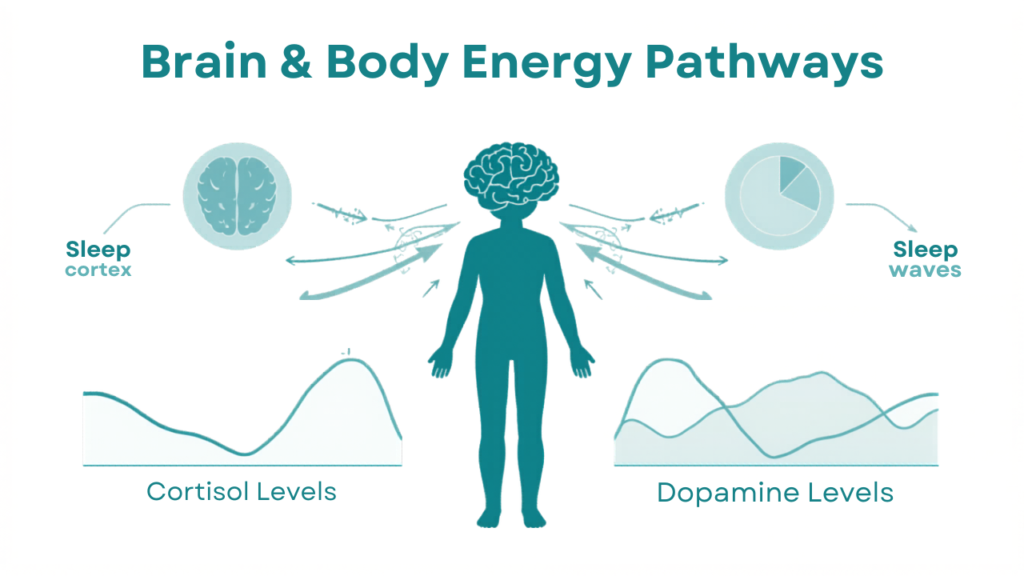
Your cortisol rhythm drives your energy window
Cortisol is a hormone most people associate with stress. But it also plays a central role in your daily energy cycle. In a healthy pattern, cortisol peaks sharply about 30–45 minutes after waking — this is what creates your natural morning alertness. If you skip movement, skip food, or stay in low light first thing, that peak flattens. You miss your natural energy window, and you spend the rest of the day trying to manufacture it with caffeine.
Your brain needs movement to produce focus chemicals
Sitting still for long periods reduces blood flow to your prefrontal cortex — the part of your brain responsible for attention, planning, and decision-making. It also suppresses dopamine and norepinephrine, two chemicals that drive motivation and sharp thinking. A study published on PubMed found that even 10 minutes of low-intensity movement significantly improved executive function and sustained attention in adults. Your brain doesn’t focus well when your body is completely still. It never evolved to.
Poor sleep quality disrupts memory and mood the next day
It’s not just how long you sleep — it’s what happens during those hours. During deep sleep, your brain clears metabolic waste, consolidates memories, and resets emotional regulation systems. If your sleep is frequently interrupted, too shallow, or poorly timed, you wake up with cognitive debt. You can technically sleep 7 hours and still feel like you got 4. Light exposure before bed, inconsistent sleep times, and late eating are the usual culprits — not some mysterious condition.
Source: NCBI
The Fix: 5 Daily Habits That Actually Work
These aren’t complicated. None of them require a gym membership, a supplement stack, or a 5am wakeup. They require consistency — which is harder but also more powerful.
1. Get 10 minutes of morning light within the first hour of waking
Step outside or sit near a bright window for 10 minutes right after you wake up. Natural light is the primary signal your brain uses to set your cortisol peak and anchor your circadian rhythm. It tells your body: it’s daytime, wake up properly.
Common mistake: using your phone in a dark room first thing. Artificial screen light doesn’t trigger the same response — it’s too dim and the wrong spectrum. Sunlight (even on a cloudy day) is 10–50x brighter than indoor lighting.
2. Drink 2 glasses of water before your first coffee
Your brain is roughly 75% water. After 7–8 hours without fluids, you’re already mildly dehydrated when you wake up — even before you feel thirsty. That mild dehydration measurably slows reaction time, increases mental fatigue, and reduces your ability to sustain attention.
Common mistake: reaching for caffeine first. Coffee is a mild diuretic. It can make the dehydration slightly worse before it makes you feel better. Water first, then coffee.
3. Eat breakfast that includes protein and slow carbs
Skip the sugary cereal or the nothing-at-all approach. Your brain runs on glucose, but it needs a steady supply — not a spike followed by a crash. Protein slows digestion and stabilizes blood sugar for 3–4 hours. Fast carbs alone spike your glucose and then drop you hard around 10am.
Simple options that work: eggs with toast, oats with nuts and banana, Greek yogurt with fruit. The exact food matters less than the combination of protein + slow carbs.
Common mistake: skipping breakfast “because you’re not hungry.” That lack of hunger is often a suppressed signal from poor sleep or chronic dehydration. Your brain needs fuel regardless.
4. Take a 5-minute movement break every 50–60 minutes of work
Set a timer. When it goes off, stand up, walk around, do 10 squats, stretch your neck and shoulders — anything that gets you out of the sitting position for 5 minutes. This one habit prevents the afternoon energy crash more effectively than any energy drink.
Sitting compresses your spine, restricts blood flow, and tells your nervous system to go into low-alert mode. Short movement breaks reset circulation and trigger a small release of dopamine and serotonin. Honestly, this one surprised me the most — I didn’t expect 5 minutes to make a real difference. It does.
Common mistake: waiting until you feel tired to take the break. By then, the drop has already happened. Preventive beats reactive, every time.
5. Keep a consistent sleep and wake time — including weekends
Your brain’s sleep-wake cycle runs on a 24-hour internal clock. Every time you sleep in on the weekend by 2+ hours, you’re effectively giving yourself mild jet lag. It shifts your cortisol rhythm, makes Monday morning feel harder than it needs to, and quietly erodes your weekday energy baseline over time.
Pick a wake time that works for your schedule and hold it 7 days a week. I’m not 100% sure this one is easy for everyone — life gets in the way. But even holding it 5 out of 7 days is meaningfully better than sleeping inconsistently every weekend.
Common mistake: treating weekends as ‘sleep debt payback.’ You can’t pay off sleep debt with one long sleep. What you can do is stabilize your rhythm so the debt stops accumulating.

Abdellah’s Experience: What Changed for Me
I used to leave my warehouse shifts feeling like someone had scooped my brain out. Not tired — blank. I’d get home, sit down, and just… stare. Coffee wasn’t helping. Sleeping more on weekends made it worse somehow.
I started with just the first two habits: 10 minutes outside in the morning before driving to work, and two glasses of water before my first coffee. That’s it. I didn’t change my sleep, my food, or my workout routine.
After four days, I noticed the 2pm blankness wasn’t hitting as hard. After two weeks, I added the movement breaks — just walking the length of the warehouse once an hour. The afternoon fog disappeared almost completely.
The job didn’t get easier. My body just stopped running on empty before noon.

Try This for 5 Days (Then Tell Me I’m Wrong)
Don’t overhaul your life. Just add these five things for 5 days:
- 10 minutes of morning light — outside or near a bright window, within the first hour of waking
- 2 glasses of water before your first coffee, every single morning
- A real breakfast — protein + slow carbs, no sugary cereal or skipping
- A 5-minute movement break every 50–60 minutes of work
- Same wake time every day — including Saturday and Sunday
Track how you feel on Day 1 versus Day 5. Most people notice the afternoon fog starts lifting by Day 3. Not because these habits are magic — but because they’re correcting something your body has quietly been asking for.

The Real Reason Your Energy and Focus Are Low
It’s uncomfortable to admit, but most of the daily brain fog and energy crashes people experience aren’t medical problems. They’re maintenance problems. Your body needs light, water, food, movement, and consistent sleep rhythms — and it gives you exactly what you give it.
Small habits, done consistently, beat any supplement or productivity hack every time. The boring answer is the right one.
Want to go deeper on one of the most important habits here? Read: how to sleep better naturally (without medication) — it builds directly on what’s covered in the sleep section above.
And if you’re struggling with that 2pm wall specifically, check out: why you feel tired every day even after rest
Table of Contents
Medical Disclaimer
This content is for informational purposes only and does not constitute medical advice. Always consult a qualified healthcare professional for personal health concerns.
