



You tell yourself you’d exercise if you had more time. But that’s not really the problem, is it? Most people who can’t make it to the gym aren’t short on time — they’re short on energy. And the cruel irony is that the less you move, the less energy you have to move.
The gym is a barrier for most people. The commute, the membership, the hour minimum — it all adds up to a reason not to start. But your body doesn’t care about your gym schedule. It cares about movement. And 10 minutes is enough to change how your entire day feels.
I used to think quick workouts were just for people who couldn’t commit to real training. I was wrong about that. Very wrong.
Why So Many People Skip Exercise — Even When They Want to Move
According to a study published in the American Journal of Health Promotion, lack of time is the most cited barrier to exercise — used by over 40% of adults who don’t meet weekly movement guidelines. But when researchers followed up, the same people found time for other low-priority activities. The real blocker isn’t the clock. It’s the all-or-nothing mindset that says a 10-minute workout doesn’t count.
And so nothing happens. The gym bag stays packed. The evening run stays in the plan. The body stays still.
Sound familiar? Here’s what that cycle usually looks like:
- You finish work physically tired but mentally wired — too exhausted to train, too restless to relax
- You plan to work out ‘later’ — and later never comes
- Skipping one day turns into skipping a week without much drama
- You wake up stiffer, heavier, lower energy than the week before
- Motivation drops further — because it’s hard to want to do something that feels difficult to start
The good news: this is fixable. And it doesn’t require a gym, an hour, or a new identity.

What’s Actually Happening Inside Your Body When You Stop Moving
Your body is not a machine that depletes fuel with use. It’s the opposite. Movement generates energy. Stillness drains it. Understanding this one thing changes how you think about exercise entirely.
Physical inactivity suppresses your energy hormones
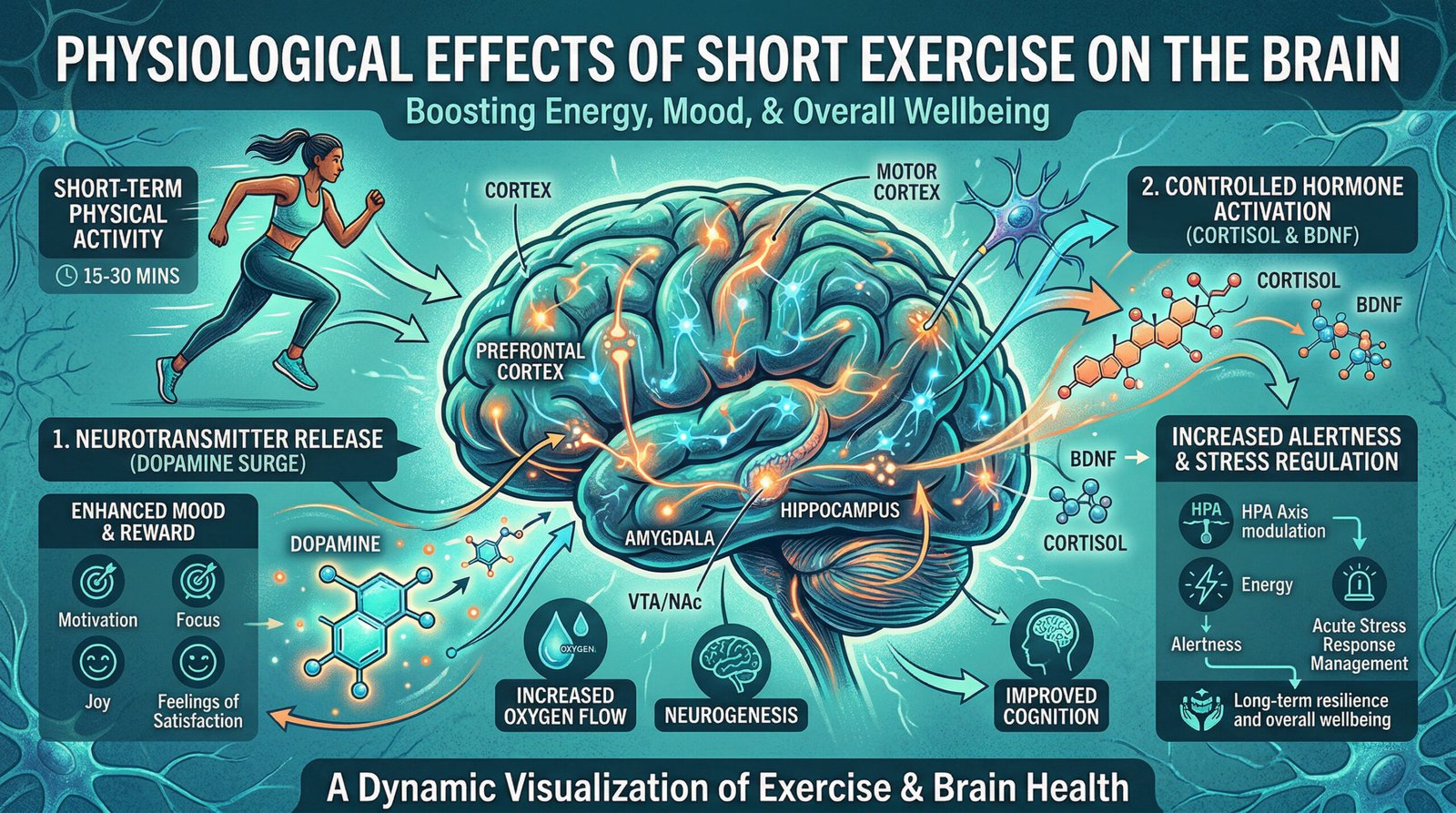
When you sit still for long periods, your body interprets it as a low-demand state and dials down production of dopamine, serotonin, and norepinephrine — three chemicals that regulate energy, motivation, and alertness. A 2018 review published in Frontiers in Physiology confirmed that even brief bouts of movement are enough to trigger measurable increases in these neurotransmitters. You don’t need a long workout. You need movement that signals your nervous system to shift gears.
Your circulation slows — and your brain feels it first
Sitting for 30 minutes reduces blood flow to your brain by about 20%. Less blood flow means less oxygen, less glucose delivery, and less mental sharpness. You’ll feel this as that ‘zoned out’ sensation in the afternoon — not sleepiness exactly, but a low-grade fog that doesn’t lift until you get up and move. Brief exercise restores cerebral blood flow within 3-5 minutes of starting.
Cortisol builds up without a physical outlet
Stress creates cortisol. Cortisol is designed to prepare your body for physical action. But if you don’t actually move — if the stress is mental and the body stays still — cortisol accumulates. That’s the ‘wired but tired’ feeling: your system is on alert but has nowhere to go. Short, moderate-intensity exercise is one of the most effective ways to metabolize excess cortisol and return your body to a calm, focused baseline.
The Fix: A 10-Minute Energy Workout You Can Do Anywhere
No equipment. No warm-up app. No shoes required if you’re in your apartment. This is a simple circuit designed to raise your heart rate, engage your major muscle groups, and trigger the hormonal response that lifts energy within 10 minutes.
Do each exercise for 45 seconds, rest for 15 seconds, then move straight to the next. One round takes 10 minutes exactly.
1. Jumping jacks — 45 seconds
Start here. Jumping jacks raise your heart rate fast and force both sides of your body to coordinate — which activates your nervous system quickly. If you’re in a flat with thin floors, do step-jacks: step one foot out at a time instead of jumping. Same cardiovascular benefit, zero noise downstairs.
Common mistake: going too fast and losing form. Moderate pace, arms fully extended overhead each rep.
2. Bodyweight squats — 45 seconds
Your legs contain the largest muscle groups in your body. Squatting activates them all at once — quads, glutes, hamstrings — which drives a large hormonal response relative to the effort. Keep your chest up and lower to where your thighs are parallel to the floor. You don’t need to go lower than that.
Common mistake: letting your knees cave inward. Push them out over your little toes as you descend.
3. Push-ups — 45 seconds
Upper body pressing activates your chest, shoulders, and triceps and increases core stability demand. Do standard push-ups if you can. Knee push-ups work equally well for energy purposes — the goal here is stimulus, not strength performance.
Common mistake: letting your hips sag. Keep your body in a straight line from head to heels.
4. High knees — 45 seconds
This is where the workout tips from moderate to high intensity. Drive your knees up to hip height alternately, arms pumping. High knees spike your heart rate the fastest of anything in this routine — which means the biggest hormonal kick. Even 30 seconds of real effort here is enough to change your energy state for hours.
Common mistake: leaning back. Keep your torso upright and core tight.
5. Plank hold — 45 seconds
End with a plank. It’s the only static hold in the routine, and it forces full-body tension without raising heart rate further — giving you a natural wind-down within the workout. Hold on your forearms or hands, body straight, breathe steadily. If 45 seconds is too long at first, drop to your knees halfway through. Common mistake: holding your breath. Exhale slowly through your mouth the whole hold.

Abdellah’s Experience: What Changed for Me
I work shifts that start early. I used to arrive already low on energy — stiff, foggy, moving through the first two hours on autopilot. I knew I should exercise, but I kept thinking I needed at least 30 minutes for it to matter. That belief cost me a lot of good mornings.
Then I started doing exactly this 10-minute circuit in my kitchen before leaving. No shoes, no music, sometimes half-asleep. After the first week I noticed I was arriving at work already warm, already alert. My body was ready before the shift even started.
Honestly, it felt almost too simple to work. But that’s the thing — it doesn’t need to be complicated to be effective.
The workout you actually do beats the perfect workout you keep postponing. Every single time.

Try This for 7 Days (Then Tell Me I’m Wrong)
Don’t change your sleep, your diet, or your schedule. Just add this one thing for 7 days:
- Do the 5-exercise circuit every morning — 10 minutes, before anything else
- Do it before coffee, before your phone, before breakfast
- Track your energy level at 10am, 2pm, and 6pm on Day 1 and Day 7
- Note whether you feel stiff arriving at work vs the week before
Most people notice a difference by Day 3. Not because 10 minutes transforms your fitness — it won’t. But because your body stops starting the day in a low-energy default state. And that matters more than people expect.

The Real Reason You Have No Energy Has Nothing to Do With the Gym
The gym is not where energy is made. Movement is. And movement has no minimum duration requirement. Your body doesn’t check whether you’re wearing gym shoes or whether you paid a monthly fee. It responds to stimulus.
Ten minutes of real movement beats zero minutes of perfect planning. And once you feel the difference in how your day goes, you stop needing motivation — because you have evidence.
5 Daily Habits That Boost Energy and Focus — pairs directly with this workout routine for a full energy system
Creatine for Brain Health — if you want to stack brain energy with physical movement, read this next
Table of Contents
Medical disclaimer
This content is for informational purposes only and does not constitute medical advice. Always consult a qualified healthcare professional for personal health concerns.