

You’ve probably seen the cold plunge videos. Athletes sitting in ice baths. Executives jumping into freezing lakes at 5am. Social media makes it look like a personality trait — a way to signal toughness, discipline, or belonging to some elite performance tribe.
But strip away the ritual and the branding, and what you’re actually looking at is a legitimate biological tool. Cold exposure does something to your body that almost nothing else can replicate in the same short window: it floods your nervous system with neurochemicals that sharpen focus, accelerate recovery, and build stress tolerance from the inside out. This isn’t about suffering for the sake of it. It’s about understanding what cold actually does at the cellular and hormonal level — and using it precisely enough to get the benefit without the theatre.
Why So Many Active People Are Recovering Slower Than They Should
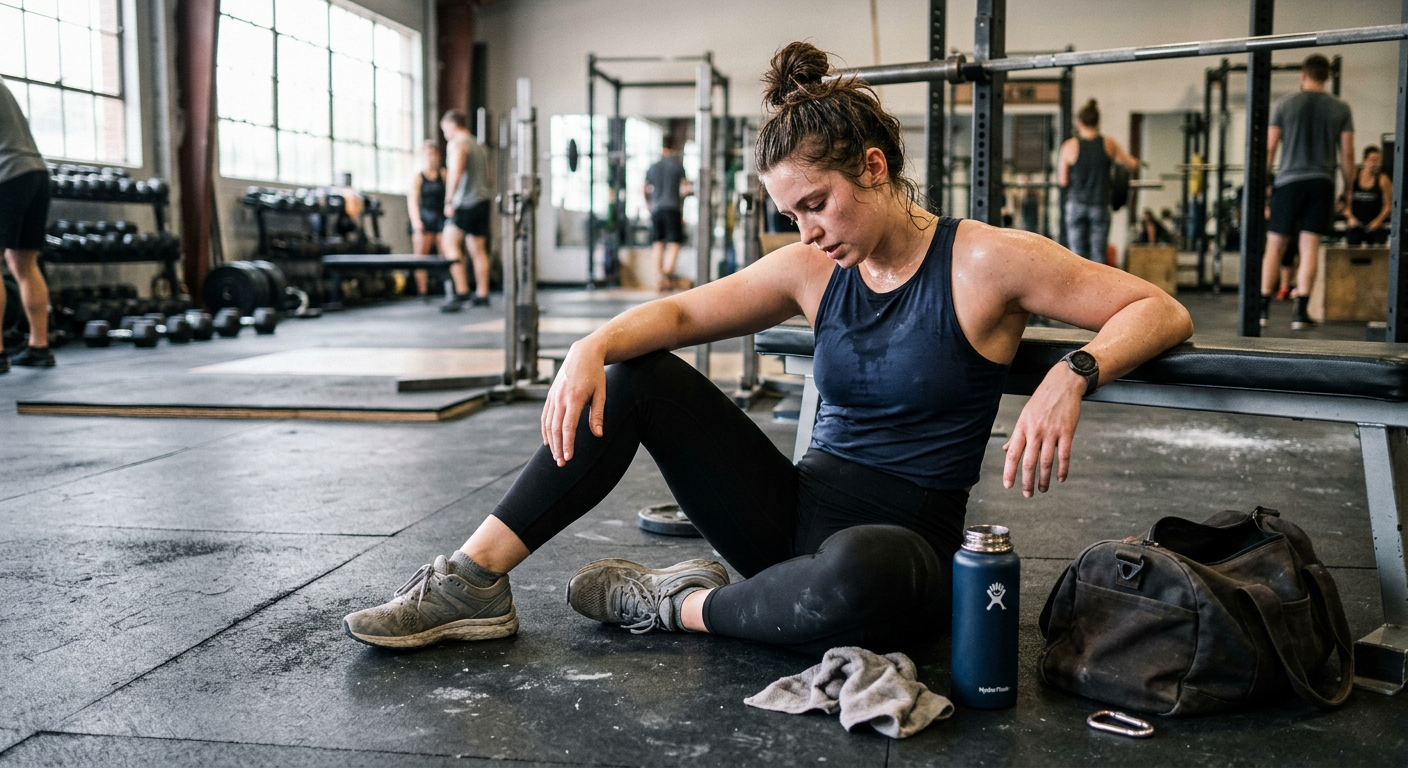
Most people who train hard, work physically demanding jobs, or simply push through high-stress days are operating with a recovery deficit. Not because they’re not resting — but because passive rest alone doesn’t reset the nervous system or clear the biological markers of physical stress fast enough.
The result is a slow accumulation: soreness that lingers a day longer than it should, mental flatness that follows hard effort, and a general sense that you’re always one step behind where your body should be. According to data reviewed across multiple sports science studies, inadequate recovery is one of the leading causes of performance decline in active adults — and most people address it with the wrong tools.
Do any of these sound familiar?
- Muscle soreness that’s still there 48 hours after a hard session or physical day
- A mental fog that follows high-effort periods — the brain slowdown after physical stress
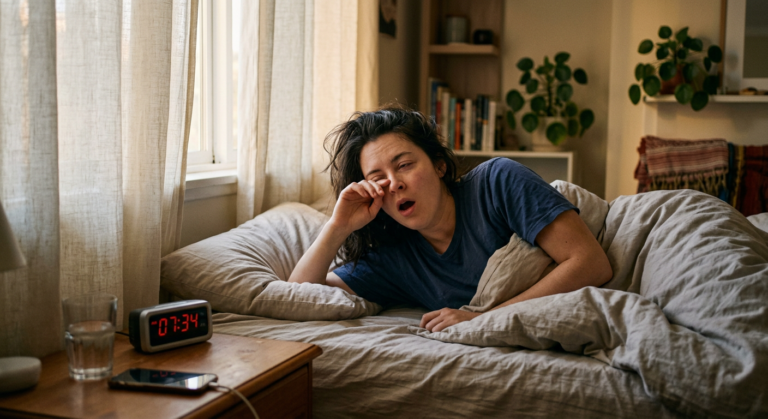
- Low motivation to train or push again the next day, even when you’ve slept
- Feeling wired but not alert — physically tired but mentally restless
- A slow build of background fatigue that doesn’t fully clear on rest days
These aren’t signs of overtraining. They’re signs of under-recovery. And cold exposure addresses several of these mechanisms directly — faster than most people expect.
What’s Actually Happening Inside Your Body
Cold exposure is a controlled stressor. And like most controlled stressors — exercise being the most obvious — the adaptation it triggers is the point, not the discomfort.
Cold triggers a powerful neurochemical response
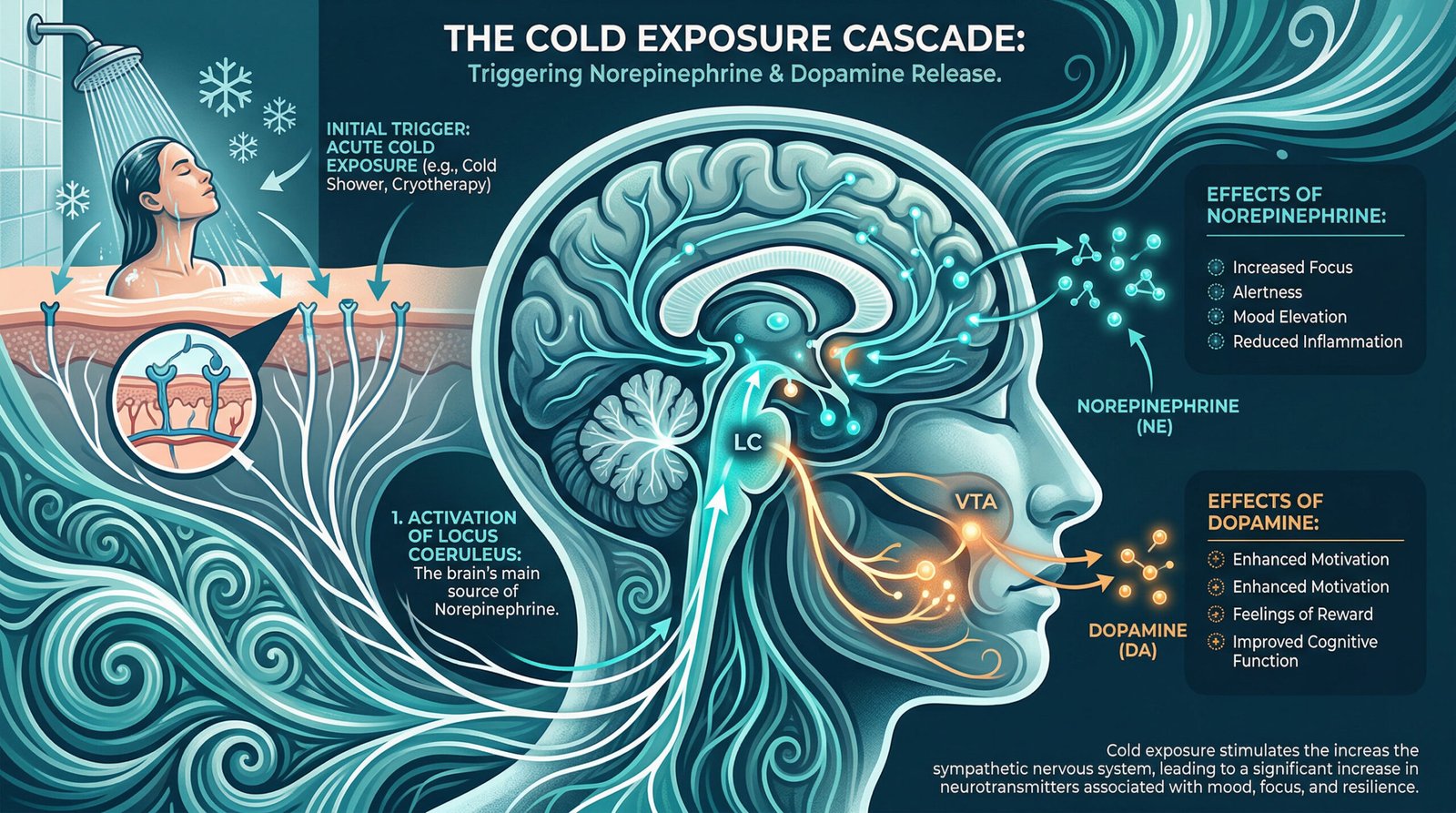
The moment cold water hits your skin, your body activates a survival response. Your sympathetic nervous system fires. Your heart rate spikes. Your breathing deepens. And your brain releases a cascade of neurochemicals to match the perceived threat.
A review published in the Journal of Neuropsychiatry and Clinical Neurosciences confirmed that cold-water immersion triggers the release of norepinephrine, dopamine, serotonin, and beta-endorphins — the same neurotransmitters linked to alertness, motivation, mood regulation, and stress resilience.
Norepinephrine, in particular, can spike by 200–300% during cold exposure — and crucially, the elevation persists for hours after the exposure ends. That’s not a caffeine hit that fades in 90 minutes. It’s a sustained neurochemical shift that affects focus, attention, and emotional regulation throughout the day.
It accelerates physical recovery between efforts
On the physical side, cold water immersion reduces the accumulation of creatine kinase — a blood marker of muscle damage — and significantly lowers delayed-onset muscle soreness (DOMS) after hard training.
A 2023 meta-analysis published in Sports Medicine — pooling 28 randomized controlled trials — found that cold water immersion was superior to other recovery methods for reducing muscle soreness, and improved perceived feelings of recovery 24 hours after high-intensity exercise. It also improved muscular power recovery following both eccentric and high-intensity exercise.
The mechanism is partly vascular: cold causes blood vessels to constrict, then dilate on rewarming — a pumping action that clears metabolic waste products from muscle tissue faster than passive rest alone. Think of it as wringing out a sponge.
It builds stress tolerance — not just physical toughness
Repeated cold exposure is a form of hormesis — deliberate low-dose stress that makes the system more resilient. Each time you expose your body to cold and breathe through the initial shock, you’re training your nervous system to respond more efficiently to stress in general.
The prefrontal cortex — your brain’s rational control centre — stays online during cold exposure when you actively control your breathing. Over time, this repeated practice of staying calm under acute physiological stress translates into better emotional regulation, faster recovery from anxiety, and a lower baseline cortisol level.
I’m honestly not sure how much of this is the cold itself versus the discipline of doing something uncomfortable every day — but the research on both pathways points in the same direction.
The Fix: 4 Ways to Use Cold Exposure Without Overdoing It
You don’t need a cold plunge tank or an ice delivery subscription. The threshold for biological effect is lower than most people think — and the method matters more than the drama.
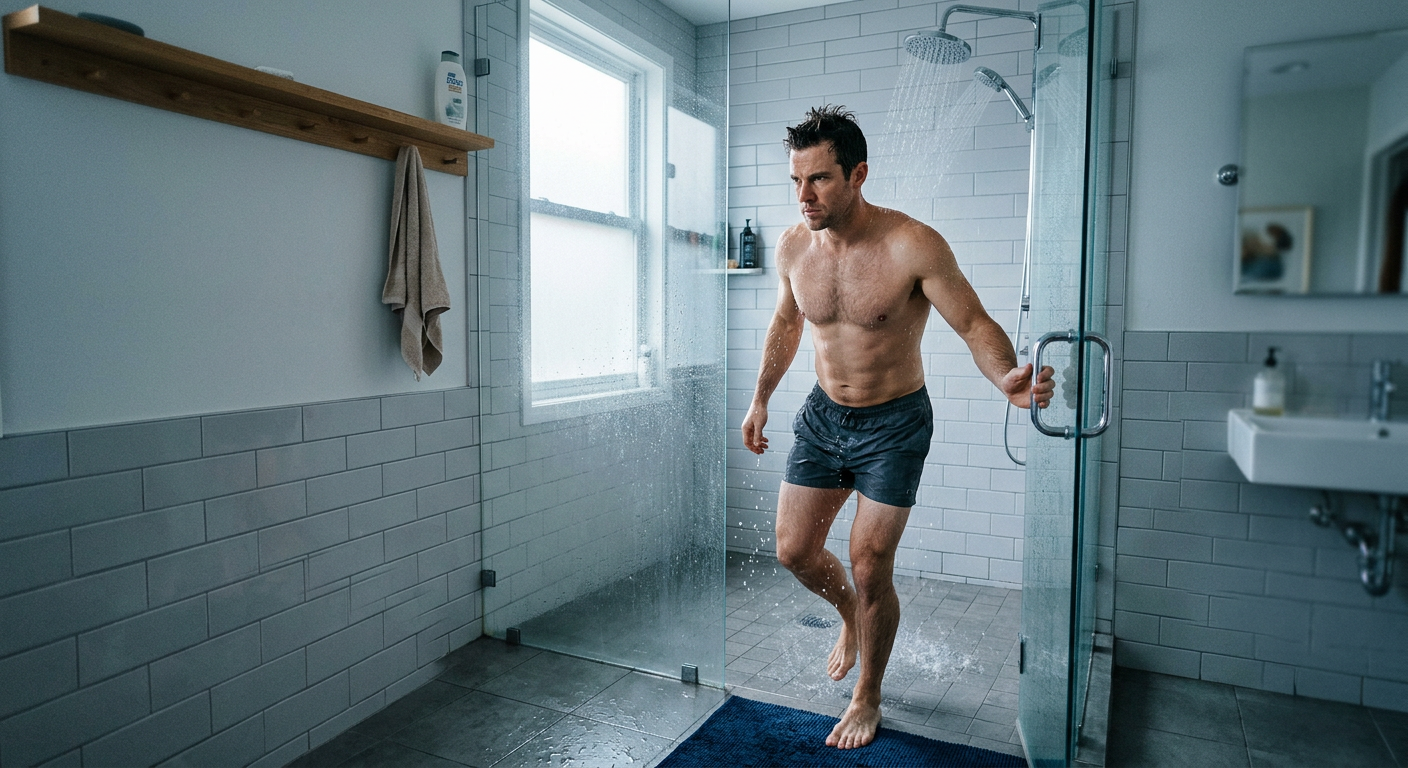
1. End your shower cold — 30 to 90 seconds, every morning
This is the lowest-barrier entry point and still produces a measurable neurochemical response. Finish your normal shower, then switch the temperature to cold and hold it for 30 to 90 seconds. Focus on your breathing — slow exhales are more important than the temperature.
The goal is not to white-knuckle through it. The goal is to stay calm while your body registers the cold as a threat. That contrast — discomfort without panic — is what trains the nervous system over time.
Common mistake: gasping and tensing up, then exiting after 10 seconds. The response you’re after requires at least 30 continuous seconds. Slow your exhale first, then let the cold do the rest.
2. Use cold immersion after training — 10 to 15 minutes at 11–15°C
If you train hard and recovery speed matters to you — whether that’s sport, manual labor, or high-volume gym work — cold water immersion after effort is where the research is strongest.
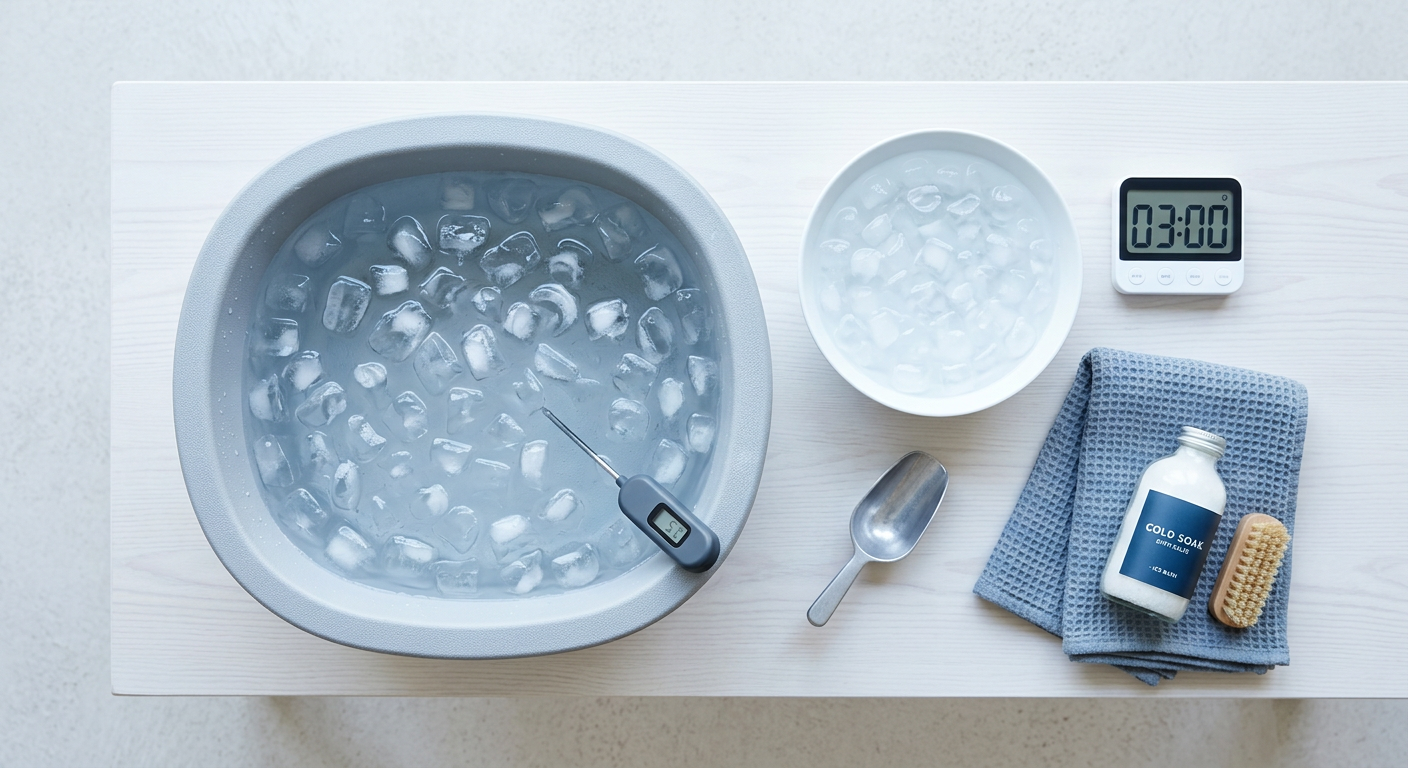
Aim for 10–15 minutes in water between 11°C and 15°C immediately or within 30 minutes post-exercise. A cold bath at home works. You don’t need specialist equipment — a bathtub filled with cold water and a bag of ice gets you to the right temperature range.
Common mistake: using cold immersion directly after a strength-training session when your goal is muscle growth. Research shows cold immediately post-lifting can blunt hypertrophy signals. Save it for days focused on recovery or aerobic/high-intensity work — not after your heavy lifting sessions.
3. Time your cold exposure to amplify its effect
Morning cold exposure pairs exceptionally well with the cortisol awakening response — your body’s natural alertness spike in the first 30–45 minutes after waking. Adding cold during this window amplifies the norepinephrine and dopamine release on top of an already-activated system.
Evening cold exposure, on the other hand, can disrupt sleep for some people by raising core temperature through the rewarming response. If you’re sensitive to sleep disruption, keep cold exposure to the morning or early afternoon.
Common mistake: doing a cold plunge right before bed to ‘relax.’ The body rewarming process is stimulating, not sedating. It’s the wrong tool for winding down.
4. Start with contrast showers if full cold is too much
Alternating 30 seconds hot, 30 seconds cold, repeated 3 to 5 times, produces many of the same vascular and neurochemical benefits as full cold immersion — and is significantly easier to sustain as a daily habit.
The contrast between temperatures drives the vascular pumping action that clears metabolic waste, and the repeated neural activation of switching between extremes still triggers the norepinephrine response. It’s a legitimate starting point, not a watered-down version.Common mistake: treating contrast showers as a permanent substitute. After 2–3 weeks, push toward ending on cold and extending the cold period. The adaptation requires progressive challenge — staying at the same level indefinitely stops producing new benefit.
Abdellah’s Experience: What Changed for Me
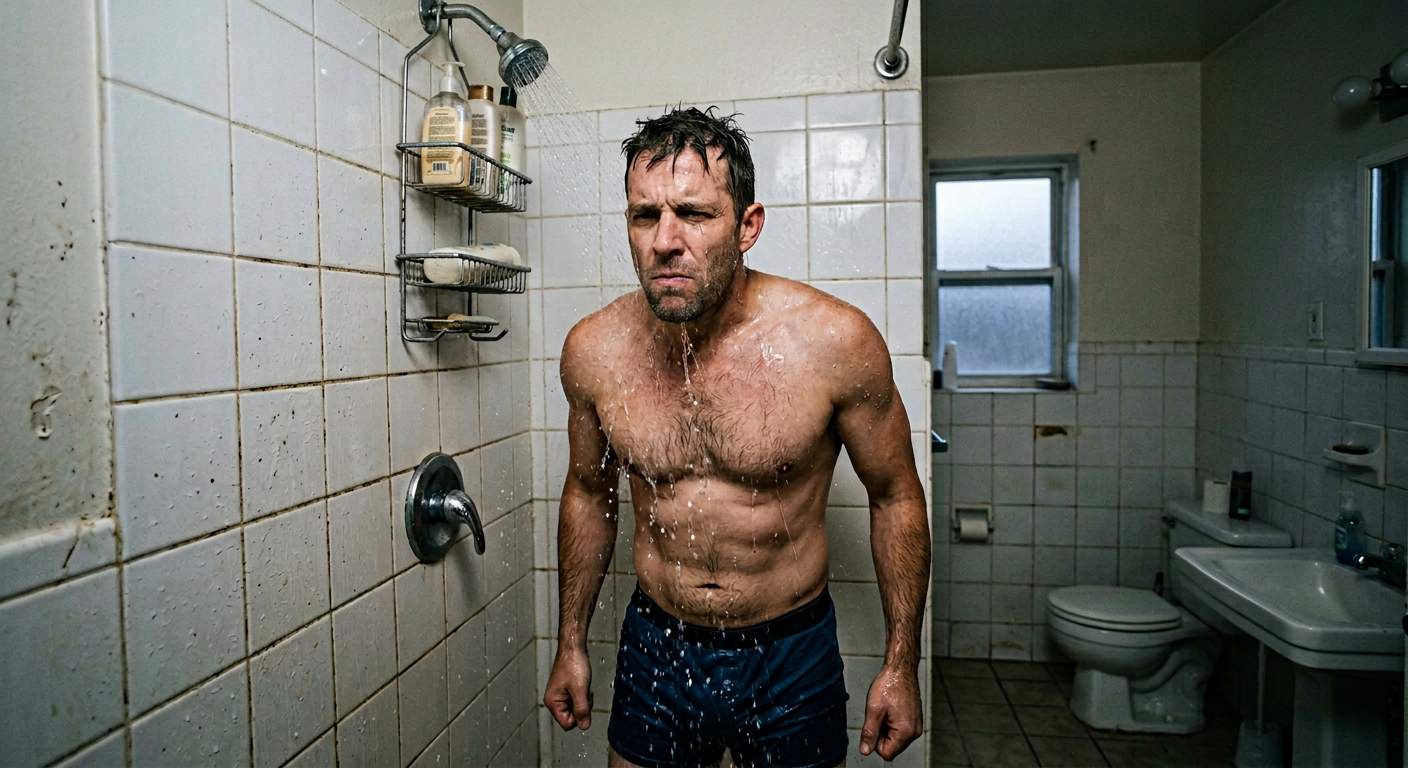
I started cold showers not because I wanted to — I started because I was desperate. After back-to-back long shifts, my body wasn’t recovering fast enough. The soreness was carrying into the next day and my head felt slow all morning regardless of how much sleep I got.
I tried ending my shower cold for 60 seconds every morning for two weeks. The first three days were genuinely awful. Day four I noticed something: I was alert by the time I got to work in a way that usually took two coffees. Not wired — just switched on.
By week two, the lingering post-shift soreness was noticeably shorter. And the mental flatness that used to follow hard days started clearing faster. Same job. Same hours. Same sleep. Just 60 seconds of cold water every morning.
It wasn’t willpower that kept me doing it. It was the fact that it actually worked.
Try This for 7 Days (Then Tell Me I’m Wrong)
One week. One change. Nothing else:
- Every morning for 7 days, finish your shower with 60 seconds of cold water
- Keep your breathing slow — one long exhale before you switch, then breathe through it
- Don’t cut it short. 60 seconds minimum, every single day
- On any day you train or do physical work, try extending to 90 seconds
Track two things: morning alertness on Day 1 vs Day 7, and how quickly you feel mentally ready after waking. Most people notice a shift by Day 3. Not dramatic — quiet. The brain fog clears faster. The morning resistance shrinks.
The Real Reason Cold Exposure Works Has Nothing to Do With Being Tough
The people who stick with cold exposure long-term aren’t doing it to prove something. They’re doing it because the neurochemical shift it produces is real and repeatable — and because nothing else they’ve tried delivers it in 60 seconds.
Cold is a tool. Like sleep, training, or nutrition — it works when it’s applied correctly and consistently. The discomfort is the dose. And the dose, done right, produces an adaptation that carries forward into everything else you do that day. Want to go deeper on the stress tolerance side of this? Read: The Plants That Fight Stress at the Root (Not Just the Symptoms) — it covers the adaptogenic approach that stacks well with cold exposure for sustained resilience.
Table of Contents
Medical disclaimer
This content is for informational purposes only and does not constitute medical advice. Always consult a qualified healthcare professional for personal health concerns.