



You think brain fog is just tiredness. You think poor concentration is stress. You’ve probably accepted a certain level of mental flatness as your baseline — something to push through rather than fix.
But here’s what most people don’t know: your brain is roughly 60% fat, and the single most important type of fat for brain function — omega-3 — is one your body cannot make on its own. You have to eat it. And most people in the modern world aren’t eating nearly enough.
That’s not a theory. The research on omega-3 and brain health has become one of the most consistent bodies of evidence in nutritional neuroscience. We’re talking about memory, focus, mood, and long-term cognitive protection — all affected by a nutrient most people completely ignore.
Why So Many People Are Running on an Omega-3 Depleted Brain
Modern diets have shifted dramatically toward processed foods and omega-6 fats — the kind found in vegetable oils, fast food, and packaged snacks. The ratio of omega-6 to omega-3 in the average diet used to be roughly 4:1. Today it’s closer to 20:1 in many Western countries, according to research published in the journal Biomedicine & Pharmacotherapy.
This imbalance matters because omega-6 and omega-3 compete for the same pathways in the brain. Too much omega-6 promotes neuroinflammation. Too little omega-3 means your brain cells can’t maintain the membrane flexibility they need to communicate efficiently.
The result shows up in ways most people attribute to other causes:
- Brain fog that sits behind your eyes all morning, especially without coffee
- Short attention span — losing your train of thought mid-sentence
- A low, flat mood that isn’t quite depression but isn’t quite fine either
- Forgetting names, words, or what you walked into a room to do
- Mental fatigue after tasks that didn’t used to feel this draining
None of that is inevitable. And for a lot of people, it’s directly connected to what they’re — and aren’t — eating.

What’s Actually Happening Inside Your Body
Omega-3 isn’t just a supplement trend. It’s structural material your brain is actively built from — and replacing it matters at the cellular level.
DHA is the building block of your brain cell membranes
Docosahexaenoic acid — DHA — is the dominant omega-3 in your brain. It makes up a large portion of the fatty acids in your cerebral cortex and is critical for maintaining the fluidity and flexibility of brain cell membranes.
When membranes are rich in DHA, neurotransmitter receptors — the docking stations for serotonin, dopamine, and other signalling chemicals — work more efficiently. The electrical signals between neurons travel faster. Synaptic connections form and strengthen more easily.
When DHA is deficient, membranes become more rigid. Signal transmission slows. This is one of the main structural reasons low omega-3 intake is associated with slower processing speed, weaker memory consolidation, and reduced mental flexibility.
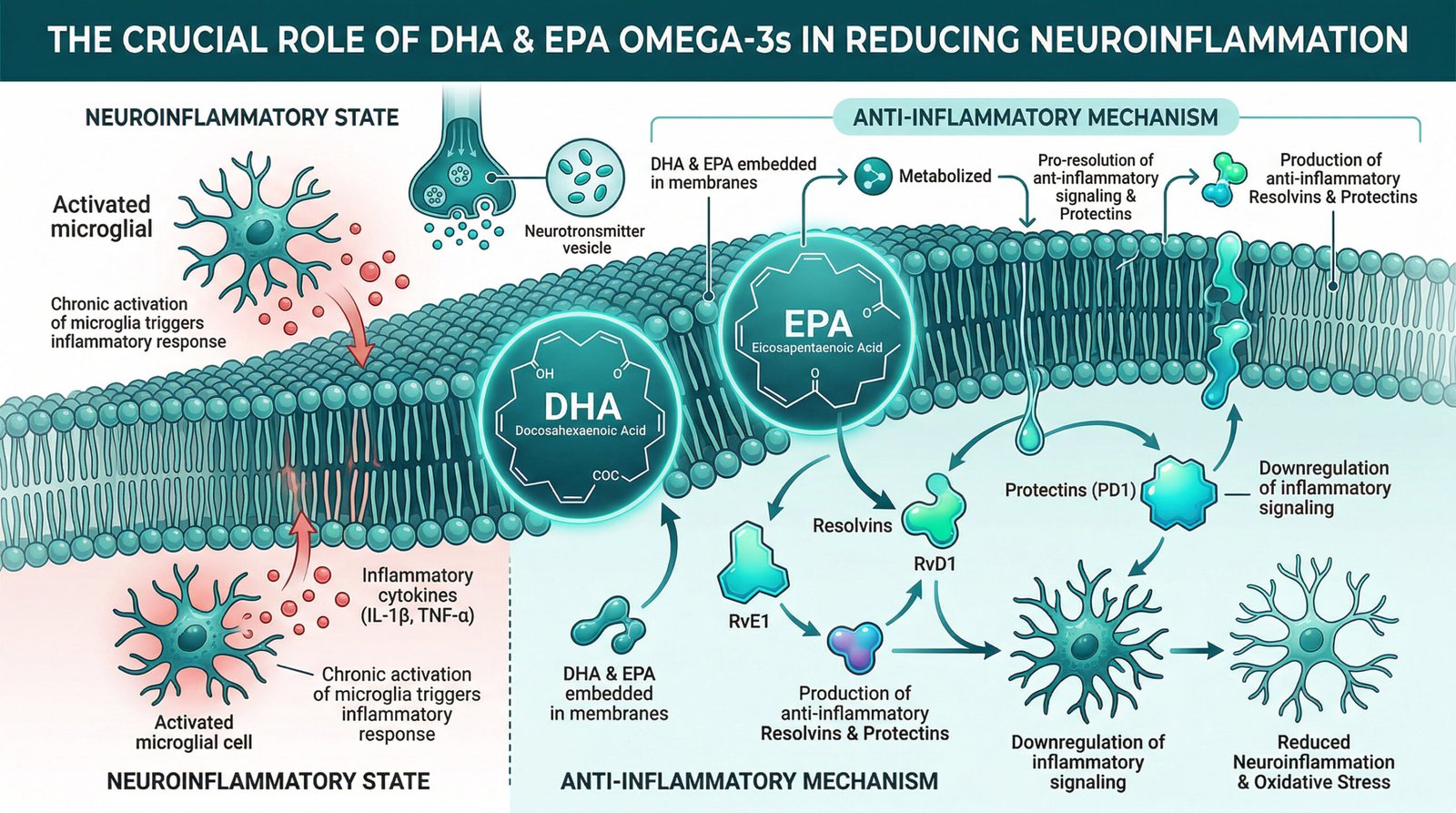
EPA reduces neuroinflammation — the hidden cause of brain fog
Eicosapentaenoic acid — EPA — works differently from DHA. Its primary role in the brain is anti-inflammatory. It inhibits the production of pro-inflammatory molecules called eicosanoids, which — when chronically elevated — damage neural tissue and disrupt neurotransmitter signalling.
Neuroinflammation is now recognized as a key driver of depression, brain fog, and accelerated cognitive decline. It’s a slow, invisible process most people never connect to how they feel day-to-day.
A 2024 review published in the International Journal of Molecular Sciences confirmed that EPA and DHA both produce antidepressant effects through their modulation of neuroinflammation, neurotransmitter function, and neuroplasticity — the brain’s ability to form new connections and adapt to new information.
Omega-3 supports BDNF — your brain’s growth hormone
BDNF — brain-derived neurotrophic factor — is a protein that acts like fertiliser for your neurons. It promotes the growth of new brain cells, strengthens existing connections, and protects against age-related cognitive decline.
Chronic stress, poor sleep, and a diet low in omega-3 all suppress BDNF production. Higher omega-3 intake, on the other hand, is consistently associated with elevated BDNF levels — which is one reason it has a measurable effect on learning, mood regulation, and resilience to stress.
Honestly, the BDNF connection is the part of the omega-3 story that gets the least attention publicly — and it’s probably the most important one for long-term brain health.
The Fix: 4 Ways to Actually Get Enough Omega-3 for Your Brain
There’s no magic dose that works overnight. Omega-3 builds up in brain tissue gradually — most studies show meaningful cognitive effects at 8–12 weeks of consistent intake. But the habits are simple.
1. Eat fatty fish 2–3 times per week
Salmon, sardines, mackerel, and anchovies are the most concentrated food sources of EPA and DHA. A 100g serving of salmon provides roughly 2,000–2,500mg of combined EPA and DHA — close to the amount used in most clinical studies showing cognitive benefit.
Sardines are worth special mention. They’re cheap, shelf-stable, high in omega-3, and one of the cleanest sources of fish you can eat — low in mercury, low in environmental toxins, and no cooking required.
Common mistake: relying on tuna as your main fish source. Canned tuna has very little omega-3 compared to fatty fish. It’s a protein source, not an omega-3 source.
2. Supplement with 1,000–2,000mg of EPA+DHA daily
If you’re not eating fatty fish regularly, a 2025 dose-response meta-analysis published in Scientific Reports — covering 58 randomized controlled trials — found that each 2,000mg per day increment in omega-3 supplementation significantly improved attention and perceptual speed in adults. Look for a supplement that lists the combined EPA+DHA amount on the label, not just ‘fish oil.’
A 1,000mg fish oil capsule often only contains 300mg of actual EPA+DHA. Read the back, not the front. Aim for 1,000–2,000mg of EPA+DHA combined, taken with a meal that contains some fat for better absorption.
Common mistake: buying the cheapest fish oil you can find. Low-quality fish oil is often oxidized before you open it — rancid omega-3 does more harm than good. Smell it. If it smells strongly fishy, it’s already gone off.
3. Add plant-based omega-3 sources for ALA
Walnuts, flaxseeds, chia seeds, and hemp seeds contain ALA — a plant-based omega-3 that your body can partially convert to EPA and DHA. The conversion rate is low (roughly 5–10%), so plant sources alone aren’t sufficient for brain health.
But they’re useful as a complement — especially for reducing the omega-6:omega-3 ratio in your diet overall. A small handful of walnuts (around 28g) provides about 2,500mg of ALA. Add them to breakfast or a snack instead of processed crackers or biscuits.
Common mistake: treating plant-based omega-3 as equivalent to fish-based omega-3. They work through different pathways. For brain-specific benefits, EPA and DHA from fish or marine sources are what the research is actually based on.
4. Reduce omega-6 intake at the same time
Adding omega-3 without reducing omega-6 is like trying to fill a leaky bucket. Cooking oils like sunflower, corn, soybean, and vegetable oil are all extremely high in omega-6 linoleic acid — and they’re in almost every processed food you buy.
Switching to olive oil, butter, or avocado oil for cooking immediately improves your omega-3 to omega-6 ratio without changing anything else. This alone helps omega-3 do its job more effectively in the brain.Common mistake: adding fish oil on top of an unchanged diet heavy in vegetable oils and processed snacks. The ratio is what matters — not just the absolute amount of omega-3.

Abdellah’s Experience: What Changed for Me
I spent years dismissing the foggy, slow feeling in my head as just tiredness from shifts. I thought if I slept more, it would clear. It didn’t. The fog was just always there — like thinking through cotton wool.
I started eating sardines 3 times a week and added a fish oil supplement — 1,000mg EPA+DHA per day with breakfast. I didn’t expect much. The changes people described online sounded too good to be true.
By week 6, something had shifted. I wasn’t getting distracted mid-task as often. I started finishing sentences in my head before I needed to search for the word. The flat mood I’d normalized started lifting without me doing anything else differently.I hadn’t been tired all those years. I’d been deficient.

Try This for 30 Days (Then Tell Me I’m Wrong)
Omega-3 is a slow-build nutrient. Give it the time it actually needs — 30 days of consistent intake — before you judge it:
- Eat fatty fish (salmon, sardines, or mackerel) at least 3 times this week — and every week for 30 days
- Add 1,000–2,000mg of EPA+DHA from a quality fish oil supplement daily, with your first meal
- Replace your cooking oil with olive oil or avocado oil starting today
- Add a small handful of walnuts to your daily breakfast or snack
At the end of 30 days, track one thing: the mental energy cost of your normal day. Is thinking easier? Are you losing the thread less? Most people notice the shift quietly — not a dramatic change, but a lightness where the fog used to be.

The Real Reason Your Brain Isn’t Performing the Way It Should
You’ve been told to train your brain. Use apps. Sleep more. Meditate. And those things help. But none of them work as well when your brain is structurally undernourished.
Omega-3 isn’t a supplement. It’s a raw material. And a brain that’s short on DHA and EPA is like a machine running on the wrong fuel — it works, but not the way it was built to. Want to go deeper? Read: Why You Have No Motivation (And How to Fix Your Dopamine) — it covers the exact neurotransmitter side of brain performance that omega-3 directly supports.
Table of Contents
Medical disclaimer
This content is for informational purposes only and does not constitute medical advice. Always consult a qualified healthcare professional for personal health concerns.