



Most people think about exercise as something that helps the body. Burn calories. Build muscle. Improve cardiovascular health. And all of that is true. But there’s a specific type of exercise that does something else entirely — something most people have never been told about.
It builds your brain. Literally. Not as a metaphor for focus or clarity. Physically — by stimulating the growth of new neurons, increasing the size of your hippocampus, and flooding your brain with a protein that acts as fertiliser for your neural connections. That type of exercise is called Zone 2 cardio. And the frustrating part is that most people who exercise at all are working too hard to get this specific benefit. They’re in Zone 4 when they think they’re building fitness — and completely skipping the zone where the brain-building happens.
Why So Many People Exercise But Still Feel Mentally Flat
Physical inactivity is the obvious problem — but it’s not the only one. Plenty of people who train regularly still experience brain fog, poor memory, low motivation, and difficulty concentrating. They’re working hard. They’re sweating. And they’re still not getting the cognitive benefits that exercise is supposed to deliver.
The issue is intensity. Most recreational exercisers spend their cardio time in Zone 3 to Zone 4 — working hard enough to prevent conversation, breathing heavily, heart rate climbing toward 80% of maximum. That intensity trains cardiovascular endurance and burns energy. But it doesn’t maximally stimulate the brain-derived neurotrophic factor (BDNF) pathway — the primary mechanism through which aerobic exercise rebuilds the brain.
The symptoms of a brain that isn’t getting enough Zone 2 stimulus are easy to miss because they look like a dozen other things:
- Memory that feels slower — names, words, and details taking longer to retrieve
- Difficulty holding focus on a single task for more than 20–30 minutes
- A mental flatness that follows physical effort rather than mental clarity
- Anxiety or low mood that doesn’t seem to respond to exercise the way it used to
- A sense that your thinking is less sharp than it was a few years ago
None of these are inevitable. They’re signals of a brain that isn’t getting the specific aerobic input it needs — and Zone 2 is exactly that input.

What’s Actually Happening Inside Your Body
Zone 2 is a specific metabolic state — low enough intensity that your body primarily burns fat for fuel, but high enough to sustain elevated heart rate and generate the biochemical signals that drive brain adaptation. Understanding why this zone works requires understanding three things.
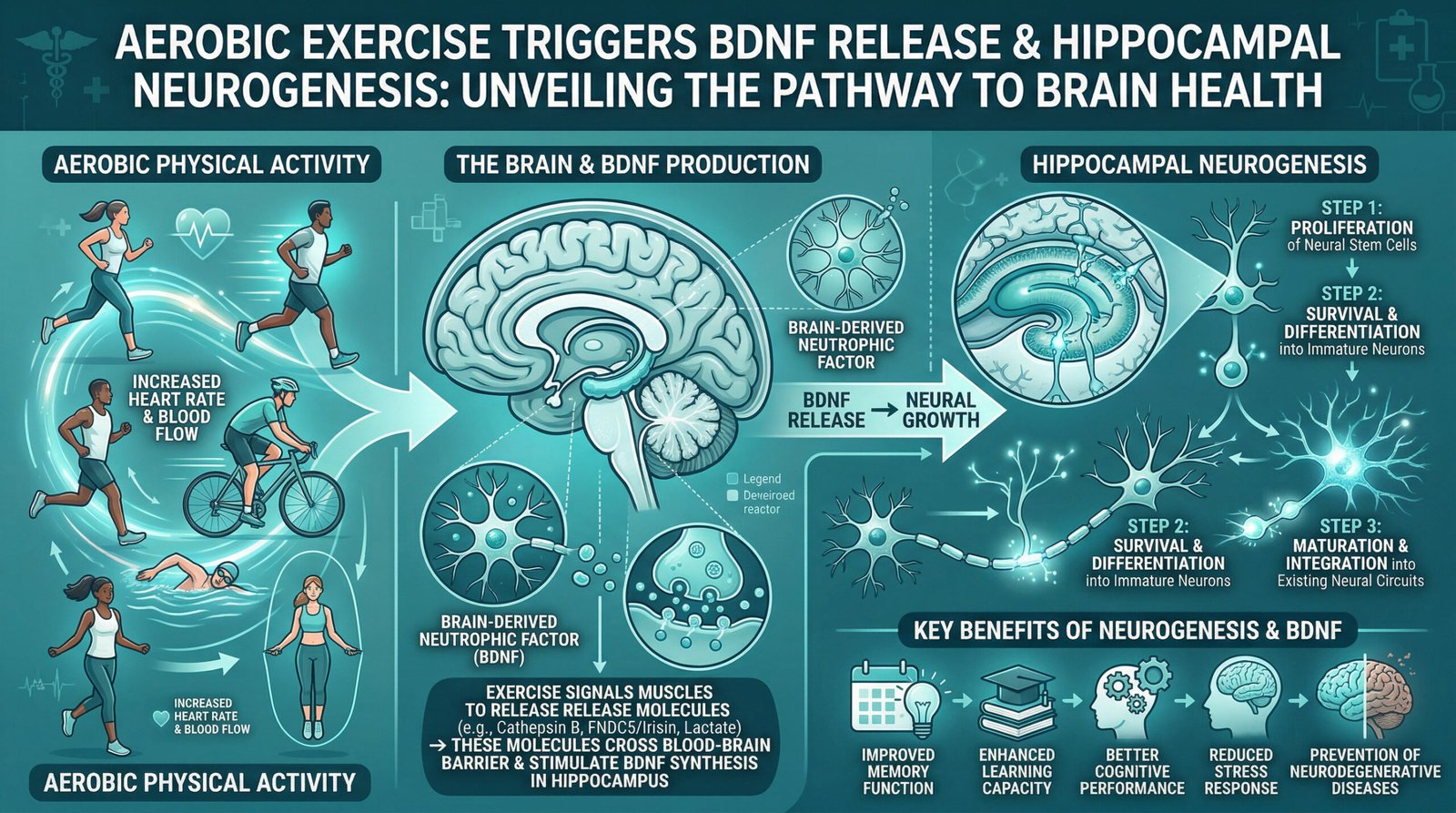
Aerobic exercise floods your brain with BDNF
BDNF — brain-derived neurotrophic factor — is the protein most directly responsible for the brain-building effects of aerobic exercise. It promotes neurogenesis (the growth of new neurons), strengthens synaptic connections, protects existing neurons from degeneration, and is critical for learning, memory consolidation, and mood regulation.
A 2024 review published in Frontiers in Neurology confirmed that aerobic exercise significantly increases BDNF levels — particularly in the hippocampus, the brain region most responsible for memory and learning — and that this effect is most pronounced with moderate-intensity sustained aerobic exercise, which maps directly onto Zone 2.
BDNF doesn’t stay elevated indefinitely after a single session. The brain-building effect accumulates with consistent, repeated exposure over weeks and months — which is why Zone 2 done three times per week for 45–60 minutes produces measurably different cognitive outcomes than occasional intense workouts.
Zone 2 actually grows the hippocampus
The hippocampus is one of the few brain regions capable of generating new neurons in adulthood — a process called adult neurogenesis. It’s also one of the first regions to shrink with age, chronic stress, and sedentary behaviour. When hippocampal volume drops, memory and spatial navigation deteriorate.
A landmark randomized controlled trial published in the Proceedings of the National Academy of Sciences found that a one-year programme of moderate-intensity aerobic exercise increased hippocampal volume by 2% — effectively reversing 1 to 2 years of age-related volume loss. The control group, who did only stretching, showed continued hippocampal shrinkage. Critically, the increase in hippocampal volume directly correlated with improvements in memory performance and higher circulating BDNF levels.
Two percent might sound modest. But the hippocampus typically shrinks 1–2% per year in adults without dementia. A 2% increase means the exercise group added the equivalent of two years of brain volume back in twelve months of consistent moderate cardio.
Zone 2 also improves cerebral blood flow and reduces neuroinflammation
Beyond BDNF, sustained aerobic exercise at low-to-moderate intensity drives cerebral angiogenesis — the growth of new blood vessels in the brain. More blood vessels mean more oxygen and glucose delivery to neurons, faster waste clearance, and greater metabolic efficiency in neural tissue.
Zone 2 also reduces systemic inflammation — one of the primary drivers of cognitive decline, brain fog, and depression. By keeping cortisol manageable (unlike high-intensity training, which spikes cortisol significantly), Zone 2 creates a neurochemical environment where the brain can repair and adapt rather than simply survive stress.
I’m not 100% certain why Zone 2 specifically outperforms other intensities for these neuroinflammatory effects — the research on intensity-specific dose-response is still developing. But the direction across multiple mechanisms consistently points toward sustained moderate aerobic work as the sweet spot.
The Fix: How to Actually Do Zone 2 (And Know You’re In It)
The biggest problem with Zone 2 is that most people either don’t know what it feels like or accidentally exercise too hard. Here’s exactly how to find it and build the habit.
1. Learn what Zone 2 actually feels like
Zone 2 is the intensity at which you can hold a full conversation — uncomfortable enough to notice you’re working, but easy enough that you could sustain it for 45–60 minutes without feeling wrecked. If you can’t speak in complete sentences, you’re too hard. If you feel like you’re just strolling, you’re too easy.
In heart rate terms, Zone 2 sits at roughly 60–70% of your maximum heart rate. A simple estimate for maximum heart rate is 220 minus your age. For a 35-year-old, that’s a target zone of approximately 111–130 beats per minute.
Common mistake: going too hard because Zone 2 feels embarrassingly easy at first, especially if you’re used to harder training. That’s normal. The whole point is sustained, low-stress aerobic output — not effort. Slow down significantly from what feels like a ‘real’ workout.
2. Choose a Zone 2 activity you’ll actually repeat
Zone 2 works through any sustained aerobic modality — walking (brisk, with slight incline), jogging, cycling, swimming, rowing, or even dancing. The activity itself matters less than the duration and consistency.
For most people without a fitness base, brisk walking with a slight incline is the most accessible entry point. A 45-minute brisk walk on a treadmill at 5–6 km/h with a 3–5% incline puts most adults squarely in Zone 2 without requiring any equipment beyond shoes.
Common mistake: treating Zone 2 as boring and compensating by adding intervals or sprints. Intervals spike you out of Zone 2 and shift the metabolic and neurochemical stimulus. Keep it steady. Bring a podcast or audiobook — Zone 2 is cognitively comfortable by design.
3. Aim for 3 sessions per week, 45–60 minutes each
The research on hippocampal growth and BDNF consistently points to a threshold of roughly 90–150 minutes of Zone 2 per week as the minimum dose for measurable cognitive benefit. Three 45-minute sessions per week clears that threshold comfortably.
Start with 3 sessions of 30 minutes if 45 feels like too much, then build by 5 minutes per session each week. The body adapts quickly. Within 4 weeks, 45 minutes at Zone 2 intensity will feel significantly easier than the first session.
Common mistake: trying to do it every day as a way to accelerate results. Zone 2 is low stress, but the brain-building adaptations happen during recovery between sessions — not during the sessions themselves. Three times per week with recovery days between is more effective than daily.
4. Be patient — the cognitive benefits take weeks to appear
Zone 2’s brain benefits are not immediate. The BDNF spike after a single session clears relatively quickly. The structural changes — hippocampal growth, new synaptic connections, improved cerebral blood flow — take consistent weeks of training to become measurable.
Most people notice a shift in mental clarity, mood, and focus within 3–4 weeks of consistent Zone 2 three times per week. The memory improvements that correspond to hippocampal changes take longer — typically 8–12 weeks before they become noticeable in daily life.
Common mistake: quitting after two weeks because it ‘isn’t working.’ Zone 2 is not a quick fix. It’s a slow, cumulative rebuild. The people who stick with it for three months are the ones who understand what they’re building — not just fitness, but brain structure.
Abdellah’s Experience: What Changed for Me
I used to think walking wasn’t real exercise. I’d jog hard for 20 minutes, feel exhausted, and consider that enough. My head was still foggy. My focus was still inconsistent. I figured I just needed more sleep.
I started three 45-minute brisk walks per week — Zone 2, nothing more, nothing less. Slow enough to hold a conversation if I’d wanted to, but steady enough that I was clearly working. For the first two weeks, it felt too easy to be doing anything.
By week four, the morning fog that had been with me for years started clearing faster. By week eight, I noticed I was holding focus through longer tasks without losing the thread. Same sleep, same diet, same stress. Just 45 minutes of Zone 2, three times a week.I wasn’t under-exercising all those years. I was exercising in the wrong zone.

Try This for 4 Weeks (Then Tell Me I’m Wrong)
One month. Three sessions a week. That’s the minimum commitment to feel the shift:
- Three times this week, do 45 minutes of Zone 2 cardio — brisk walk, easy jog, or steady cycling
- Stay in Zone 2: you should be able to speak in full sentences throughout
- No intervals, no sprints — just steady, sustainable effort for the full 45 minutes
- At the end of week 4, compare your morning mental clarity to week 1
Track one thing each day: how long it takes your brain to feel sharp after waking. Most people doing consistent Zone 2 notice this window shortening by week 3. Not dramatically — quietly. The fog just lifts faster.

The Real Reason Most Exercise Doesn’t Fix Your Brain
It’s not that exercise doesn’t work for brain health. It does — consistently, reliably, across decades of research. The problem is that the intensity most people choose activates the performance adaptation but not the neuroplasticity adaptation.
You can be fit and still have a brain that’s slowly losing volume. You can be strong and still have BDNF levels that never get high enough to drive neurogenesis. Zone 2 isn’t the only thing your brain needs — but it’s the one specific input most active people are missing. Want to go even deeper on the fuel your brain needs alongside this? Read: Your Brain Is Made of Fat — And It’s Probably Starving for Omega-3 — the dietary side of neuroplasticity that directly amplifies what Zone 2 starts.
Table of Contents
Medical disclaimer
This content is for informational purposes only and does not constitute medical advice. Always consult a qualified healthcare professional for personal health concerns.