



You already know you should drink more water. That advice has been around so long it barely registers anymore. Drink eight glasses a day. Stay hydrated. You’ve heard it a thousand times and probably ignored it just as many.
But here’s the part that rarely gets explained: dehydration doesn’t just make you thirsty or give you a headache. At levels most people experience on a regular basis — before you even feel thirsty — it’s quietly degrading your ability to concentrate, making you slower to respond, flattening your mood, and making simple tasks feel harder than they should. The threshold is lower than you think. A fluid loss of just 1–2% of your body weight — the equivalent of skipping your morning water while going about a normal day — is enough to produce measurable changes in how your brain performs. Not severe dehydration. Not a crisis. Just a typical Tuesday.
Why So Many People Spend Their Days Mildly Dehydrated Without Knowing It
Thirst is a late signal. By the time you feel thirsty, your body is already in a state of mild dehydration — your plasma osmolality has risen, your blood has thickened slightly, and your brain has already begun compensating for reduced fluid availability. Thirst is not a prevention mechanism. It’s an alarm that goes off after the problem has started.
Most adults lose 2–3 litres of water per day through urine, breathing, sweating, and digestion — even without exercise, even in a cool office. If your fluid intake doesn’t replace what you lose, the deficit builds gradually across the morning. By midday, many people are already operating at a cognitive disadvantage without a single obvious symptom to point to.
The signs are easy to confuse with other things:
- A slow, foggy feeling in the first hours of the day that coffee doesn’t fully clear
- Difficulty sustaining focus on a single task — attention drifting without an obvious reason
- Slower thinking and longer reaction times, especially on detail work
- Irritability or a short fuse that seems to appear out of nowhere in the afternoon
- Headaches that come on gradually mid-morning or after lunch
None of these scream ‘drink water.’ But a meaningful proportion of the time, that’s exactly what they’re signalling.

What’s Actually Happening Inside Your Body
Your brain is approximately 75% water by mass. It’s also one of the most metabolically demanding organs in your body — consuming about 20% of your total energy output despite being only 2% of your body weight. Water is central to nearly every process that keeps it running.
Even mild dehydration measurably impairs attention and working memory
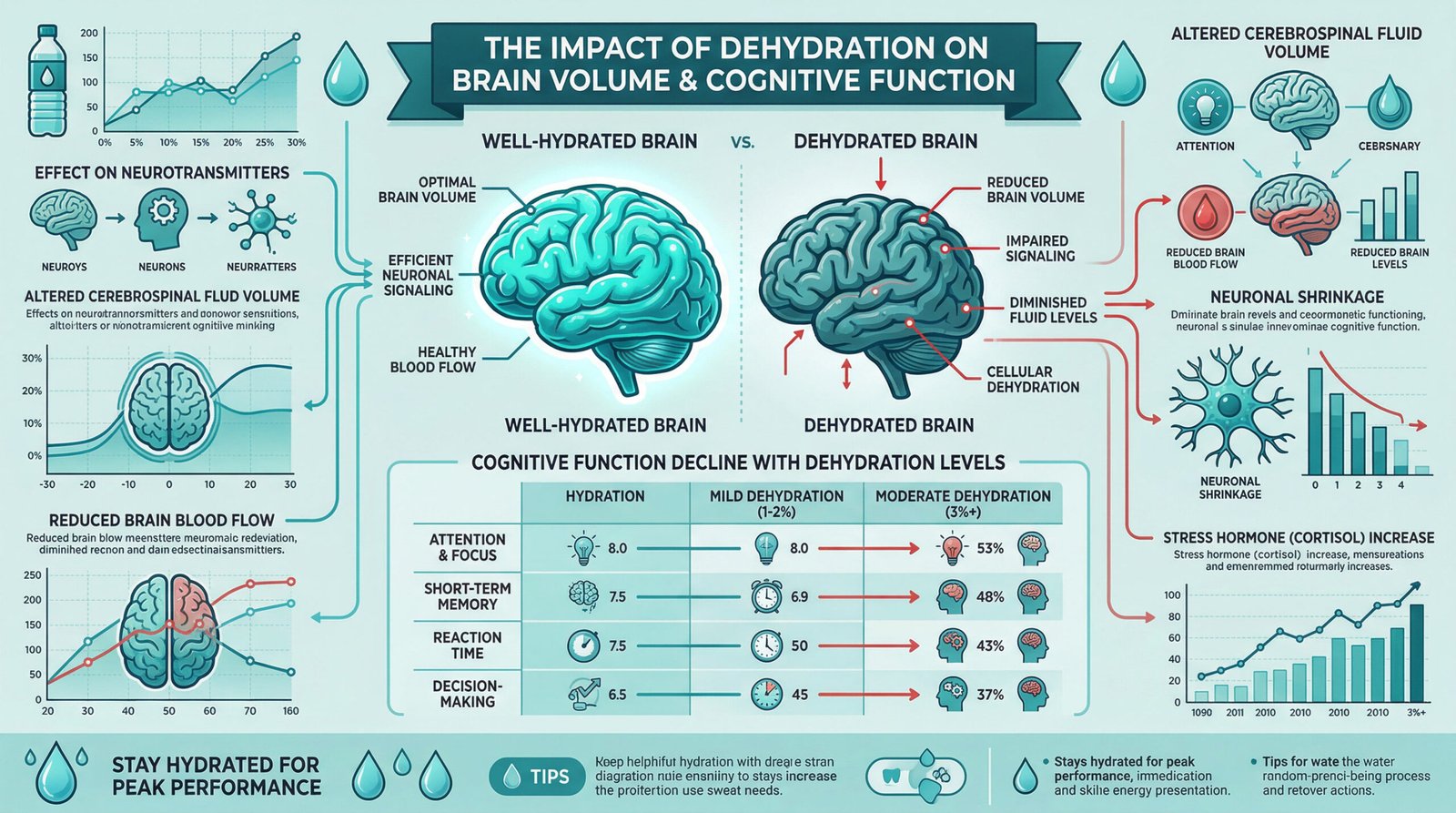
The cognitive effects of dehydration begin earlier than most people expect. Research has consistently shown that fluid losses below the traditional 2% threshold — sometimes as low as 1% of body mass — are enough to affect mood, attention, and perceived effort on cognitive tasks.
A meta-analysis of 33 studies published in Medicine & Science in Sports & Exercise found that dehydration exceeding 2% of body mass produced significant impairments in attention, executive function, and motor coordination. Critically, the authors noted that even sub-2% losses were associated with increased fatigue, reduced vigour, and greater perceived difficulty on cognitive tasks — meaning the effects begin before most people would describe themselves as ‘dehydrated.’
The brain responds to mild fluid loss by working harder to maintain the same level of performance — neuroimaging studies show increased neural activation during cognitive tasks in dehydrated adults, meaning more effort for the same output. That extra neural load shows up as mental fatigue, slower processing, and a shortened attention window.
Chronic mild dehydration is linked to long-term cognitive decline
The short-term effects are one thing. But what happens to brain function when mild dehydration is a persistent, daily state — which for many adults it is?
A prospective cohort study published in BMC Medicine in 2023 tracked 1,957 adults over 2 years and found that lower physiological hydration status — measured by serum osmolarity rather than self-reported water intake — was significantly associated with greater decline in global cognitive function over the follow-up period. The finding held after adjusting for age, body weight, physical activity, sleep, and other variables.
The distinction the researchers made is important: it wasn’t how much water people reported drinking, but their actual hydration status at the cellular level that predicted cognitive decline. You can drink two litres of water and still be dehydrated if your electrolyte balance is off or you’re losing fluid faster than you’re replacing it.
Dehydration disrupts the brain’s electrical and chemical environment
Water isn’t just a passive medium in the brain. It’s essential for maintaining ion gradients across cell membranes — the electrochemical balance that allows neurons to fire and communicate. When fluid is reduced, those gradients shift. Ion concentrations change. Neurotransmitter synthesis and release become less efficient.
Dehydration also reduces cerebral blood flow — the delivery of oxygen and glucose to neurons. And it elevates cortisol, your stress hormone, through the activation of the same hormonal cascade that the brain uses to signal thirst. That cortisol elevation compounds the cognitive impairment: you’re slower, more reactive, and more easily frustrated, all at the same time. I’ll be honest — the exact threshold at which dehydration starts affecting each individual varies more than the averages suggest. Some people seem more sensitive to fluid loss than others. But the direction of the relationship is consistent: less water in, worse brain out.
The Fix: 4 Hydration Habits That Actually Work in Real Life
The goal isn’t eight glasses. It’s consistent, distributed fluid intake that keeps your brain at its operational baseline throughout the day — before the fog arrives, not after.
1. Drink 2 glasses of water before anything else in the morning
After 6–8 hours without fluids, your blood osmolality rises overnight. You wake up in a mild state of dehydration every single morning — before the day has even made demands on you. Rehydrating first thing is the single highest-leverage hydration habit because it restores your cognitive baseline before work, commuting, or any mental effort begins.
Two glasses — roughly 500ml — is enough to meaningfully restore plasma volume and reduce morning cortisol. Do it before coffee. Caffeine is a mild diuretic and will push fluid out faster if your body is already running low.
Common mistake: counting coffee as your morning fluid. Coffee contributes to hydration overall, but its mild diuretic effect means it doesn’t fully replace plain water — especially first thing when your body needs to restore osmotic balance quickly.
2. Drink consistently throughout the day — not in large amounts at once
Drinking two litres in one sitting is not equivalent to drinking two litres spread across the day. The kidneys can only process roughly 800ml to 1 litre of water per hour. Excess fluid above that gets excreted quickly without being used. Consistent small intakes keep plasma volume stable and prevent the mid-afternoon dehydration dip that most people experience but never identify.
A practical system: keep a 500ml glass or bottle at your desk and refill it twice before lunch. Then twice more in the afternoon. That gets most people to 2 litres without needing to track anything or remember to drink.
Common mistake: waiting until you’re thirsty to drink. By the time thirst appears, you’re already cognitively impaired. Hydration has to be proactive — scheduled into your routine, not reactive to your symptoms.
3. Add electrolytes when you sweat, work physically, or drink a lot of plain water
Pure water alone isn’t always enough — especially if you’re sweating through physical work, exercising, or drinking large volumes throughout the day. Without adequate sodium, potassium, and magnesium, water doesn’t stay in the body’s compartments where it’s needed. It passes through.
A pinch of sea salt in your morning water, or an electrolyte sachet in your midday drink, makes a noticeable difference to how well your body actually retains and uses the fluid you’re consuming. This is especially relevant for anyone doing manual labour, training, or living in a hot climate.
Common mistake: drinking large amounts of plain water while working physically and wondering why you still feel foggy. Electrolyte depletion through sweat changes the equation entirely — plain water replaces volume but not the minerals your neurons need to fire properly.
4. Eat water-rich foods as part of your hydration strategy
About 20–25% of daily fluid intake comes from food in a typical diet. Cucumber, watermelon, lettuce, celery, strawberries, and oranges are all over 85% water by weight. Soups, broths, and cooked oats also contribute meaningfully to your total fluid balance.
This matters because food-sourced water comes packaged with electrolytes and nutrients that improve retention and cellular uptake. It’s not a substitute for drinking water — but it’s a meaningful supplement, especially on days when drinking feels effortful.
Common mistake: treating food hydration as irrelevant and only counting glasses of water drunk. On high-food-intake days with plenty of fruit and vegetables, your effective hydration is better than on low-intake days — even with the same water consumption.

Abdellah’s Experience: What Changed for Me
For years I blamed my slow morning brain on not sleeping enough. I’d get home from a late shift, sleep 7 hours, and still wake up foggy. Coffee helped for an hour. Then the fog came back.
I started drinking 2 large glasses of water the moment I woke up — before coffee, before checking my phone, before anything. Within three days I noticed the morning fog was clearing faster. Not dramatically, but noticeably. By the end of the first week, I was mentally functional earlier than I’d been in months.
I hadn’t changed my sleep, my diet, or my schedule. I just stopped starting every day already running low on the one thing my brain is mostly made of.
The fog wasn’t about sleep. It was about the eight hours I spent not drinking anything.

Try This for 5 Days (Then Tell Me I’m Wrong)
Just two changes for five days straight:
- Every morning, drink 2 full glasses of water before coffee, before your phone, before anything else
- Keep a 500ml bottle at your desk — refill it twice before lunch and twice in the afternoon
- If you do physical work or exercise, add a pinch of sea salt to one of your morning glasses
- Track one thing: how quickly your brain feels sharp each morning compared to Day 1
Most people notice a difference in morning clarity by Day 2 or 3. Not a dramatic transformation — just a quieter, faster version of waking up. The fog lifts sooner. The first hour of work stops feeling like wading through something.

The Real Reason You Feel Slow Before Lunch Has Nothing to Do With Sleep
Most people blame their morning sluggishness on not sleeping enough, going to bed too late, or just being ‘not a morning person.’ And sometimes those things are factors. But a significant portion of that early-day cognitive drag is simply dehydration — a problem that predates your first coffee and starts reversing within minutes of drinking a glass of water.
You don’t need a protocol or a supplement. You need water, consistently, before the deficit builds. That’s it. The cheapest, fastest cognitive intervention available — and it’s been sitting in your tap this whole time. Want to go deeper on morning energy? Read: Why You Feel Tired Every Day (Even After Rest) — it covers the other side of the morning energy equation that hydration alone doesn’t fix.
Table of Contents
Medical disclaimer
This content is for informational purposes only and does not constitute medical advice. Always consult a qualified healthcare professional for personal health concerns.