



You probably think creatine is for gym guys who want bigger muscles. And yeah, most people selling it will tell you exactly that. But here’s what they’re not mentioning — your brain runs on the same energy system creatine helps power. And most of us are running our brain on empty.
If you’ve ever felt mentally drained halfway through a day that wasn’t even that hard — foggy, slow, struggling to form a full sentence by 4pm — there’s a real biological reason for it. It’s not laziness. It’s not stress. It might be something your brain is literally missing. I didn’t expect a supplement I’d dismissed as a bodybuilder thing to change how I think. But here we are.
Why So Many People Struggle With Mental Fog and Low Focus
According to a study published in Frontiers in Human Neuroscience, nearly 60% of adults report regular difficulty concentrating — even when they’re not sleep-deprived. And yet most advice on focus is about sleep hygiene, hydration, or cutting sugar. Useful stuff. But incomplete.
The honest truth is that most focus advice ignores your brain’s energy supply entirely. Your neurons don’t run on willpower. They run on ATP — the same cellular fuel your muscles use. And when your brain’s ATP production falls behind demand, you feel it immediately.
You know the feeling. Check if any of these sound familiar:
- Mental slowness that shows up after lunch — even if you slept well
- Difficulty holding a thought or finishing a complex task
- Feeling mentally tired before your body is physically tired
- Struggling to recall words or recent information under pressure
- Motivation that disappears the moment a task gets hard
If three or more of those are regular for you, it’s fixable. And it probably has nothing to do with how smart you are.

What’s Actually Happening Inside Your Brain
Your brain is one of the most energy-hungry organs you have — it uses about 20% of your body’s total energy despite being only 2% of your body weight. When that energy supply stutters, cognitive performance drops fast.
Your brain runs on ATP — and it can run out
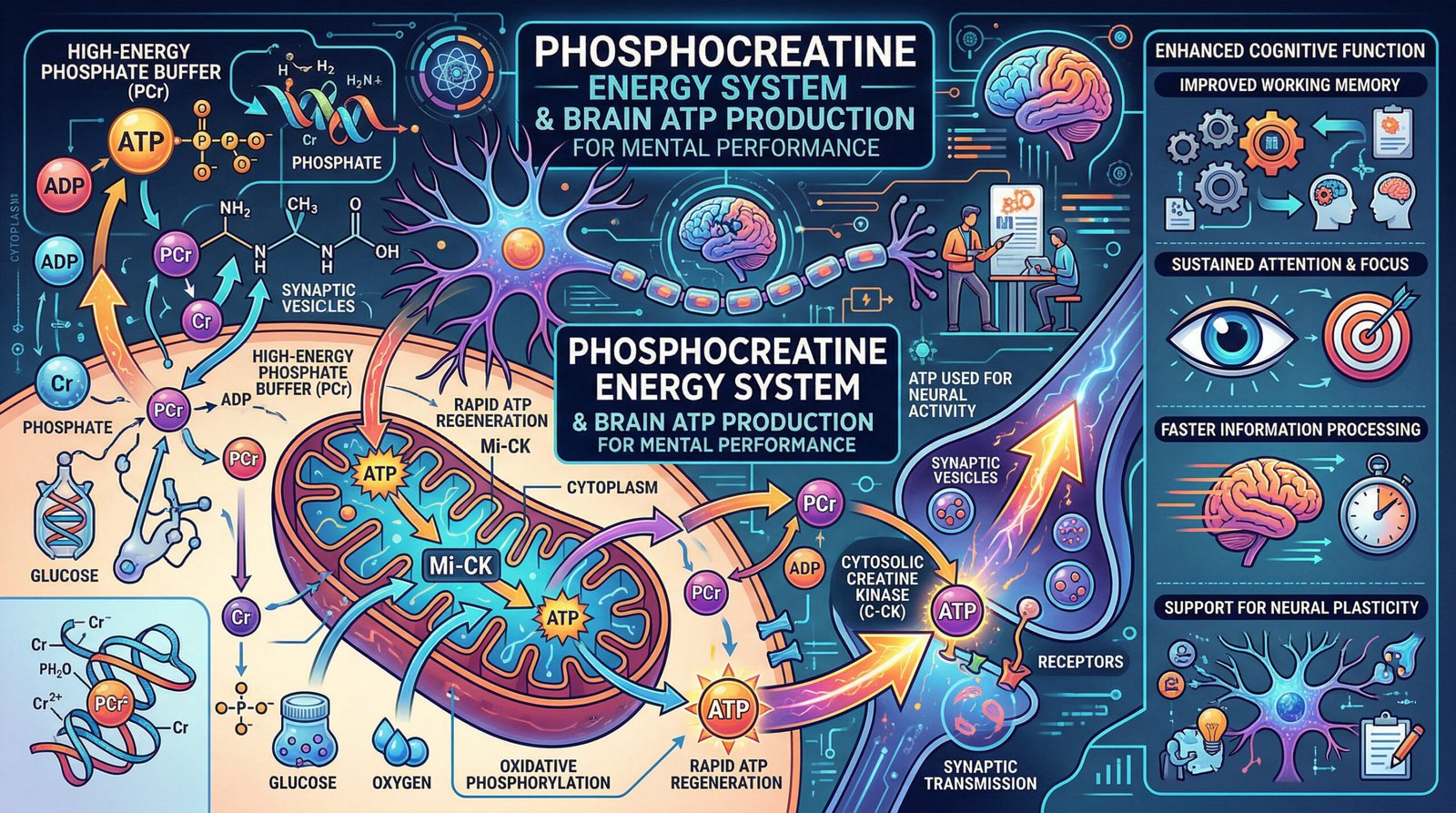
ATP (adenosine triphosphate) is the direct energy currency of your cells. Every time a neuron fires — every thought, memory, or decision — it costs ATP. Your brain can’t store large amounts of it. So when demand spikes (stress, complex thinking, long work sessions), it needs to regenerate ATP quickly.
That’s where phosphocreatine comes in. It’s a molecule stored in cells that acts as an emergency ATP reserve — it donates a phosphate group to rebuild depleted ATP in milliseconds. Without enough phosphocreatine available, your brain can’t keep up during high cognitive load. According to a review published in the journal Nutrients (2021), cognitive tasks directly deplete brain creatine stores — and supplementation can restore them.
Vegetarians and people under stress are most depleted
Creatine is found naturally in red meat and fish. If you eat little of either — or you’re under chronic stress, which also drains phosphocreatine stores — your baseline brain creatine levels may be lower than optimal. I’m not 100% sure this explains every case of brain fog, but the correlation in the research is hard to ignore.
A 2003 study in the Proceedings of the Royal Society found that vegetarians who supplemented with creatine scored significantly higher on memory and processing speed tests compared to placebo. That’s not a small effect.
Sleep deprivation makes it worse
Here’s something most people don’t know: sleep deprivation specifically depletes brain creatine. When you don’t get enough sleep, your brain burns through its phosphocreatine reserves faster. This is why creatine has been studied as a way to offset the mental effects of sleep loss — and the results are promising. Your brain is not equally fueled every day. The question is whether you’re doing anything about it.
The Fix: Four Habits That Actually Work
These aren’t complicated. None of them require a prescription. But they do require some consistency — because creatine’s effects on the brain build up over time, not overnight.
1. Start with creatine monohydrate — 3 to 5 grams a day
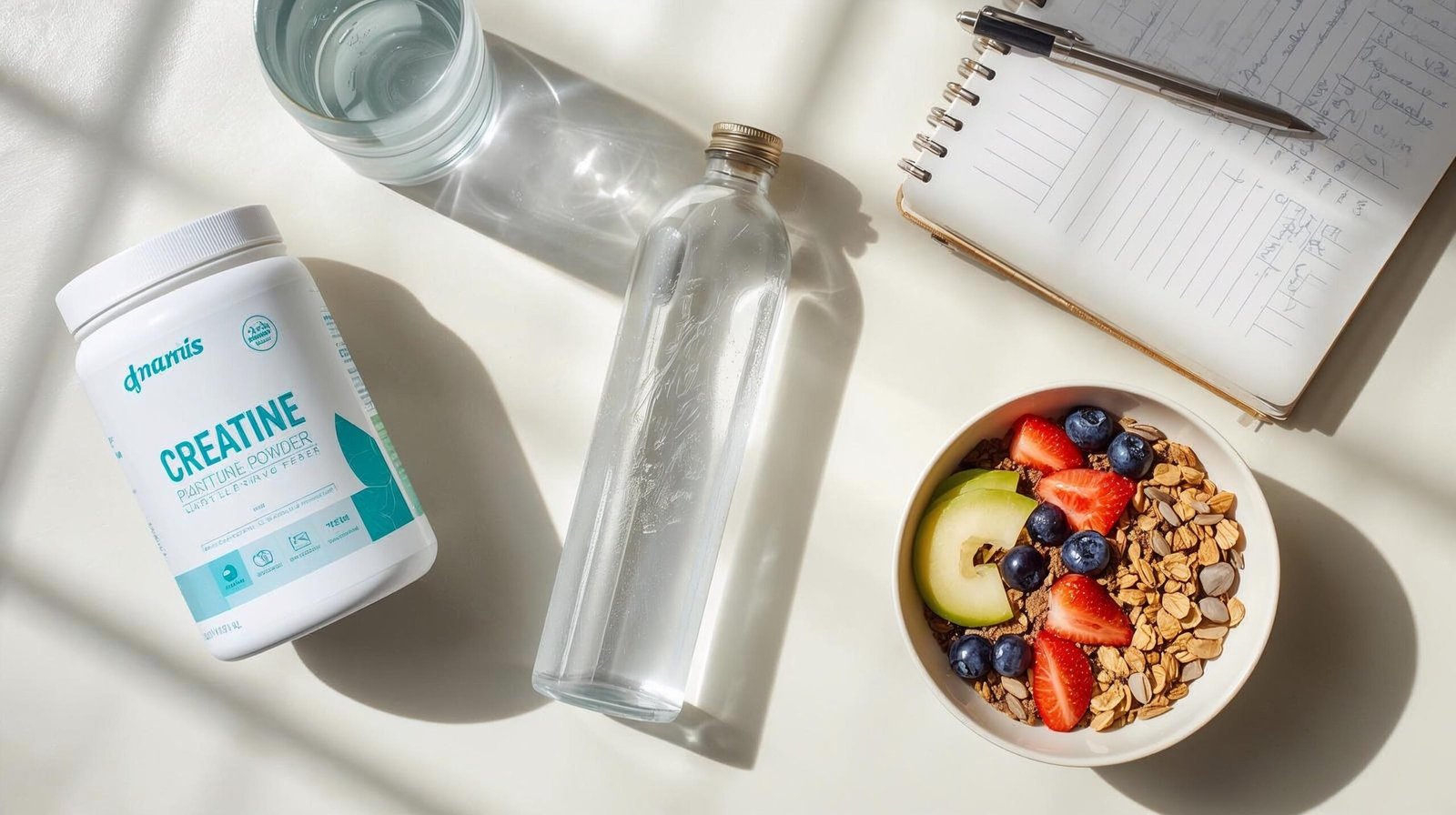
Creatine monohydrate is the most researched form. Not creatine HCl, not ethyl ester — just plain monohydrate. Take 3–5g per day with a glass of water. You don’t need a loading phase. Just take it consistently. Effects on brain energy typically become noticeable after 4–8 weeks of daily use.
Common mistake: buying fancy creatine blends with added stimulants. You don’t need them. Pure monohydrate is cheaper and better studied.
2. Take it with food that includes carbohydrates
Insulin helps shuttle creatine into cells more efficiently. Taking your daily dose alongside a meal with carbohydrates — oats, fruit, rice, bread — improves uptake compared to taking it on an empty stomach. You don’t need a huge carb load. Just don’t take it with black coffee alone.
Common mistake: taking it dry or inconsistently. Timing doesn’t matter much day to day, but daily consistency is everything.
3. Stay well hydrated throughout the day
Creatine pulls water into your cells. This is actually part of how it works — it increases intracellular water content, which is linked to better cell function. But it also means your hydration needs go up slightly. Aim for 2–2.5 liters of water per day minimum when supplementing.
Common mistake: blaming headaches or foggy feeling on creatine, when dehydration is usually the actual cause.
4. Combine with consistent sleep — even just one more hour
Creatine and sleep work together. The research on creatine reducing the cognitive impact of sleep loss doesn’t mean you should skip sleep. It means creatine gives your brain a better baseline to recover from — or perform despite — imperfect nights. One extra hour of sleep combined with daily creatine is a genuinely powerful combination for mental clarity.
Common mistake: expecting creatine to fully replace rest. It buffers. It doesn’t replace.
Abdellah’s Experience: What Changed for Me
I started taking creatine for the same reason most people do — I was lifting and read it helped. I wasn’t expecting anything from it mentally. But about six weeks in, I noticed something strange: I was finishing difficult writing tasks without hitting the usual wall halfway through. My shift work leaves me with late-evening windows for writing, and normally my brain is useless by 9pm.
I didn’t connect it to creatine at first. I thought I’d just been sleeping better. But I hadn’t changed my sleep. What I had changed was 4 grams of creatine monohydrate with breakfast every morning and a bit more water throughout the day.
Honestly, this one surprised me. I’d dismissed it as a muscle supplement for two years.
The brain is a muscle in the sense that matters most — it runs out of fuel, and you can do something about that.

Try This for 30 Days (Then Tell Me I’m Wrong)
Don’t change your entire supplement stack. Just do this for 30 days and track how your thinking changes:
- Buy creatine monohydrate — plain, no blends, unflavored is fine
- Take 3–5g every morning with breakfast (include some carbs)
- Drink at least 2 liters of water per day
- Note your afternoon mental energy on Day 1, Day 7, and Day 30
Most people don’t notice anything the first week. The second week, something shifts. By Day 30, the difference is usually clear enough that you stop wondering if it’s placebo.

The Real Reason Your Brain Feels Slow Has Nothing to Do With Intelligence
It’s uncomfortable to hear, but most mental fatigue is a supply problem, not a capacity problem. Your brain isn’t underperforming because you’re not smart enough or focused enough. It’s underperforming because it literally doesn’t have enough energy to fire at full capacity.
Creatine is the least complicated intervention that addresses this directly. It’s not trendy, it’s not expensive, and it’s been studied for decades. The gym crowd found it first. But there’s no reason you should leave it there.
How to Sleep Better Naturally — the sleep and creatine combination amplifies everything covered here
5 Daily Habits That Boost Energy and Focus — pairs directly with this article
Table of Contents
Medical Disclaimer
This content is for informational purposes only and does not constitute medical advice. Always consult a qualified healthcare professional for personal health concerns.