



You think low testosterone is something that happens to men over 60. A slow, inevitable decline — the price of getting older. Nothing you can do except wait it out or go see a doctor about injections.
But here’s what the research is actually showing: men under 50 are experiencing significant testosterone drops — and the biggest driver isn’t age. It’s the way they’re living. The sleep they’re skipping. The food they’re eating. The chronic, low-grade stress they’ve learned to call normal.
That’s both bad news and good news. Bad because you’ve probably been doing this for years without realizing it. Good because lifestyle changes can reverse a lot of this — without injections, without clinics, without turning your life upside down.
Why So Many Men Under 50 Are Running Low on Testosterone
Research published in the European Journal of Endocrinology has confirmed that testosterone levels in men have been declining across generations — meaning a 35-year-old today has measurably lower testosterone than a 35-year-old did 30 years ago. Age alone doesn’t explain this.
The gap is being filled by lifestyle factors: poor sleep, processed food, chronic stress, sedentary work, and excess body fat around the abdomen. These aren’t abstract risks — they directly suppress the hormonal machinery your body uses to produce testosterone.
Do any of these sound familiar?
- Fatigue that starts early in the day and doesn’t fully lift
- Lower motivation to train, compete, or push yourself physically
- Reduced drive — not just sexual, but ambition and focus too
- More fat around the stomach even without eating more
- A flat mood, or a short fuse that wasn’t there a few years ago
These aren’t personality changes or signs you’re getting soft. They’re biological signals. And they’re worth taking seriously.

What’s Actually Happening Inside Your Body
Testosterone production is a multi-step hormonal chain — and it’s surprisingly easy to disrupt at any point in that chain without realizing it.
Your HPG axis is being suppressed by everyday stress
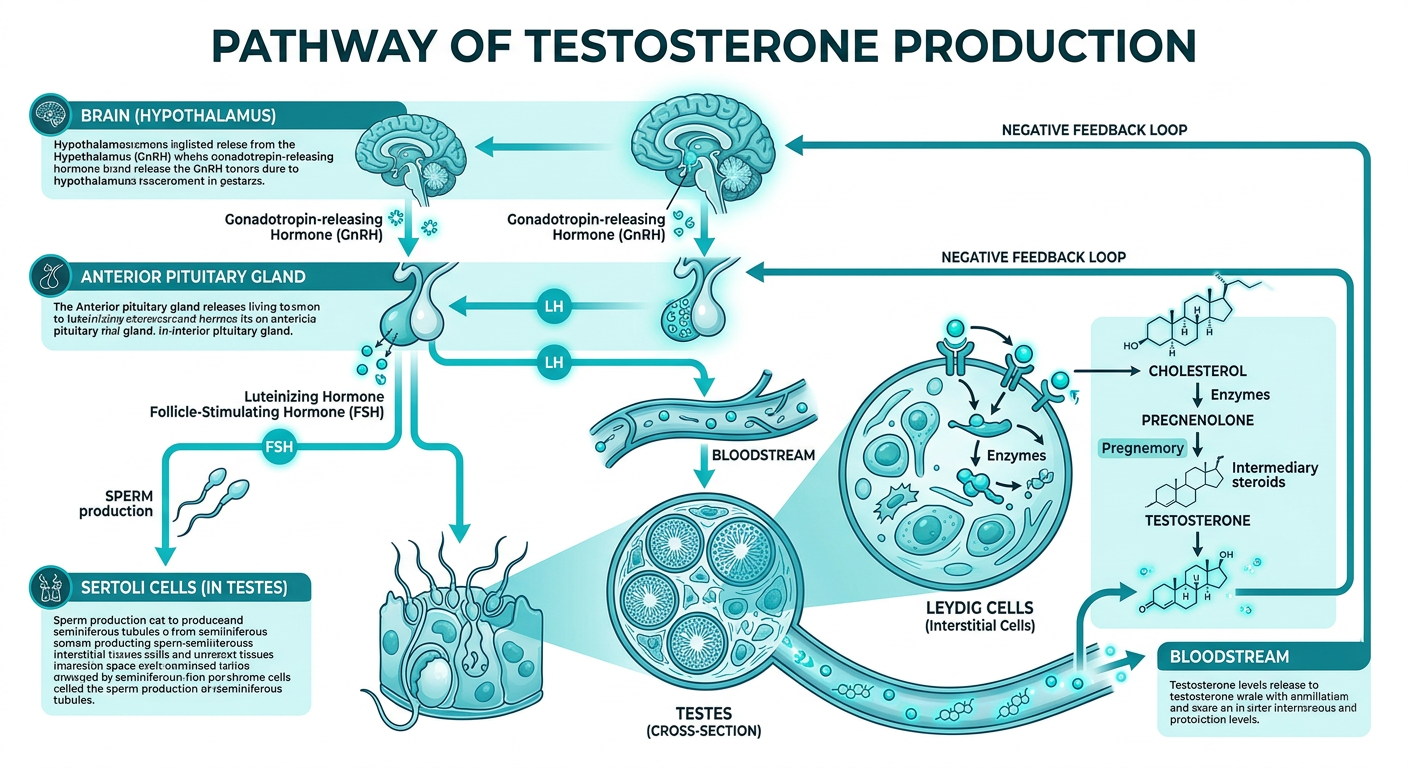
Testosterone production starts in the brain. The hypothalamus releases GnRH, which signals the pituitary to release LH, which then tells the Leydig cells in your testes to produce testosterone. This is called the HPG axis.
Chronic stress floods your system with cortisol — and cortisol directly suppresses GnRH release at the top of this chain. Less GnRH means less LH means less testosterone. The whole cascade slows down, not because your testes have failed, but because the signal from the brain is being blocked upstream.
The result is what researchers call functional hypogonadism — low testosterone caused by lifestyle and environmental factors, not structural damage. It’s reversible. But it doesn’t reverse on its own.
Poor sleep cuts testosterone production at the source
Most of your daily testosterone is produced during sleep — specifically during deep sleep cycles in the early hours of the night. Cut that window short and you cut production directly.
A University of Chicago study found that men who slept just 5 hours a night for one week showed a 10–15% drop in daytime testosterone levels. For context, normal aging only reduces testosterone by about 1–2% per year. One week of bad sleep did in days what aging takes years to do.
And this isn’t just a lab finding. It’s the reality of shift work, late screens, irregular schedules, and the general habit of treating sleep as optional.
Excess body fat converts your testosterone into estrogen
Adipose tissue — body fat, particularly the visceral kind around your abdomen — contains an enzyme called aromatase. Aromatase converts testosterone into estradiol, a form of estrogen.
The more abdominal fat you carry, the more active aromatase you have, and the faster your available testosterone gets converted. It’s a compounding cycle: lower testosterone makes it harder to maintain muscle and easier to gain fat, which drives even more conversion.
I’m not 100% sure why some men are more sensitive to this cycle than others — but the direction of the relationship is clear and consistent across studies.
The Fix: 5 Lifestyle Shifts That Actually Move the Needle
None of these require a gym membership or a diet overhaul. They require consistency with small, specific things you’re probably already doing — just doing wrong.
1. Protect 7–9 hours of sleep like it’s a training session
Sleep is when your testosterone is made. Treat it with the same seriousness you’d give any performance habit. Aim for 7–9 hours, in a dark, cool room, with a consistent wake time — even on weekends.
The consistent wake time matters more than most people realize. It anchors your circadian rhythm, which directly regulates the hormonal pulses that trigger testosterone production during sleep.
Common mistake: sleeping in on weekends to ‘catch up.’ This shifts your rhythm forward, disrupts your weekday sleep quality, and doesn’t meaningfully recover hormonal debt.
2. Lift heavy things — compound movements, 3 times a week
Resistance training is one of the most well-documented natural testosterone triggers. Specifically, compound movements — squats, deadlifts, rows, overhead presses — that recruit large muscle groups and create real mechanical stress on the body.
You don’t need to train like an athlete. Three sessions a week, 30–45 minutes each, focusing on getting progressively stronger over time. That progressive load is the signal that tells your body it needs more testosterone to support the adaptation.
Common mistake: only doing cardio. Long-duration steady-state cardio at the expense of strength work can actually increase cortisol relative to testosterone — the opposite of what you want.
3. Cut the late-night alcohol
Alcohol directly suppresses Leydig cell function — the cells in your testes that produce testosterone. Even moderate drinking in the evening disrupts sleep architecture, blunting the deep sleep stages where most testosterone production happens.
You don’t have to stop drinking entirely. But shifting alcohol consumption to earlier in the day and keeping it to 1–2 drinks has a measurable impact on your sleep quality and next-morning hormonal output.
Common mistake: using alcohol to wind down before bed. It feels like it helps you sleep, but it fragments your sleep cycles and suppresses REM — the stages your hormones depend on most.
4. Get 15–20 minutes of direct sunlight in the morning
Morning sunlight does two things that matter for testosterone. First, it anchors your circadian rhythm, which improves sleep quality — which improves hormone production. Second, sunlight on skin drives vitamin D synthesis, and vitamin D deficiency is consistently associated with lower testosterone in men.
This doesn’t require lying on a beach. A 15-minute walk outside in the morning — before 10am, without sunglasses — is enough to trigger both effects. It’s one of the cheapest, most underrated habits in this entire list.
Common mistake: getting sunlight through a window. Glass blocks UV-B rays, which are required for vitamin D synthesis. It has to be direct outdoor exposure.
5. Manage your stress before it manages your testosterone
Chronic stress keeps cortisol elevated — and elevated cortisol suppresses the HPG axis, as we covered. The solution isn’t meditating for an hour a day. It’s reducing the low-grade, constant stress load that most men have normalized.
That means: deliberate downtime with no screen and no task. A 10-minute walk after work. A consistent wind-down routine that signals to your nervous system that the day is over. These aren’t soft suggestions — they’re hormonal inputs.
Common mistake: only managing stress reactively, after it peaks. The goal is keeping the baseline cortisol level lower across the whole day — which requires small, consistent decompression habits, not just occasional big resets.

Abdellah’s Experience: What Changed for Me
I spent years treating sleep as a weakness — six hours max, up early, grind. By my mid-30s I was putting in more hours than ever and getting less from it. Training felt pointless. The motivation I used to have just wasn’t there.
I didn’t think ‘testosterone’ at first. I just noticed the changes. Less drive. More irritability. A flatness I couldn’t explain. I started taking sleep seriously — 8 hours, consistent wake time, no alcohol within 3 hours of bed. Added morning walks. Dropped the cardio-only routine for 3 days of lifting.
Six weeks in, I felt like myself again. Not dramatically — quietly. The drive came back. Training started producing results again. I stopped being short-tempered for no reason.
I didn’t change my age. I just stopped making my body produce less of what it needed to work.

Try This for 14 Days (Then Tell Me I’m Wrong)
Pick just three of the five habits above — whichever feel most achievable right now. Commit to all three for 14 days without skipping:
- Sleep 7.5–8 hours with a fixed wake time — no exceptions, including weekends
- Do 3 resistance training sessions — any compound movements, 30 minutes minimum
- Walk outside for 15 minutes within an hour of waking — direct sun, no sunglasses
- No alcohol within 3 hours of your sleep time
Track your energy, mood, and motivation on Day 1 vs Day 14. Most men don’t notice a dramatic shift — they notice a quieter one. The flatness starts to lift. The effort in training starts to feel more rewarding. That’s not placebo. That’s your hormonal baseline moving.

The Real Reason Your Testosterone Is Lower Than It Should Be
It’s not your age. Men under 50 don’t have an age problem — they have a lifestyle problem. And lifestyle problems have lifestyle solutions.
The habits that suppress testosterone aren’t dramatic. They’re the ordinary, accumulated weight of skipped sleep, chronic stress, processed food, and physical inactivity. Remove enough of them consistently, and your body will do the rest. Want to go deeper? Read: How to Sleep Better Naturally (Without Medication) — the sleep habits covered there work directly with everything in this article.
Table of Contents
Medical disclaimer
This content is for informational purposes only and does not constitute medical advice. Always consult a qualified healthcare professional for personal health concerns.