



You think stress is just part of the job. Maybe you’ve even made peace with it — told yourself that everyone feels this way, that it’s just the price of being an adult with responsibilities.
But what if your body was never designed to run at this level of stress indefinitely? And what if the reason you feel wired at night but exhausted in the morning isn’t your mindset — it’s your cortisol?
There’s a category of plants called adaptogens that have been used for centuries to help the body cope with stress — not by numbing it, but by literally changing how your nervous system responds to pressure. And the science behind them is more interesting than I expected.
Why So Many People Are Stuck in Stress Overdrive
Chronic stress has become so normal that most people don’t even recognize it anymore. According to research published in The Lancet, stress-related conditions now account for a significant share of global disease burden — and most people experiencing chronic stress don’t seek help because they think it’s just their life.
The problem isn’t a single bad week. It’s the slow, grinding drip of cortisol that never fully switches off. Your body was built for short bursts of stress — not months or years of it.
Sound familiar? Check how many of these apply:
- Waking up already tense, before the day has even started
- A tired feeling that coffee doesn’t fix — just masks
- Snapping at small things that didn’t used to bother you
- Trouble falling asleep even when you’re completely drained
- A sense that you’re always ‘on’ but never truly recovering
If you checked 3 or more, this isn’t weakness. It’s a biological system that’s been running in emergency mode for too long — and that’s actually fixable.

What’s Actually Happening Inside Your Body
Stress isn’t just in your head. It’s a full-body chemical event — and understanding it is the first step to changing it.
Your HPA axis is stuck in the ‘on’ position
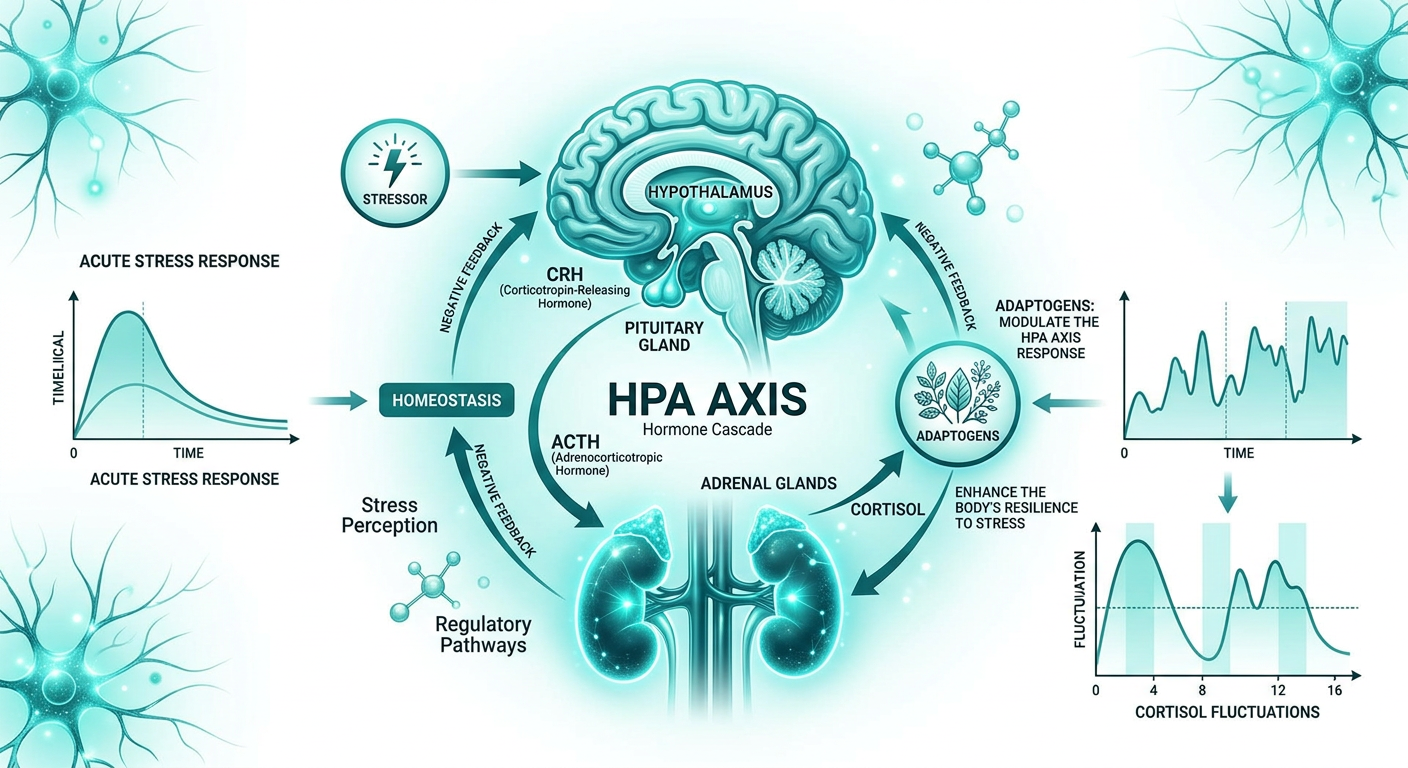
When you experience stress — any stress, from a deadline to a difficult conversation — your brain triggers the HPA (hypothalamic-pituitary-adrenal) axis. This releases cortisol, your main stress hormone.
Cortisol is useful in short bursts. It sharpens focus, raises your heart rate, and prepares your body to act. But when the trigger never goes away, cortisol stays elevated for hours, days, even weeks.
Chronically high cortisol damages your sleep, suppresses your immune system, disrupts digestion, and gradually burns out the very glands that produce it. This is what researchers call HPA axis dysregulation — and it’s more common than most people realize.
Your nervous system can’t find neutral
Your autonomic nervous system has two modes: sympathetic (fight-or-flight) and parasympathetic (rest-and-digest). Chronic stress keeps you locked in sympathetic mode.
The result? Your heart rate stays slightly elevated, your digestion slows, your muscles carry constant tension, and your brain keeps scanning for threats even when there aren’t any. It becomes your default state.
And here’s the part that doesn’t get talked about enough: once you’re stuck in this mode, ordinary things — an email notification, a loud noise, a busy inbox — feel disproportionately stressful. Your threshold shrinks.
Cortisol disrupts the hormones that calm you down
Cortisol and the hormones that help you relax — serotonin, GABA, melatonin — are in direct competition. When cortisol is high, those calming signals get suppressed.
A 2025 meta-analysis published in BJPsych Open — covering 15 randomized trials and 873 adults — found that ashwagandha significantly reduced cortisol levels and improved stress resistance compared to placebo. The mechanism involves modulation of the HPA axis, helping it return to baseline faster after a stress trigger.
That’s the core of how adaptogens work: not sedation, not stimulation. Regulation.
The Fix: 4 Adaptogens That Actually Have Research Behind Them
These aren’t trendy supplements. They’ve been used in Ayurvedic and Traditional Chinese Medicine for centuries — and now there’s clinical research to back what those traditions observed.
1. Ashwagandha — the cortisol regulator
Ashwagandha (Withania somnifera) is probably the most researched adaptogen for stress. Take 300–600mg of a root extract daily, ideally with food in the evening.
It works by reducing cortisol output and modulating the HPA axis response — meaning your body calms down faster after a stressful event, rather than staying on high alert.
Common mistake: buying cheap powder with no standardization. Look for KSM-66 or Sensoril — these are the extract forms used in the actual studies.
2. Rhodiola Rosea — the mental fatigue fighter
Rhodiola targets a different problem: the exhaustion that comes from prolonged mental effort. Take 200–400mg in the morning — it’s mildly stimulating, so avoid it in the evening.
Its active compounds (rosavins and salidrosides) help the body maintain ATP production under stress, so your brain doesn’t slow down as dramatically when you’re under pressure.
Common mistake: taking it on an empty stomach. It can cause mild nausea for some people — take it with a small meal.
3. Holy Basil (Tulsi) — the nervous system calmer
Holy basil isn’t the same as the basil you cook with. As a tea or supplement (300–600mg), it has a direct effect on cortisol and acts on the GABA receptors that produce a calming effect in the brain.
I’m not 100% sure why this one hits differently for some people versus others, but it seems to work especially well for the ‘wired but tired’ feeling — where you’re exhausted but still can’t switch off.
Common mistake: treating it like a one-time fix. Holy basil builds effect over 2–4 weeks of consistent use. Taking it for two days and quitting is why most people don’t notice anything.
4. Eleuthero — the endurance adaptogen
Eleuthero (often called Siberian ginseng) works more on physical stress resilience — reduced performance under fatigue, lowered immune function from overwork. Take 300–1200mg in divided doses.
It’s less dramatic than ashwagandha or rhodiola day-to-day, but it shines when you’re in a period of high physical and mental demand — think busy season at work, exam periods, or sustained physical output.
Common mistake: cycling off too soon. Give it 6–8 weeks to assess its effect properly.

Abdellah’s Experience: What Changed for Me
After two years working warehouse shifts on a rotating schedule, I hit a wall that sleep alone couldn’t fix. I was technically getting enough rest — but I’d wake up tense, and by mid-shift I was running on fumes and irritability.
I started ashwagandha (KSM-66, 300mg in the evening) and holy basil tea in the mornings. For the first week, honestly, I didn’t notice much. But by day 12, something shifted. I was finishing shifts without that hollowed-out feeling. Small frustrations stopped triggering the same physical reaction.
I didn’t change my schedule, my workload, or my diet. I just gave my nervous system something to help it recover.
The stress didn’t disappear. I just stopped carrying it in my body for hours after it was gone.

Try This for 14 Days (Then Tell Me I’m Wrong)
Don’t overhaul everything. Just pick one adaptogen and commit to 2 weeks:
- Pick one: ashwagandha (evening) or rhodiola (morning) — not both at first
- Take it consistently at the same time every day — with food
- Replace one stress-trigger habit: for example, swap the second coffee for herbal tea
- At the end of each day, rate your stress recovery out of 10 — how fast did you come down from the day’s peak?
Track Day 1 vs Day 14. Most people don’t feel a dramatic shift — they notice a quieter one. The tension that used to linger for hours just… doesn’t last as long.

The Real Reason Stress Keeps Winning
Most stress solutions are about managing the surface — breathing exercises, time off, long weekends. And those things help. But they don’t touch the underlying biological machinery that keeps resetting to high-alert.
Adaptogens work differently. They give your body the raw material to regulate itself. That’s an uncomfortable truth, because it means the fix isn’t dramatic — it’s quiet, cumulative, and requires consistency over weeks, not hours.
Want to go deeper? Read: How to Sleep Better Naturally (Without Medication) — it covers the exact sleep recovery strategies that work alongside adaptogen use.
Table of Contents
Medical disclaimer
This content is for informational purposes only and does not constitute medical advice. Always consult a qualified healthcare professional for personal health concerns.