



You’re exhausted. But you can’t relax.
You finish work and your body won’t switch off. Your jaw is tight, your shoulders won’t drop, your mind keeps running even when there’s nothing left to think about. You sleep but don’t recover. You rest but don’t feel rested. And no matter how many times you tell yourself to calm down, something underneath just won’t listen.
That something has a name. It’s your nervous system — and more specifically, it’s a nerve most people have never heard of called the vagus nerve. Understanding it changed how I deal with stress entirely. And it might do the same for you.
Why So Many People Feel Wired and Exhausted at the Same Time
The medical term for the state most chronically stressed people live in is sympathetic dominance — your nervous system is stuck in fight-or-flight mode far longer than it was ever designed to be. According to research published in Frontiers in Psychiatry, chronic sympathetic activation is one of the most widespread and underrecognized drivers of fatigue, anxiety, poor sleep, digestive problems, and impaired immune function in modern adults.
The problem isn’t just that you’re stressed. It’s that your body has lost the ability to shift back out of stress when the threat is gone. The off-switch stops working properly. And that’s not a mindset problem — it’s a physiology problem.
Sound familiar? Here’s what a dysregulated nervous system actually feels like day to day:
- Feeling wired but tired — exhausted but unable to fully relax or switch off
- Waking up at 3 or 4am with a racing mind for no clear reason
- Digestive issues — bloating, nausea, constipation — that come and go with stress
- A short fuse: reacting to small things with a level of intensity that surprises even you
- A background hum of low-level anxiety that never fully goes away
- Feeling physically heavy or flat, even after doing nothing all day
If 3 or more of those hit close to home, your vagus nerve is likely underactivated. And there are specific, evidence-backed things you can do about it today.

What’s Actually Happening Inside Your Body
Your autonomic nervous system runs everything you don’t consciously control — your heart rate, breathing, digestion, immune response, even your emotional tone. It has two main branches: the sympathetic (fight-or-flight) and the parasympathetic (rest-and-digest). The vagus nerve is the primary channel of the parasympathetic branch.
The vagus nerve is your body’s built-in brake pedal
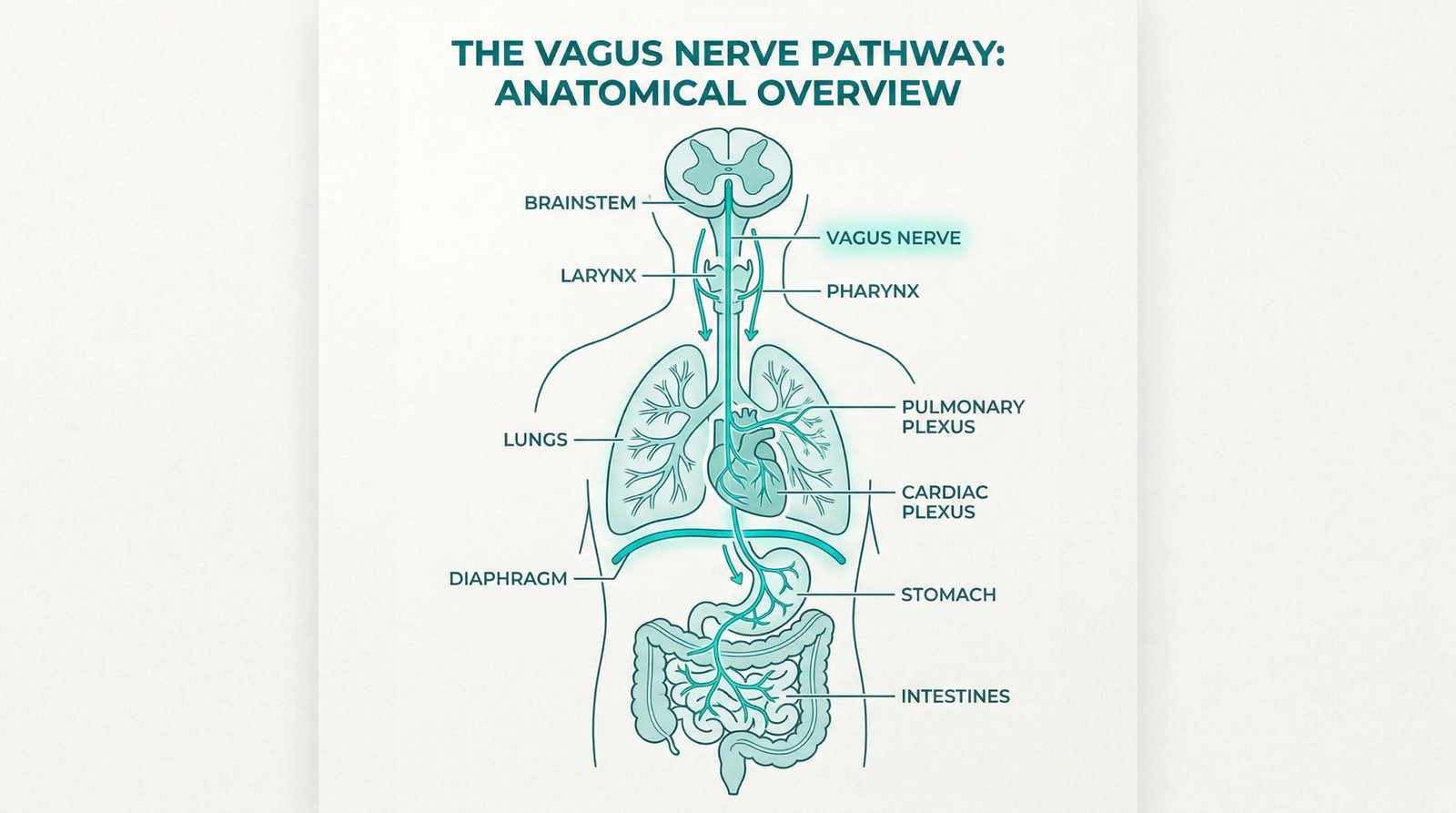
The vagus nerve — Latin for ‘wandering nerve’ — is the longest cranial nerve in your body. It runs from your brainstem all the way down through your throat, heart, lungs, and gut, touching almost every major organ on the way. Its job is to signal safety to your brain and body. When it’s active, your heart rate slows, your breathing deepens, your digestion resumes, and your mood settles.
When it’s underactive — what researchers call low vagal tone — your body defaults to the sympathetic state. You stay on high alert even when nothing is wrong. The brake pedal is there, but it’s not engaging properly.
Vagal tone determines how fast you recover from stress
Heart rate variability (HRV) is the gold-standard measure of vagal tone. It measures the subtle variation between heartbeats — and higher variability means your vagus nerve is actively shifting your heart rate up and down in response to breathing, which is a sign of a healthy, responsive nervous system. A landmark study in Psychological Science found that people with higher HRV recovered from acute stress significantly faster, had better emotional regulation, and reported lower baseline anxiety. The vagus nerve isn’t just about relaxation — it’s about resilience.
The gut-brain-vagus connection is bidirectional
About 80% of the signals travelling along the vagus nerve go upward — from your gut to your brain, not the other way around. This means your gut microbiome directly influences your mood, anxiety level, and nervous system state through vagal signalling. When your gut is inflamed or dysbiotic, those signals tell your brain there’s a threat. And your stress response stays elevated accordingly.
This is one reason chronic stress and digestive problems so often travel together — it’s not coincidence, it’s circuitry. According to a 2018 review in Neuroscience and Biobehavioral Reviews, vagus nerve stimulation has shown measurable reductions in anxiety, depression markers, and inflammatory cytokines. I’m not 100% sure the full mechanism is understood yet, but the evidence is consistent enough that it’s worth taking seriously.
The Fix: 4 Ways to Activate Your Vagus Nerve Daily
These aren’t complicated practices. Each one has a clear physiological mechanism — they work by directly stimulating the vagus nerve or by creating the conditions in which it activates naturally. You don’t need equipment, a gym, or a meditation app.
1. Extended exhale breathing (physiological sigh)
Your heart rate rises slightly on the inhale and drops on the exhale. The longer your exhale relative to your inhale, the more time your heart spends in the low-rate phase — and the more vagal activation you get. The most effective pattern: inhale for 4 counts, exhale for 6 to 8 counts. Even 5 breaths done this way shifts measurable markers of nervous system state within 90 seconds.
The physiological sigh — a double inhale through the nose followed by a long slow exhale — is an even faster reset. Stanford neuroscientist Andrew Huberman’s lab found it to be the single most effective breathing pattern for acute stress relief.
Common mistake: breathing too fast between rounds or tensing the body during the exhale. Slow it down. The exhale should feel like you’re deflating, not pushing air out.
2. Cold water on the face or a cold shower
The diving reflex — triggered by cold water contact with your face — is one of the most reliable ways to activate the vagus nerve rapidly. Cold water on the forehead, temples, or the back of the neck sends an immediate signal through the vagus that dramatically drops heart rate and activates the parasympathetic system. A 30-second cold splash to the face first thing in the morning is enough to shift your baseline state for hours.
Common mistake: cold showers that are so intense they trigger panic instead of calm. Start with just the face or wrists. The goal is a mild, manageable cold stimulus — not suffering.
3. Humming, chanting, or singing
The vagus nerve runs through your larynx and throat. Vibrating that tissue through humming, chanting, or even singing activates vagal fibres directly. This sounds almost too simple to be real — but the research backs it. A 2015 study in the Journal of Evidence-Based Complementary and Alternative Medicine found that chanting Om produced measurable deactivation of limbic brain regions associated with anxiety and stress. Even 3 to 5 minutes of low humming in the morning works. Nobody needs to hear it.
Common mistake: humming too softly or just mouthing words. The vibration is the mechanism — you need to feel it resonating in your chest and throat for it to be effective.
4. Slow, deliberate eating without screens
Digestion is a parasympathetic-dominant process — your gut works best when your nervous system is calm. Eating while scrolling, rushing, or standing up keeps you in a mild sympathetic state that impairs digestion and mutes the vagal signals coming back from the gut. Sitting down, chewing slowly, and eating without screens for even one meal per day is a legitimate vagus nerve practice, not just a wellness cliche. The gut-vagus pathway is always listening.Common mistake: doing this only sometimes. The vagus nerve responds to consistency — irregular practices produce irregular results. One meal per day done properly is more valuable than occasional mindful eating when you remember.

Abdellah’s Experience: What Changed for Me
I didn’t know what the vagus nerve was two years ago. What I knew was that I’d finish a warehouse shift completely strung out — heart rate still up, mind still racing, unable to sit still even when I was off the clock. I’d lie in bed exhausted and spend an hour staring at the ceiling.
A friend mentioned extended exhale breathing and cold water on the face. I thought it was something people said to sound interesting. I tried both for one week anyway — 5 slow breaths with a long exhale on my break, cold water splash before bed.
By Day 3 I was falling asleep within 20 minutes instead of an hour. By Day 7 the tightness I’d been carrying in my chest for months had noticeably softened. Same job. Same hours. Same life. Just a different signal going into my nervous system.
You can’t think your way out of a physiological state. But you can breathe your way out of one.

Try This for 5 Days (Then Tell Me I’m Wrong)
Add these four things to your existing routine — no extra time blocks required:
- Morning: splash cold water on your face for 30 seconds before anything else
- Morning or commute: 5 rounds of 4-count inhale, 6-count exhale (takes under 2 minutes)
- One meal per day: sit down, no phone, chew slowly — just one meal
- Before bed: 3 minutes of low humming or the physiological sigh breathing (double inhale, long exhale)
- Track your jaw tension, sleep onset time, and afternoon anxiety level on Day 1 vs Day 5
Most people notice the first shift in sleep quality within 2 to 3 days. The anxiety reduction tends to follow in the same window. Give it the full 5 days before forming any conclusions.

The Real Reason You Can’t Just Relax (And What Actually Fixes It)
Telling a dysregulated nervous system to calm down is like telling a car alarm to stop going off by asking nicely. It doesn’t work that way. The system responds to signals — physiological, physical, sensory signals — not instructions.
The vagus nerve is the fastest route to those signals. And the practices that activate it aren’t complicated. They’re just specific. That’s the part most people skip. If you want to build on this, the next step is understanding how sleep fits into nervous system recovery: read why you feel tired every day even after rest. And if stress eating is part of your pattern, this pairs directly with: best foods to eat when chronically stressed.
Table of Contents
Medical disclaimer
This content is for informational purposes only and does not constitute medical advice. Always consult a qualified healthcare professional for personal health concerns.