



You’ve probably heard that stress is bad for your health. But chances are, nobody ever showed you what stress is actually doing inside your body — in real time, beat by beat.
There’s a number your body is calculating right now. It changes every few seconds based on how rested you are, how anxious you feel, what you ate, how much you slept last night. That number is your HRV — heart rate variability — and learning how to improve HRV naturally might be the most practical thing you do for your long-term health this year.
But here’s the part most people get wrong: HRV isn’t just about fitness. It’s your nervous system’s report card. And if yours is low, your body is already struggling — even if you don’t feel it yet.
Why So Many People Are Running on a Depleted Nervous System
Chronic stress has become so normal that most people don’t recognize it anymore. According to research published in Frontiers in Physiology, low HRV is associated with a significantly increased risk of anxiety, depression, cardiovascular disease, and poor recovery from physical effort — and most people with low HRV have no idea.
The problem isn’t one bad day. It’s the slow, invisible accumulation of stress that never fully unwinds. You sleep, but you don’t recover. You rest, but you don’t restore. Your nervous system stays stuck in alert mode — and your HRV keeps dropping.
Sound familiar? Here’s what a depleted nervous system actually looks like:
- You wake up tired, even after 7 or 8 hours of sleep
- You feel wired in the evening but can’t switch off
- Small things irritate you more than they should
- You recover slowly from exercise, illness, or hard days
- Your focus and patience seem to drain faster than they used to
If you checked 3 or more, your nervous system is asking for help. And the good news is — this is fixable, without medication, expensive devices, or a life overhaul.

What’s Actually Happening Inside Your Body
HRV stands for heart rate variability — the tiny variation in time between each heartbeat. And I know, that sounds technical. But the idea is simpler than you think.
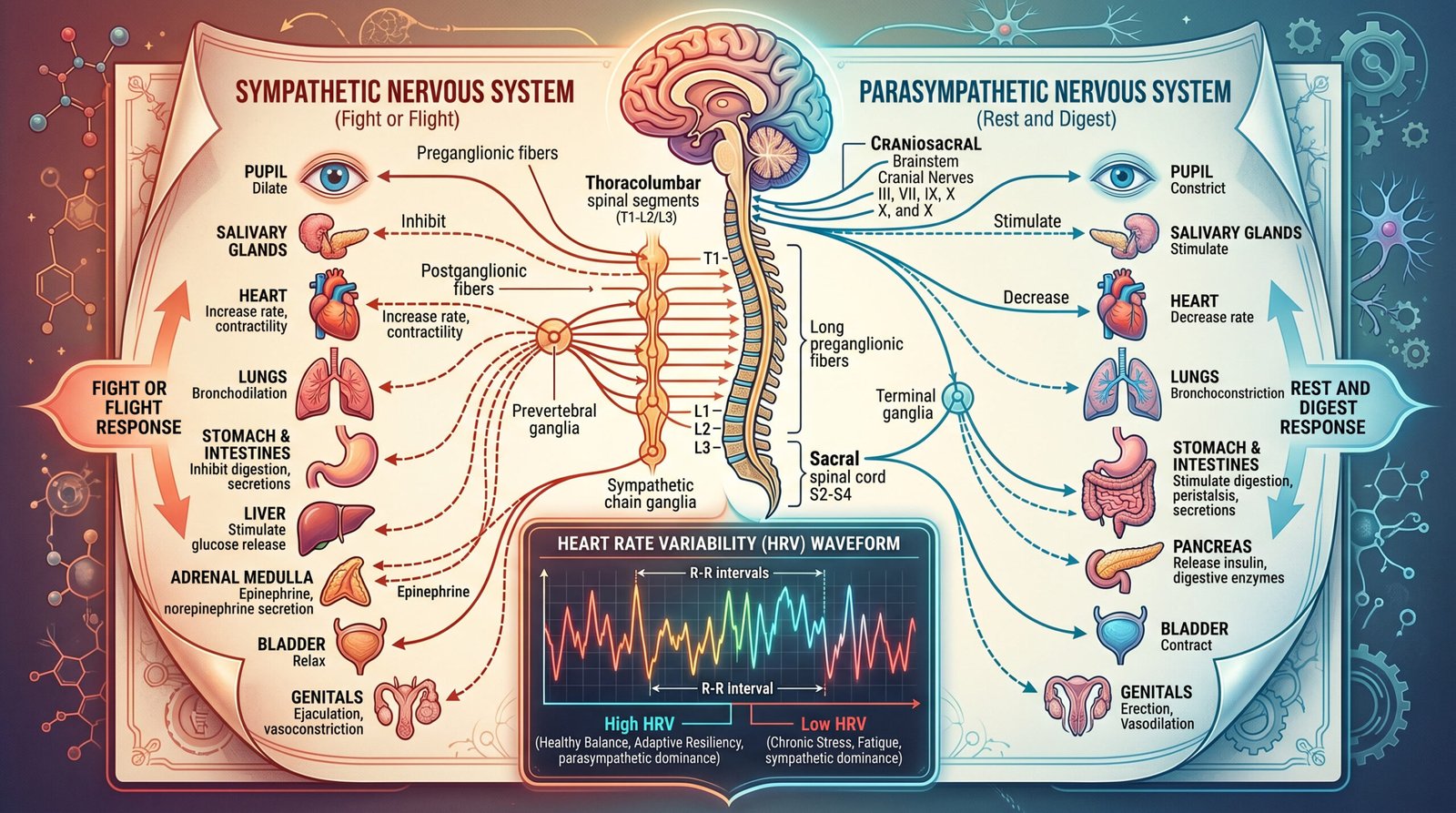
Your heart doesn’t beat like a metronome. A healthy heart beats slightly faster when you inhale and slightly slower when you exhale. That variation is controlled by your autonomic nervous system — the system that manages everything you don’t consciously control: breathing, digestion, heart rate, immune response.
High variability = your nervous system is flexible and resilient. Low variability = it’s stuck, rigid, stuck in survival mode. That’s what makes HRV such a useful signal. It tells you how much recovery capacity you actually have.
Your nervous system has two modes — and most people are trapped in one
Your autonomic nervous system runs two opposing branches. The sympathetic branch is your fight-or-flight response — it speeds your heart up, tenses your muscles, sharpens your focus on threats. The parasympathetic branch is your rest-and-digest response — it slows things down, promotes recovery, lowers inflammation, and restores your energy.
HRV is essentially a measure of how much parasympathetic activity your body is generating. When you’re stuck in chronic stress — even mild, background stress — your sympathetic system dominates. Your HRV drops. Your body can’t fully recover between rounds of effort.
According to a review published by the National Institutes of Health, HRV is one of the most reliable non-invasive markers of autonomic nervous system health and stress resilience. Honestly, that surprised me when I first read it — I assumed HRV was something only athletes tracked.
Sleep is when HRV recovery happens — but stress blocks it
Your HRV is highest during deep, quality sleep. That’s when your parasympathetic system dominates and your body does its real repair work. But here’s the problem: stress suppresses the deep sleep stages where this happens most.
So the cycle feeds itself. Stress lowers your HRV. Low HRV means your body can’t recover fully during sleep. Poor sleep raises your cortisol the next day. Higher cortisol keeps you in sympathetic overdrive. And your HRV drops further.
You can break this cycle. But you have to target the right things.
Breathing is the fastest lever you have
Of all the inputs that affect your HRV, breathing is the one you can change immediately — without a prescription, a device, or a specialist. Slow, controlled breathing directly activates the vagus nerve, which is the main channel of your parasympathetic system.
Even 5 minutes of slow breathing — inhaling for 4 to 6 seconds, exhaling for 6 to 8 seconds — measurably increases HRV within the session. I’m not 100% sure the effect is the same for everyone, but the research on this is consistent enough that it’s worth making a daily habit.
This is why breathwork shows up in every serious stress recovery protocol. It’s not mystical. It’s physiology.
The Fix: Four Habits That Actually Improve HRV
None of these require a smartwatch or a subscription. They’re habits that shift your nervous system back toward balance — consistently, over time.
1. Do 5 minutes of slow breathing every morning
Before coffee, before your phone, before anything — sit quietly and breathe slow. Inhale for 5 seconds through your nose. Exhale for 7 seconds through your mouth. That’s it. Do this for 5 minutes.
This single habit activates your vagus nerve and begins shifting your nervous system into parasympathetic dominance right at the start of your day. Most people feel calmer within 3 minutes.
Common mistake: breathing too fast. If you don’t slow down to 5-7 seconds per phase, you’re not triggering the parasympathetic response. The slowness is the point.
2. Protect the first and last 30 minutes of sleep
Your HRV rises most sharply in the first 90 minutes of sleep and the last 90 minutes before waking. Both of these windows are wrecked by screens, stimulation, and alcohol. Cut screens 30 minutes before bed. Don’t check your phone first thing after waking.
These two 30-minute windows are when your nervous system transitions in and out of deep recovery. Guard them like they matter — because they do.
Common mistake: checking email at 10pm. It puts your sympathetic system back on alert exactly when your body needs to wind down. Even reading stressful news counts.
3. Eat to support your nervous system, not just your energy
Your vagus nerve runs from your brain to your gut, and the state of your gut directly affects HRV. Foods that support vagal tone include magnesium-rich foods (pumpkin seeds, dark leafy greens), omega-3s (sardines, walnuts, flaxseed), and fermented foods that support gut bacteria.
Alcohol is the most common HRV suppressant that people overlook. Even 1-2 drinks measurably lowers HRV for the next 24-48 hours — not because of the hangover, but because of how alcohol disrupts parasympathetic activity during sleep.
Common mistake: eating well during the week and drinking on weekends. Your HRV data will show a sharp drop every Sunday if this is your pattern.
4. Move your body — but recover harder than you train
Regular aerobic exercise is one of the most reliable long-term HRV raisers there is. But there’s a catch: intense training without adequate recovery actively lowers HRV. Your body can’t tell the difference between the stress of a hard run and the stress of a hard week at work.
The rule is simple: on days your HRV is low (or you feel depleted), choose a walk over a workout. A 20-minute walk in the morning raises HRV. A hard session when you’re already depleted drops it further.
Common mistake: training through fatigue every single week. Your body sends clear signals. Start listening to them.

Abdellah’s Experience: What Changed for Me
During my warehouse shifts, I was running on maybe 5 hours of broken sleep and two energy drinks a day. I didn’t know what HRV was — I just knew I felt wrecked all the time, even on days off.
I started doing one thing: 5 minutes of slow breathing when I woke up. Not because I thought it would work, but because it cost nothing and took no time. After 4 days, I noticed I was getting through the first half of my shift without that tight, irritable feeling I’d normalized.
After two weeks, I added the sleep protection habit — no phone for 30 minutes before bed. My sleep didn’t get longer. But something about it felt different. Deeper. I stopped dreading the alarm.I wasn’t less stressed. I was just recovering from it.

Try This for 5 Days (Then Tell Me I’m Wrong)
Don’t overhaul your life. Just add these four things for 5 days and track how you feel:
- 5 minutes of slow breathing first thing in the morning (inhale 5s, exhale 7s)
- No screens 30 minutes before sleep — and 30 minutes after waking
- One daily walk — even 15 minutes — and skip hard training if you feel depleted
- Add walnuts, dark leafy greens, or sardines to one meal each day
Write down how you feel on Day 1 and Day 5. Energy level, sleep quality, irritability, focus. Most people notice a shift faster than they expect — not because these habits are dramatic, but because they’re correcting something that’s been quietly draining you for a long time.

The Real Reason Your Body Can’t Recover Isn’t What You Think
It’s not your job. It’s not your schedule. It’s the fact that your nervous system has been in fight-or-flight for so long it doesn’t remember how to switch off.
HRV is the measure of that stuck-ness. And the habits that raise it aren’t complicated — they’re just the ones you’ve been skipping because they feel too simple to matter.
They’re not. Start with the breathing. Everything else builds from there.
Want to go deeper? Read: Why You Feel Tired Every Day (Even After Rest) — it covers the daily energy habits that pair directly with HRV recovery.
Table of Contents
Medical disclaimer
This content is for informational purposes only and does not constitute medical advice. Always consult a qualified healthcare professional for personal health concerns.