



You eat reasonably. Not perfectly, but reasonably. And yet something is off — the brain fog, the afternoon slump, the strange inability to focus for more than 20 minutes, the cravings that hit even when you’re not hungry. You’ve blamed stress, sleep, work. You haven’t blamed the food.
But what if the chips, the granola bars, the microwaveable meals, and the flavored drinks you eat without a second thought are doing something to your brain — not just your waistline? Not in a vague “junk food is bad” way. In a specific, measurable, neurochemical way that researchers are only now beginning to fully map.
Ultra-processed food isn’t just low-nutrition. It’s actively engineered to interfere with the systems your brain uses to regulate focus, mood, and energy. And the science behind exactly how it does this is some of the most interesting — and unsettling — research in nutrition right now.
Why So Many People Feel Foggy, Flat, and Stuck in a Craving Loop
Ultra-processed foods now make up more than 50% of daily caloric intake in many Western countries. In the US and UK, that figure climbs to over 60% of children’s diets, according to data cited in a 2025 review published in Frontiers in Public Health. And the mental health consequences are becoming impossible to ignore.
A meta-analysis covering 79,701 participants found that people in the highest ultra-processed food intake category had a 20–50% higher risk of developing depressive symptoms compared to those who ate the least. A separate 2024 study published in Neurology linked high UPF consumption to both cognitive decline and stroke risk — independently of obesity and other known risk factors.
And it’s not just clinical outcomes. Everyday functional symptoms are just as telling. Check how many of these feel familiar:
- Brain fog that hits mid-morning, even after a full night of sleep
- Cravings that appear within an hour of finishing a meal
- Low mood or irritability that has no obvious cause
- Difficulty starting tasks that require sustained focus
- A general sense of mental flatness — not depressed, just not quite switched on
These aren’t personality traits or signs of laziness. For many people, they’re symptoms — and the food environment is a major driver.

What’s Actually Happening Inside Your Brain
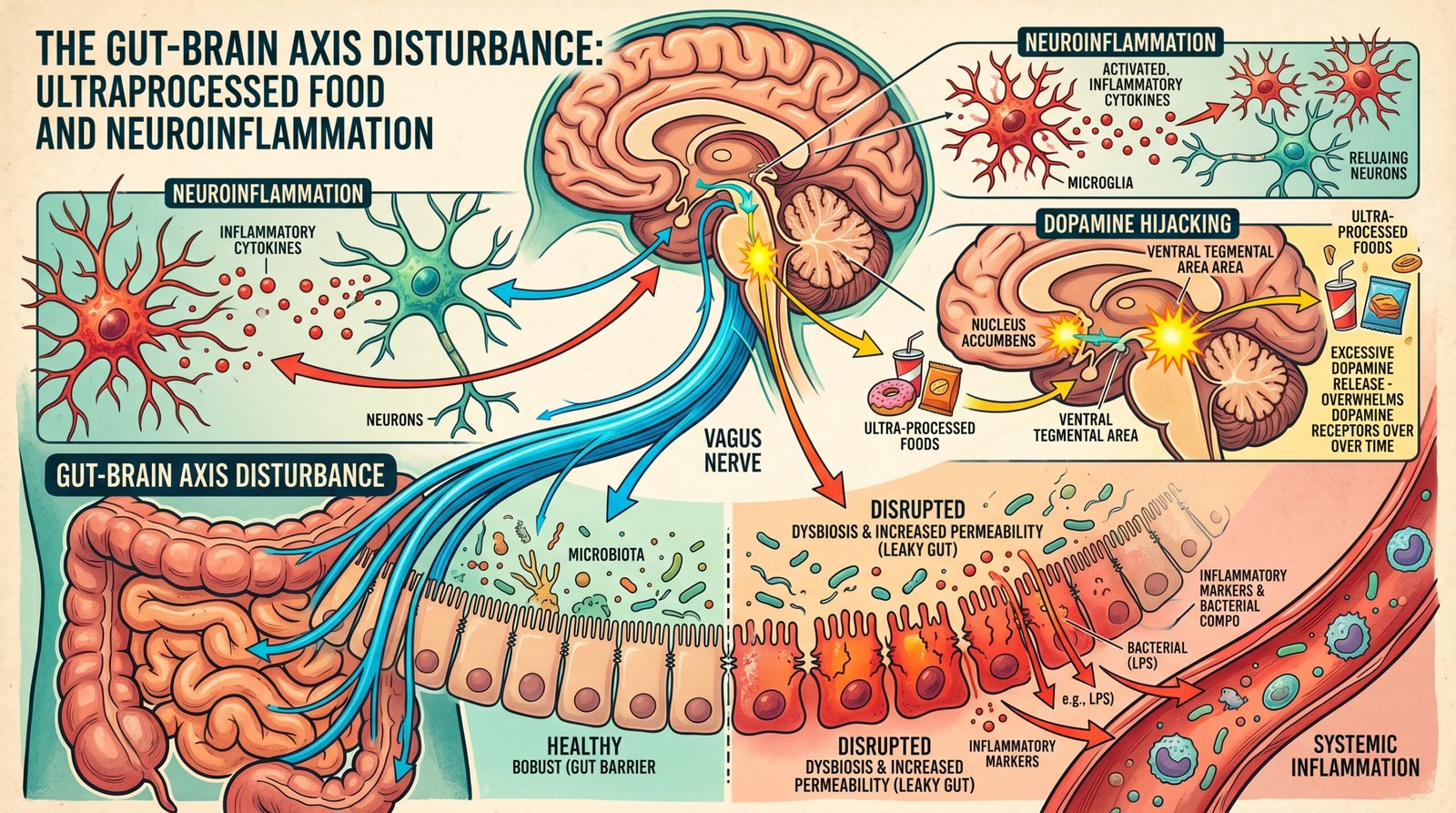
Ultra-processed foods don’t just lack nutrients. They actively disrupt three of the brain’s most fundamental regulatory systems — and each disruption compounds the others. Understanding these three mechanisms is the difference between “eating less junk food” as a vague goal and knowing exactly what you’re fighting against.
Mechanism 1: Dopamine hijacking and the reward loop that doesn’t switch off
Your brain’s reward system evolved to reinforce behaviors that helped you survive — finding food, forming connections, completing goals. Dopamine is the signal it uses: when you do something beneficial, dopamine fires, and your brain creates a motivation to repeat it.
Ultra-processed foods are engineered around combinations of fat, sugar, and salt that rarely occur together in nature. Research published in Frontiers in Public Health (2025) confirms that these fat-plus-sugar formulations trigger supra-additive dopamine firing in the midbrain — stronger than either fat or sugar alone. The reward signal is artificially amplified.
Here’s where it gets damaging: when dopamine receptors are overstimulated repeatedly, they downregulate — meaning your brain reduces the number of active receptors to protect itself from the noise. The result is that normal pleasures — finishing a task, a conversation, a walk outside — start generating less dopamine signal than they used to. The food that caused the problem now becomes the only thing that feels rewarding enough to register.
This is the craving loop. Not a lack of willpower. A measurable change in receptor sensitivity that the food itself created.
Mechanism 2: Gut-brain disruption and the serotonin shortfall
Most people think of serotonin as a brain chemical. But roughly 90% of the body’s serotonin is produced in the gut — by the gut microbiome, specifically by beneficial bacteria that depend on fiber, variety, and intact food structures to thrive.
Ultra-processed foods are low in fiber and high in synthetic emulsifiers and additives that disrupt the gut lining. A 2025 review in Nutrients (MDPI) found that UPFs are consistently associated with reduced microbial diversity, lower populations of beneficial bacteria like Akkermansia muciniphila and Faecalibacterium prausnitzii, and increased gut permeability — the condition sometimes called ‘leaky gut.’ When the microbiome is disrupted, serotonin and GABA production both drop.
The downstream effect isn’t just mood. Serotonin regulates appetite signaling, sleep architecture, and the ability to feel satisfied after eating. A serotonin shortfall from a disrupted gut doesn’t just make you feel flat — it makes you hungrier, sleep lighter, and crave more of the exact food that caused the disruption.
Mechanism 3: Neuroinflammation — when your brain starts to slow down
The third mechanism is the least talked about and possibly the most serious for long-term cognitive health. Chronic consumption of ultra-processed foods triggers low-grade systemic inflammation. That inflammation doesn’t stay in the gut — it crosses the blood-brain barrier and activates microglia, the brain’s immune cells.
When microglia are chronically activated, they produce inflammatory cytokines that slow neural signaling, impair synaptic plasticity, and reduce neurogenesis — the brain’s ability to form new connections. A 2024 study published in Neurology found that people with high UPF intake showed measurable structural changes in feeding-related brain regions, partially mediated by systemic inflammation. Separately, longitudinal data now links high-UPF diets to a 25–35% increased risk of all-cause dementia, according to a 2024 meta-analysis of nine cohorts. Honestly, that last number surprised me when I first came across it. A 25–35% excess risk isn’t a small signal — it’s the kind of association that would shut down a pharmaceutical compound in a clinical trial.
The Fix: 5 Food Environment Habits That Rewire Back
The goal here isn’t a strict diet. It’s a food environment audit — changing what’s physically available to you so that your brain is no longer defaulting to ultra-processed inputs by default. Willpower is finite. Environment is not.
1. Do a single-shelf kitchen audit
Go through one shelf, one drawer, or one section of your fridge. For each item, check the ingredient list. If it contains more than 5 ingredients — or ingredients you wouldn’t find in a normal kitchen (emulsifiers, artificial flavors, hydrogenated oils) — it’s ultra-processed. Don’t throw everything out. Just identify what’s there.
Awareness of your baseline is step one. Most people dramatically underestimate how much of their daily intake is ultra-processed until they actually look.
Common mistake: doing this once and going back to the same shopping habits. The audit only works if it changes what enters the house.
2. Replace — don’t just remove
Trying to cut ultra-processed food through restriction alone will fail within a week for most people. The dopamine downregulation means your brain will fight back hard. The smarter move: replace the ultra-processed default with a whole-food alternative that still gives your brain some reward.
Practical swaps that actually hold up: dark chocolate instead of milk chocolate bars, roasted nuts instead of chips, Greek yogurt with fruit instead of flavored yogurt, sparkling water instead of soda. None of these require cooking skills or extra time.
Common mistake: replacing ultra-processed snacks with “healthy” packaged snacks. Read the label — many protein bars and “natural” snacks are still ultra-processed.
3. Add fiber before you eat anything else
Fiber feeds the beneficial gut bacteria responsible for serotonin production. The fastest way to begin rebuilding the gut microbiome isn’t a probiotic supplement — it’s consistent dietary fiber from whole foods. One apple, a handful of oats, a portion of legumes, a small salad. Something fiber-rich before or during each meal.
Research consistently shows that microbiome diversity responds to dietary changes within days, not months. You don’t need to wait years to feel the difference — most people notice a mood and focus shift within one to two weeks of consistently increasing fiber intake.
Common mistake: adding a fiber supplement while keeping the same ultra-processed base diet. The supplement helps, but it won’t fix disruption caused by daily emulsifier and additive exposure.
4. Change what you eat first in the morning
Your first meal sets the metabolic and neurochemical tone for the next 3–4 hours. A breakfast of ultra-processed food — even something marketed as healthy like flavored granola or a cereal bar — spikes blood sugar, triggers a dopamine response that primes your brain for more cravings, and leaves your gut microbiome working from a deficit.
The target: a breakfast built on eggs, oats, plain yogurt, or fruit. Nothing fancy. Just something your gut bacteria can use and your blood sugar can handle without crashing.
Common mistake: skipping breakfast to “eat clean.” Skipping leaves your brain without raw materials for serotonin and focus through the first half of the day.
5. Create a 20-minute friction barrier for ultra-processed food
This one is pure behavioral neuroscience. Decision fatigue is real, and ultra-processed food is designed to win in low-willpower, high-convenience moments. The solution isn’t more discipline — it’s a physical gap. When you want an ultra-processed snack, start a 20-minute timer and do something else.
About 60–70% of the time, the craving will pass on its own. The times it doesn’t, you’ve made a deliberate choice rather than a reflexive one. That distinction matters neurologically — it keeps the prefrontal cortex involved in the decision instead of handing control entirely to the reward circuit.
Common mistake: using the timer while sitting next to the food. Distance is the variable — out of sight, out of the immediate reward loop.

Abdellah’s Experience: The Day I Actually Read the Label
My warehouse shifts ran on vending machine food. Chips, energy bars, those sugary coffee drinks in the small cans. I told myself it was fine because I wasn’t eating that much — just enough to get through the day.
Then one afternoon I read the ingredient list on the granola bar I was eating. Seventeen ingredients. Six I couldn’t pronounce. I started checking everything in my bag. Same story, almost everywhere.
I didn’t overhaul anything. I just stopped buying those specific items and replaced them with roasted almonds, bananas, and plain water. One shelf change in my kitchen. Two weeks later, the 2pm brain fog I’d had for years was noticeably lighter. I’m not 100% sure which mechanism was responsible — but something shifted, and it happened faster than I expected.The food industry spent billions engineering products to keep you coming back. The least you can do is spend two minutes reading the label.

Try This for 7 Days (Then Tell Me I’m Wrong)
Don’t try to eat perfectly. Just shift your food environment for one week using these five actions and track what changes in your focus and mood.
- Kitchen audit: check one shelf today — identify every ultra-processed item using the 5-ingredient rule
- Morning swap: replace your first meal with something whole — eggs, oats, or plain yogurt with fruit, no exceptions
- Fiber first: eat something fiber-rich before or with every meal — an apple, a handful of oats, a small salad, anything whole
- Replace one snack: swap the one ultra-processed snack you eat most often for a whole-food alternative — nuts, fruit, dark chocolate
- 20-minute rule: every time you crave ultra-processed food, set a 20-minute timer and move away from it before deciding
Compare Day 1 vs Day 7. Track your focus in the morning, your mood mid-afternoon, and how often you feel the compulsive pull to eat when you’re not actually hungry. Those three metrics will tell you everything you need to know.

The Real Reason You Can’t Focus Has Nothing to Do With Your Phone
We spend enormous energy trying to fix focus with apps, schedules, and digital detoxes. But if the food you eat three times a day is actively disrupting your dopamine system, your gut-brain communication, and your brain’s inflammatory state — no productivity system is going to fix that.
Ultra-processed food isn’t a moral failing. It’s a deliberate engineering choice made by an industry that profits from your brain’s inability to stop. Knowing the mechanism doesn’t make you immune to it. But it does make your choices more deliberate — and that’s where the shift starts. If low energy is feeding the cycle too, read: why you feel tired every day — fatigue and daily energy habits — it connects directly to what your brain needs to function at its baseline.
Table of Contents
Medical disclaimer
This content is for informational purposes only and does not constitute medical advice. Always consult a qualified healthcare professional for personal health concerns.