



You’ve probably never thought about magnesium. Most people haven’t.
But if you deal with muscle cramps that wake you at night, anxiety that has no clear cause, poor sleep despite genuine tiredness, or a jaw that stays tight no matter how much you try to relax — there’s a good chance this one mineral is at the root of all of it. Not stress. Not age. Not a mystery. Just a deficiency so common it’s practically invisible. According to research published in the journal Nutrients, an estimated 45 to 50% of adults in Western countries consume less magnesium than their bodies require — and most of them have no idea, because the early symptoms look exactly like a dozen other problems people have learned to live with.
Why So Many People Are Low in Magnesium Without Knowing It
Magnesium is the fourth most abundant mineral in your body and is involved in over 300 enzymatic reactions — from energy production to DNA repair to nerve signalling. But unlike iron or calcium, it doesn’t show up in routine blood tests. And because it’s stored primarily inside cells, not in your blood, a standard blood panel can read as normal even when your cellular magnesium is meaningfully depleted.
The problem isn’t just that people don’t eat enough magnesium-rich foods — though that’s part of it. It’s that modern life is depleting magnesium faster than most people can replenish it. Stress, alcohol, refined carbohydrates, caffeine, and certain medications all increase urinary excretion of magnesium. The more stressed you are, the more magnesium you burn through. And the more deficient you become, the harder it is to manage stress. Sound familiar?
Here’s what low magnesium actually looks and feels like — and why it gets misdiagnosed constantly:
- Muscle cramps or twitches, especially in the legs and calves at night
- Persistent low-level anxiety or a sense of inner tension that won’t switch off
- Poor sleep quality — difficulty staying asleep or reaching deep sleep
- Tension headaches, particularly around the temples or the back of the skull
- Constipation or sluggish digestion that doesn’t respond to changes in diet
- Fatigue that feels deeper than normal tiredness — a physical heaviness that rest doesn’t fully fix
If 3 or more of those apply to you regularly, low magnesium is worth taking seriously. And fixing it doesn’t require a doctor’s visit or expensive testing — it starts with food and a few simple habit changes.

What’s Actually Happening Inside Your Body
Magnesium doesn’t just do one thing. It’s involved in so many biological systems simultaneously that when levels drop, the effects ripple through your energy, your nervous system, your muscles, and your sleep all at once. That’s why the symptom picture looks so scattered — it’s not one problem, it’s the same deficiency showing up in different tissues.
Magnesium is your nervous system’s natural off-switch
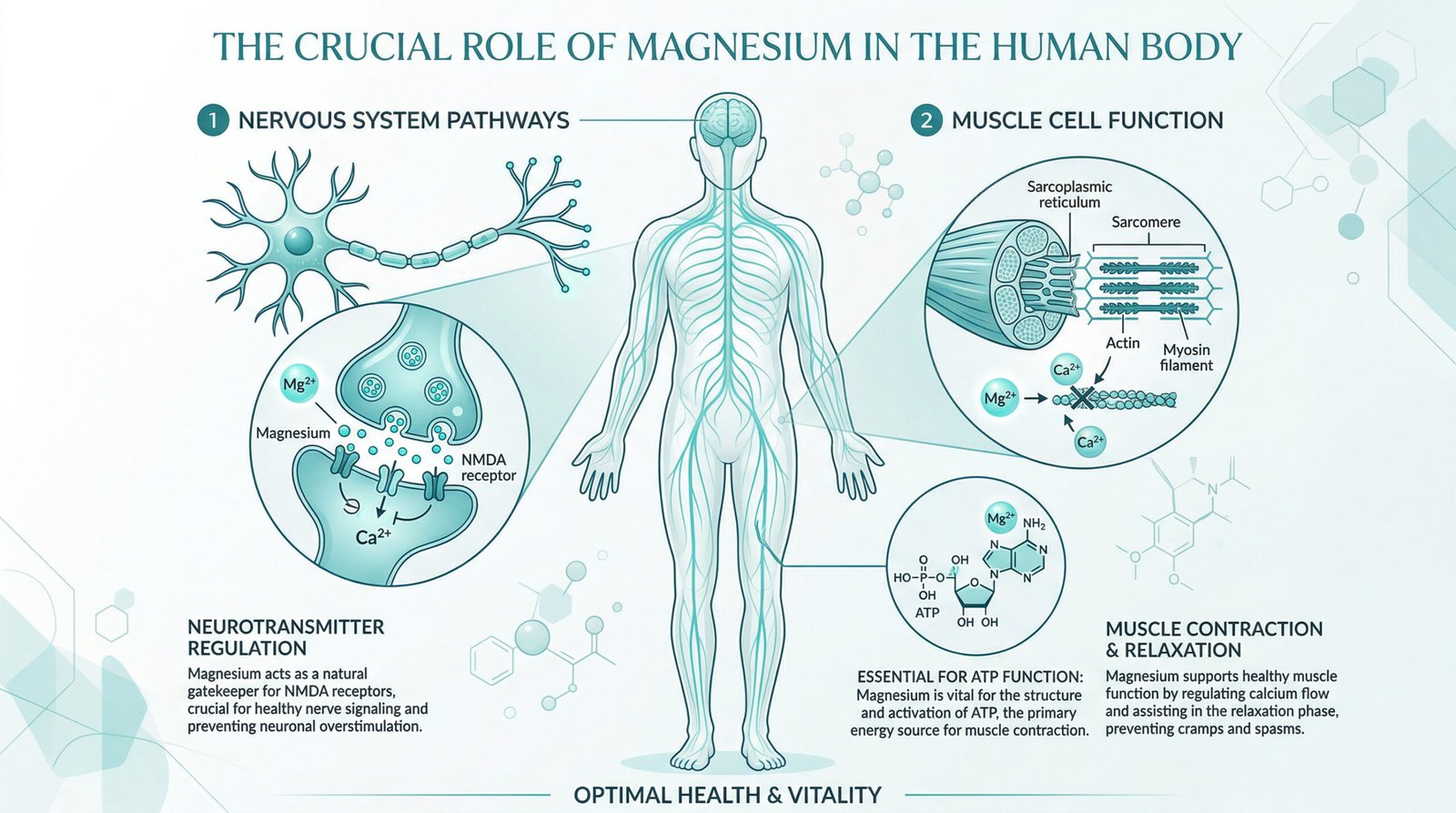
Your nervous system runs on a careful balance of excitatory and inhibitory signals. Glutamate is the brain’s primary excitatory neurotransmitter — it activates neurons, drives alertness, and fires the stress response. Magnesium is the primary physiological blocker of NMDA receptors, which are the main channels through which glutamate acts. When magnesium is sufficient, it literally sits inside those channels and prevents them from being over-activated.
When magnesium is low, that blocking function weakens. Your nervous system becomes hyperreactive — more sensitive to stimuli, more prone to anxiety, less able to shift from alert to calm. A landmark review in Magnesium Research found that magnesium deficiency was significantly associated with higher rates of anxiety, depression, and hyperarousal in multiple population studies. It’s not a coincidence — it’s receptor chemistry.
Muscle cramps are a direct sign of cellular magnesium shortage
Muscle contraction requires calcium. Muscle relaxation requires magnesium. When a nerve signal fires, calcium floods into the muscle cell and triggers the contraction. Magnesium then drives the calcium back out, allowing the muscle to relax. Without adequate magnesium, this calcium clearance is impaired — the muscle stays in a partially contracted state longer than it should, and under the right conditions (overnight dehydration, physical fatigue, warmth), it locks up entirely.
This is why nocturnal leg cramps — which affect up to 60% of adults at some point — are one of the most reliable early warning signs of low magnesium. I’m not 100% sure that magnesium deficiency is the only cause, but the calcium-magnesium balance is consistently implicated in the research, and magnesium repletion resolves them in a meaningful proportion of cases.
Low magnesium disrupts melatonin production and deep sleep
Magnesium plays a direct role in regulating the HPA axis — your body’s stress response system — and in supporting the production of GABA, the primary inhibitory neurotransmitter that quiets brain activity before sleep. Low GABA activity is strongly associated with difficulty falling asleep, light sleep, and early morning waking. Magnesium also modulates melatonin synthesis in the pineal gland. According to a clinical trial published in the Journal of Research in Medical Sciences, older adults given magnesium supplementation showed significant improvements in sleep onset time, sleep duration, and insomnia severity compared to placebo — with effects mediated through GABA and melatonin pathways.
The Fix: 4 Ways to Restore Your Magnesium Levels
You don’t need to immediately reach for a supplement. Food-first is the better long-term approach, and the foods highest in magnesium are genuinely worth eating regardless. But if your symptoms are significant, combining dietary changes with a well-chosen supplement form can accelerate recovery considerably.
1. Eat dark leafy greens every single day
Spinach, kale, and Swiss chard are the most magnesium-dense foods available. One cup of cooked spinach delivers roughly 157mg of magnesium — about 37% of the daily recommended intake for adults. The key word is cooked: raw spinach contains oxalates that bind to magnesium and reduce absorption. Heat breaks down the oxalates and makes the magnesium significantly more bioavailable. One serving daily, in any form, is enough to meaningfully contribute to your baseline.
Common mistake: counting a small handful of raw spinach in a smoothie as a full serving. It barely registers. Cook it, wilt it, or blend it with heat — and use a full cup, not a token leaf.
2. Add pumpkin seeds and dark chocolate as daily snacks
Pumpkin seeds are one of the highest magnesium foods by weight — 28g provides around 150mg. Dark chocolate at 70% cacao or above provides roughly 65mg per 30g serving, alongside polyphenols and a small cortisol-lowering effect. Both are portable, require zero preparation, and genuinely taste good. A small handful of pumpkin seeds and two squares of dark chocolate as an afternoon snack covers roughly 40 to 45% of your daily magnesium requirement passively, without any planning.
Common mistake: buying roasted, salted pumpkin seeds. High heat and processing reduce the magnesium content and degrade the beneficial fats. Raw or lightly toasted, unsalted is the version worth buying.
3. If supplementing, choose magnesium glycinate or malate
Not all magnesium supplements are equal. Magnesium oxide — the most common and cheapest form — has very poor bioavailability (around 4%) and often causes digestive upset. Magnesium glycinate is bound to glycine, an amino acid with its own calming properties, and is absorbed significantly better with minimal gut side effects. It’s the most consistently recommended form for sleep, anxiety, and muscle issues. Magnesium malate is better suited for energy and fatigue support. Dosage: 200 to 400mg elemental magnesium per day, taken in the evening with food.
Common mistake: taking magnesium on an empty stomach or in a single large dose. It absorbs better in smaller amounts with food, and splitting it into two doses reduces the risk of any loose stools — which is the main side effect of taking too much at once.
4. Reduce the things that drain magnesium daily
Fixing your intake is only half the equation if you’re simultaneously accelerating depletion. Caffeine increases urinary excretion of magnesium. Alcohol depletes it significantly — even moderate drinking has been shown to increase magnesium losses. Refined sugar and processed carbohydrates require magnesium for their metabolism without supplying any in return. And chronic stress burns through magnesium faster than almost any other factor.
You don’t have to eliminate any of these completely. But if you’re adding magnesium-rich foods with one hand and losing it through 3 coffees, a glass of wine, and a high-stress day with the other, you’ll spend a long time chasing your tail.Common mistake: fixing diet but ignoring stress. As covered in the article on the vagus nerve, chronic sympathetic activation is one of the fastest ways to deplete magnesium — dietary changes work better when your stress response isn’t running at full speed simultaneously.

Abdellah’s Experience: What Changed for Me
For a long time I had this thing where my left calf would cramp in the night — badly enough to wake me up and take a minute to walk off. I assumed it was from standing all shift, maybe dehydration. I drank more water. It kept happening.
A colleague mentioned magnesium offhand. I started adding a handful of pumpkin seeds to my break and two squares of dark chocolate at night. After 10 days the cramps stopped. Not reduced. Stopped. I also noticed my jaw felt less tight in the mornings, which I hadn’t even connected to the same issue until it was gone.
I added a magnesium glycinate supplement three weeks later and the sleep improvement was the thing I didn’t expect. Heavier sleep, fewer wake-ups, calmer in the mornings. From a mineral I’d never thought about once in my life.
The body doesn’t always need something complex. Sometimes it just needs what it’s been running short on.

Try This for 10 Days (Then Tell Me I’m Wrong)
Make these 4 changes consistently for 10 days and track your symptoms:
- Add one cup of cooked spinach or dark leafy greens to your daily meals — any form, any meal
- Eat a small handful of raw pumpkin seeds and 2 squares of dark chocolate (70%+) daily as a snack
- Optional: take 200 to 300mg magnesium glycinate with your evening meal
- Cut one magnesium drainer: either reduce afternoon caffeine, skip the alcohol 3 nights per week, or reduce processed sugar intake
- Track on Day 1 and Day 10: muscle cramp frequency, jaw tension on waking, sleep quality, and background anxiety level
Most people notice muscle symptoms improving within 5 to 7 days. Sleep changes tend to follow in the second week, particularly if supplementing. Anxiety and tension are usually the last to shift — but they do shift, and the difference feels like background noise being turned down.

The Real Reason So Many Symptoms Have the Same Root
When multiple things go wrong at once — sleep, muscles, mood, energy — it’s tempting to treat each one separately. A magnesium deficiency is one of the few situations where a single nutritional gap genuinely causes all of them simultaneously, through distinct but connected mechanisms.
It’s not a magic mineral. But it is one that most people are chronically short on, for reasons that are entirely fixable. And the symptoms of fixing it — better sleep, fewer cramps, less anxiety, more consistent energy — are among the most tangible improvements you can make with a simple dietary change.
If chronic stress is accelerating your magnesium depletion, read: your nervous system is stuck — here’s how to reset it. And if sleep quality is still a concern after addressing magnesium, this pairs directly with: how to get more deep sleep.
Table of Contents
Medical disclaimer
This content is for informational purposes only and does not constitute medical advice. Always consult a qualified healthcare professional for personal health concerns.