



You think your brain is slowing down because you’re stressed or not sleeping enough.
But what if the real problem is sitting on your plate every morning — or more accurately, not sitting on it at all?
Most people who complain about brain fog, poor focus, and mental fatigue are eating the wrong things before their most demanding hours. Not less. Not too much. Just the wrong things. And one nutrient — one most people underestimate for brain function — is almost always missing.
Why So Many People Struggle With Focus and Mental Clarity
Brain fog is not a personality trait. According to research published in Nutrients, cognitive fatigue and poor mental performance are strongly linked to nutritional gaps — and inadequate protein intake is one of the most overlooked causes.
We talk endlessly about sleep and stress. But the conversation almost never turns to amino acids. And that’s a problem, because your brain can’t manufacture its own alertness chemicals without them.
Sound familiar? Here’s what protein-starved thinking actually looks like:
- You re-read the same sentence three times and still don’t absorb it
- You lose your train of thought mid-conversation or mid-task
- Decision fatigue hits you before noon — even on low-pressure days
- You feel mentally flat: not sad, not anxious, just… slow
- Coffee helps briefly but the crash hits harder each time
The good news? This is fixable. And it doesn’t require a dietitian, a supplement stack, or a complete diet overhaul.

What’s Actually Happening Inside Your Brain
Your brain is not a static organ running on electricity. It’s a chemical system — and the chemicals it runs on are built from what you eat. Protein is where those chemicals come from.
Amino acids are the raw material for your thinking chemicals
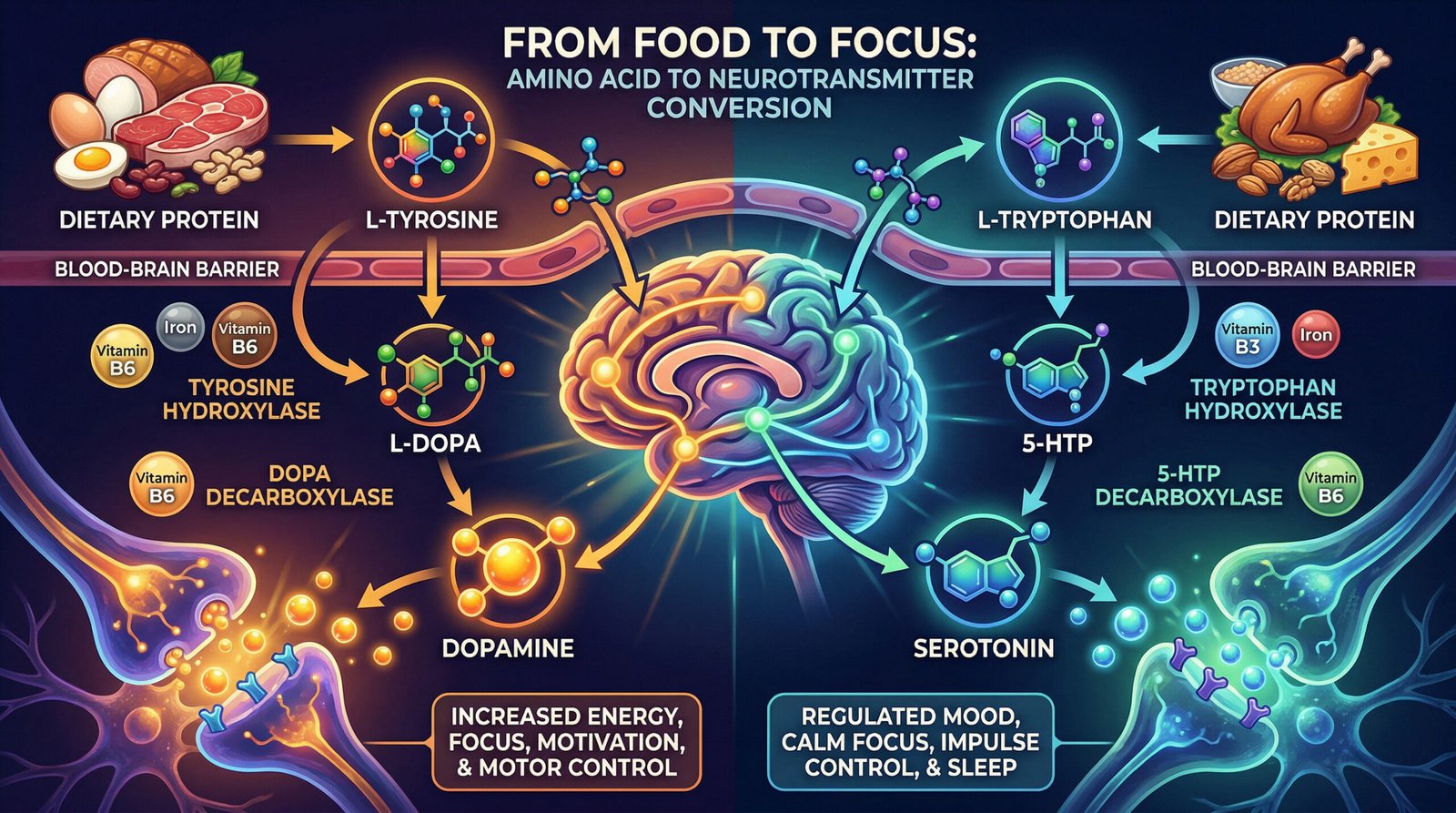
When you eat protein, your body breaks it down into amino acids. Several of these are direct precursors to neurotransmitters — the chemical messengers that control focus, motivation, mood, and memory.
Tryptophan converts to serotonin (mood stability and calm focus). Tyrosine converts to dopamine and norepinephrine (drive, attention, mental speed). Without enough of these amino acids coming in through food, your brain can’t produce enough of these chemicals to function at full capacity.
A 2024 systematic review published in Nutrition Research Reviews (Cambridge University Press) confirmed that dietary protein intake directly influences neurotransmitter synthesis and cognitive performance — particularly in adults under cognitive or physical stress.
Blood sugar swings impair thinking — but protein stabilizes them
Here’s something that surprised me: protein is one of the most effective blood sugar stabilizers there is. When you eat protein alongside carbohydrates, it slows glucose absorption and prevents the sharp spike-and-crash cycle that leaves you foggy and irritable by mid-morning.
A carb-only breakfast — toast, cereal, fruit juice — sends your blood glucose soaring in 20 minutes, then crashing 45 minutes later. Your brain detects that crash as a minor emergency. It releases cortisol to compensate. And cortisol, in the short term, actively impairs prefrontal cortex function — the part of your brain responsible for reasoning, planning, and clear thinking.
Low dopamine looks like laziness but it’s actually chemistry
If you’ve ever had a day where you just couldn’t get started — not tired exactly, just unmotivated, foggy, drifting — that’s often a dopamine problem. And dopamine is made from tyrosine, a non-essential amino acid found in high-protein foods like eggs, chicken, cheese, and lentils.
You can’t will yourself into dopamine. You can eat your way toward it. That’s not a metaphor — it’s straightforward biochemistry. According to Healthline’s review of dopamine-supporting foods, tyrosine-rich protein sources are among the most evidence-backed dietary interventions for supporting mental drive and focus.
The Fix: Four Habits That Actually Sharpen Your Thinking
None of these require a meal plan or special shopping. They’re small, specific adjustments to how you eat — most of them in the morning.
1. Build a protein-first breakfast — minimum 20 grams
This is the single highest-leverage change you can make. Before your brain engages with its first real task, give it the amino acids it needs to produce dopamine and serotonin for the hours ahead.
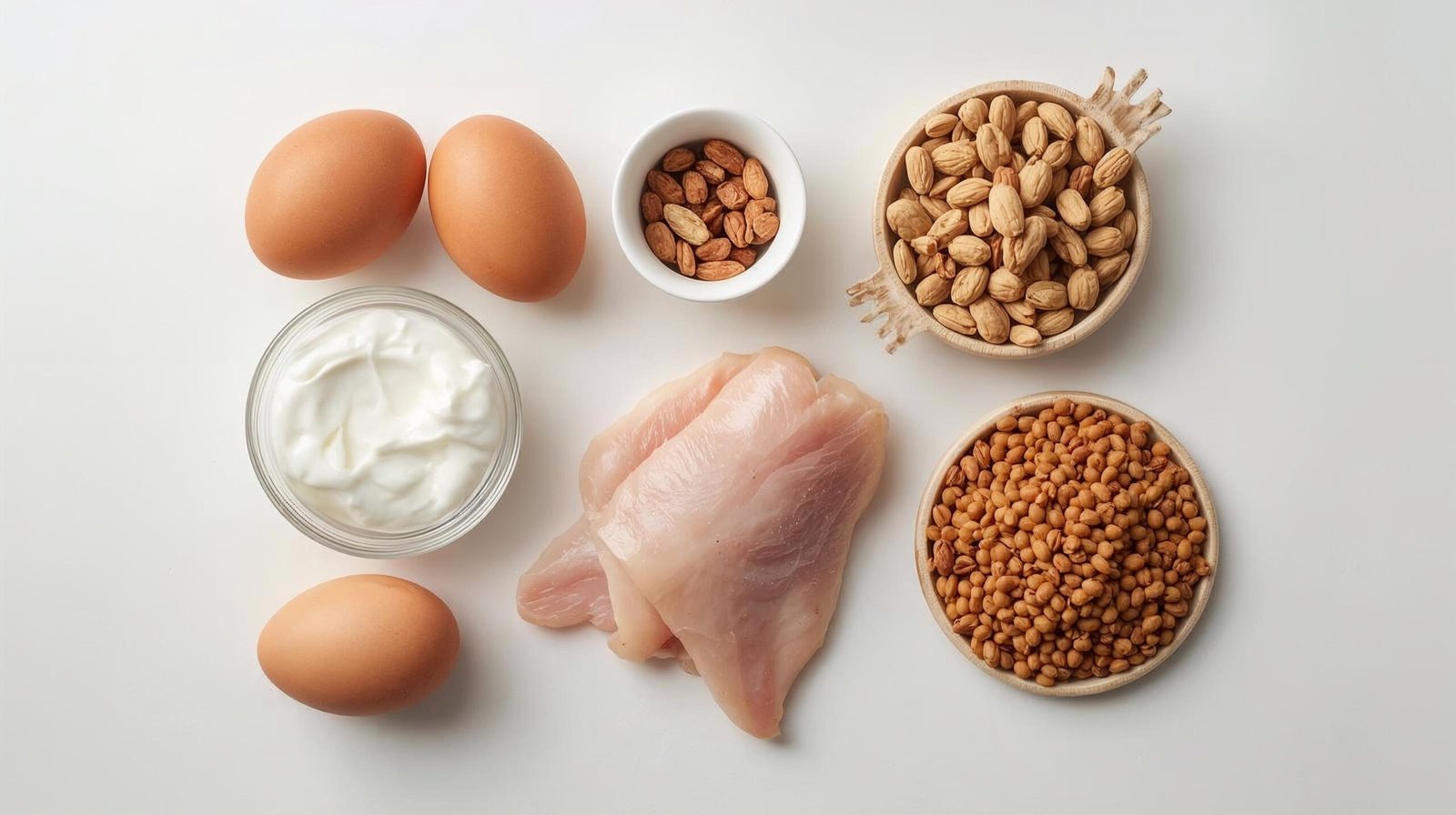
20 grams sounds like a lot but it’s not: 2 eggs + 1 cup Greek yogurt = roughly 24g. A chicken wrap with cheese = around 30g. A protein shake + a banana = 25–30g depending on the powder.
Common mistake: skipping breakfast or eating only carbs (toast, fruit, cereal). This isn’t just a missed opportunity — it actively sets up the blood sugar crash cycle that impairs your cognition for 2–3 hours.
2. Eat protein with every main meal — spread it out
Your body can only use around 25–40 grams of protein per meal effectively for muscle and neurotransmitter synthesis. Eating 80 grams at dinner and nothing at breakfast doesn’t give your brain a steady supply of amino acids throughout the day.
Aim to include a protein source at every meal: eggs or Greek yogurt at breakfast, chicken or legumes at lunch, fish or meat at dinner. Spread across the day, this gives your brain a consistent raw material supply from morning to evening.
Common mistake: saving most of your protein for dinner. Your brain’s most cognitively demanding hours are usually morning and early afternoon — front-load accordingly.
3. Add a small protein snack before mentally demanding work
If you have a meeting, a deadline, or a focus session coming up within 60–90 minutes, eat a small protein snack beforehand. A handful of nuts, a boiled egg, or a tablespoon of peanut butter on a rice cake. Tiny, but effective.
This keeps your blood sugar stable during the task and gives tyrosine one more opportunity to reach the brain before the cognitive load peaks. I’m not 100% sure why this timing works so consistently, but the difference between a protein snack 90 minutes before deep work versus no snack is noticeable.
4. Replace your afternoon coffee with a protein snack
The 2–3pm energy crash is often blamed on circadian rhythms — and that’s partly true. But it’s also partly a protein gap. If lunch was mostly carbs, your blood sugar has dropped, and your brain is low on fresh amino acids.
Instead of reaching for coffee (which delays the crash by 45 minutes and then makes it worse), try 20 minutes of movement plus a small protein snack: Greek yogurt, a boiled egg, or some cheese with crackers. Most people are surprised how well this works compared to caffeine.
Abdellah’s Experience: What Changed for Me
I used to hit a wall at around 10am — maybe two hours into a work session. I’d blame the screen, the chair, the noise. I’d make coffee. It helped for 30 minutes.
What I didn’t realize was that I was starting every morning with two pieces of toast and fruit juice. No protein. My brain was running on a blood sugar spike that dissolved before I even sat down properly.
I switched to two eggs and Greek yogurt in the morning. That’s it. No other changes. Within four days, the 10am wall was gone. Not reduced — gone. I was finishing tasks I’d normally procrastinate on before lunch.
Your brain isn’t slowing down because you’re not smart enough. It’s slowing down because you’re not feeding it.

Try This for 5 Days (Then Tell Me I’m Wrong)
Don’t change your entire diet. Just add protein at the right moments for one working week:
- Day 1–5 morning: eat at least 20g of protein within 30 minutes of waking (eggs, Greek yogurt, or a protein shake with milk)
- Lunch: include a protein source — chicken, fish, legumes, or cheese — not just carbs
- Mid-afternoon: replace one coffee with a small protein snack + 5 minutes of movement
- Before any focus session: eat a small protein snack 60–90 minutes beforehand
Track your focus on Day 1 vs Day 5. Write down one sentence each evening: how sharp did your thinking feel today? Most people notice a change faster than they expect — not because protein is magic, but because most people are quietly deficient in it without realizing it.

The Real Reason Your Brain Keeps Letting You Down
It’s not discipline. It’s not sleep deprivation. It’s not your phone. It’s the fact that most people treat the brain like it runs on electricity when it actually runs on chemistry — and that chemistry is built from food.
Protein and cognitive performance are not separate topics. They’re the same topic. Feed your brain the raw materials it needs and it will surprise you with what it was capable of all along.
Want to go deeper? Read: how sleep affects focus and mental performance — it covers the other half of the equation that works hand in hand with what you’ve learned here.
Table of Contents
Medical disclaimer
This content is for informational purposes only and does not constitute medical advice. Always consult a qualified healthcare professional for personal health concerns.