



You think your bad mood is stress. You think your brain fog is lack of sleep. And maybe it is — partly.
But what if the real control center for how you feel every day isn’t in your head at all? What if it’s sitting in your gut, quietly sending signals upward — and you’ve been ignoring it for years?
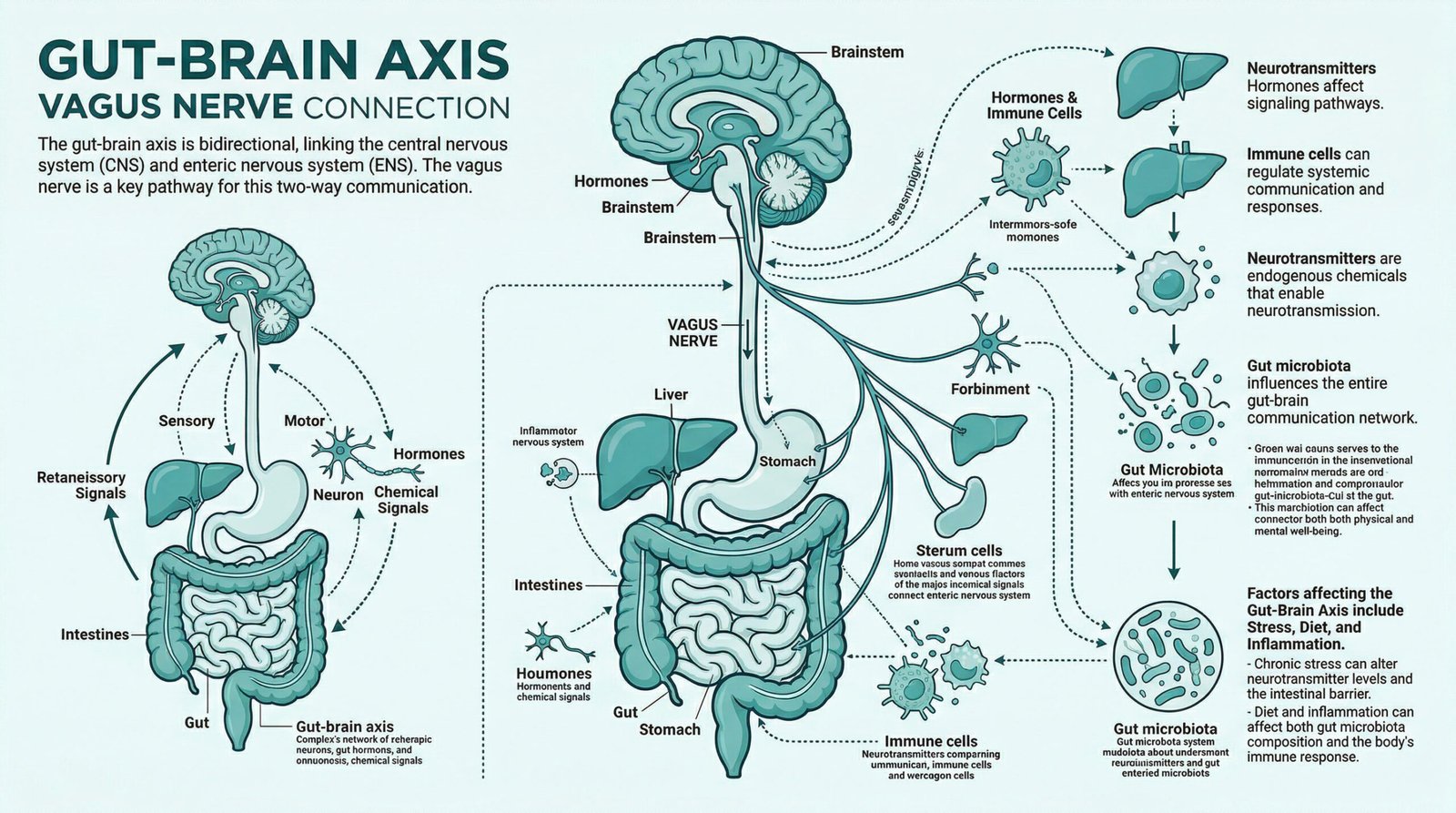
There’s a two-way communication highway between your gut and your brain called the gut-brain axis. And the research on it is uncomfortably clear: what’s happening in your digestive system right now is shaping your mood, your focus, your anxiety levels, and even how well you handle stress. This article breaks down what that actually means — and what you can do about it starting today.
Why So Many People Feel Off Without Knowing Why
According to a large-scale review published in Nature Reviews Gastroenterology & Hepatology, roughly 40% of the global population experiences gut dysfunction — and most of those people have no idea their gut is connected to their mental state.
You’ve probably heard “trust your gut” your whole life. But nobody told you the gut is literally talking to your brain, around the clock, through 500 million nerve endings. When that conversation goes wrong, you feel it — just not in the place you’d expect.
Sound familiar? Check how many of these apply to you:
- Waking up feeling anxious for no clear reason
- Brain fog that hits mid-morning or after meals
- Low motivation that doesn’t improve with more sleep
- Mood swings that seem random and unpredictable
- A general sense of being ‘flat’ — not depressed, just not yourself
If you checked 3 or more, your gut might be the missing piece. And the good news is: this is fixable.

What’s Actually Happening Inside Your Body
Your gut isn’t just digesting food. It’s producing neurotransmitters, firing off signals through the vagus nerve, and housing a colony of 100 trillion bacteria that influence your mental state daily. Here’s how each piece works.
The vagus nerve: your body’s gut-to-brain express line
The vagus nerve runs from your brainstem all the way down to your gut. It’s one of the longest nerves in your body — and about 90% of its signals travel upward, from gut to brain, not the other way around.
This means your gut is constantly reporting its condition to your brain. Bloating, inflammation, bacterial imbalance — all of it gets transmitted up that nerve as a chemical report. A 2021 study in Neuron confirmed that the gut sends far more information to the brain than the brain sends to the gut, which flips most people’s assumptions completely.
Serotonin: most of it lives in your gut, not your brain
About 90–95% of your body’s serotonin — the chemical linked to mood, calm, and emotional regulation — is produced in your gut, not your brain.
But here’s the thing: gut-produced serotonin doesn’t cross the blood-brain barrier directly. Instead, it regulates gut movement and signals the vagus nerve, which then influences your brain’s serotonin activity. When your gut bacteria are imbalanced, serotonin production drops. And when serotonin drops, so does your mood. That’s not a metaphor — it’s mechanics.
Your gut bacteria decide how inflamed your brain is
Your gut microbiome — the 100 trillion bacteria living in your digestive system — produces chemicals that either protect your brain or inflame it. When the balance tips toward harmful bacteria (through poor diet, stress, or antibiotics), inflammation spreads through your gut lining and eventually reaches your brain.
Neuroinflammation is now considered a major driver of depression, brain fog, and anxiety. A 2019 paper in Frontiers in Psychiatry linked low microbiome diversity directly to higher rates of anxiety and depression. I’m not 100% sure this is the only mechanism at play, but the evidence pointing toward gut bacteria as a mood regulator is hard to ignore.
The Fix: 4 Habits That Actually Change How Your Gut Communicates
You don’t need a probiotic subscription, a gut health protocol, or a list of expensive superfoods. These four habits work at the biological level — they directly improve your microbiome, reduce gut inflammation, and strengthen the gut-brain signal.
1. Add one fermented food per day
Fermented foods — yogurt, kefir, kimchi, sauerkraut — deliver live bacteria directly to your gut. A 2021 clinical trial published in Cell found that a diet high in fermented foods significantly increased microbiome diversity and reduced inflammatory markers in just 10 weeks.
One serving per day is enough to start. Plain yogurt with no added sugar is the simplest option. Don’t overthink it.
Common mistake: buying flavored yogurt thinking it counts. Most flavored yogurts have too much sugar, which feeds harmful bacteria instead of the good ones. Go plain.
2. Eat more fiber — specifically prebiotic fiber
Probiotics (the good bacteria) need food to survive in your gut. That food is fiber — specifically prebiotic fiber found in onions, garlic, leeks, bananas, oats, and asparagus.
Without fiber, even a healthy microbiome starts shrinking within days. Think of it this way: you can’t grow a garden without soil. Fiber is the soil your gut bacteria live in.
Common mistake: taking probiotic supplements while eating a low-fiber diet. The bacteria arrive but have nothing to eat and die off within 24–48 hours.
3. Reduce ultra-processed food for 7 days
Ultra-processed foods — packaged snacks, fast food, sugary drinks — contain additives and emulsifiers that directly damage the gut lining. A damaged gut lining is called “leaky gut,” and it’s one of the main pathways through which gut inflammation reaches the brain.
You don’t need to eliminate these foods permanently. But cutting them out for just 7 days gives your gut lining time to start repairing. And many people notice a change in mood and clarity within that window.
Common mistake: replacing them with “diet” versions. Many diet foods contain artificial sweeteners that disrupt gut bacteria just as badly as sugar does.
4. Walk for 15 minutes after your main meal
Light movement after eating speeds up gut motility — how quickly food moves through your digestive system. Slow gut motility means food ferments in the wrong way, producing gases and bacterial byproducts that trigger inflammation.
A post-meal walk also blunts the blood sugar spike from your meal, which further reduces the cortisol-gut inflammation cycle. It takes 15 minutes. You don’t need a gym.
Common mistake: sitting or lying down immediately after eating. Even 10 minutes of sitting still drops gut motility significantly compared to standing or walking.

Abdellah’s Experience: What Changed for Me
I spent about two years dismissing my gut as just ‘sensitive.’ I had bloating after most meals, I was irritable in the mornings for no reason, and my focus at work felt like trying to think through wet concrete.
I tried cutting coffee, sleeping more, even meditating. Nothing stuck. Then I read about the gut-brain connection and decided to try three things for two weeks: plain yogurt every morning, a banana before my shift, and a short walk on my lunch break.
By day 5, the morning irritability was noticeably lower. By day 10, I was finishing tasks I’d normally abandon halfway. I didn’t change my schedule, my stress load, or my sleep time.
The problem was never in my head. It was 30 centimeters below it.

Try This for 7 Days (Then Tell Me I’m Wrong)
One week. That’s all. Here’s the exact protocol, nothing added, nothing complicated:
- Morning: eat plain yogurt or drink kefir — no sugar, no flavoring
- With every meal: include one fiber-rich food (banana, oats, onion, garlic, or leafy greens)
- After your main meal: walk for 15 minutes — outside, inside, doesn’t matter
- Cut one ultra-processed item you normally eat daily (chips, a sugary drink, a packaged snack)
Track how you feel on Day 1 vs Day 7. Not weight, not digestion — specifically: mood in the morning, mental clarity mid-day, and irritability level in the evenings. Most people notice a shift by Day 4.

The Real Reason Your Mood and Focus Are Unpredictable
It’s not your willpower. It’s not your job. And it’s probably not a deficiency you need a supplement to fix.
Your gut and your brain are in constant conversation — and if the gut side of that conversation is chaotic, inflamed, or bacteria-depleted, the brain receives a bad signal. You feel it as anxiety, flat mood, and the kind of foggy thinking that no amount of caffeine clears.
Feed the system properly and the signal changes. It’s that mechanical.
Want to go deeper? Read: How sleep affects your gut bacteria and mood — it connects directly to everything covered here.
And if you’ve been struggling with consistent energy, this one ties in too: Why you feel tired every day even after rest.
Table of Contents
Medical disclaimer
This content is for informational purposes only and does not constitute medical advice. Always consult a qualified healthcare professional for personal health concerns.