
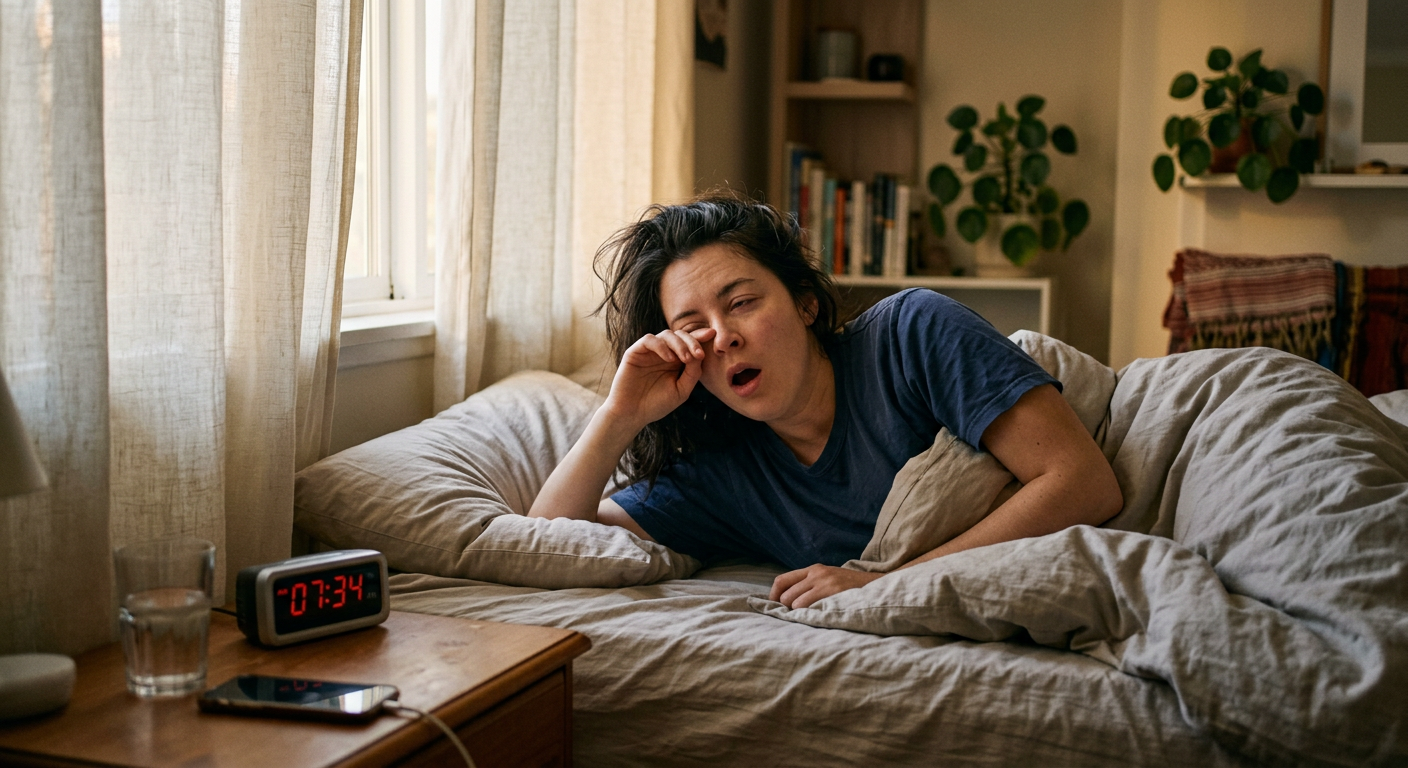

You wake up tired. You push through the morning. Then somewhere around 2pm, the wall hits — and no amount of coffee saves you.
You’ve probably blamed your job, your sleep hours, or just getting older. But here’s what most people miss: the crash isn’t random. It happens at the same time every day because your body is running on a 24-hour internal clock — and for most people, that clock is badly out of sync.
This isn’t about sleep quantity. You can sleep eight hours and still feel destroyed by mid-afternoon if your circadian rhythm is broken. And the frustrating part is that the things causing the damage are habits you repeat every single morning without knowing it.
Here’s what’s actually happening inside your body — and how to fix it without overhauling your entire life.
Why So Many People Feel Drained at the Same Time Every Day
A 2019 report published in the journal Nature and Science of Sleep found that over 60% of adults experience at least one significant energy crash daily — with the most common window between 1pm and 3pm. Most of them attributed it to not sleeping enough. But the research pointed somewhere else: circadian misalignment.
Circadian misalignment means your internal body clock is out of sync with your actual daily schedule. And it’s far more common than most people realize — especially for anyone who works irregular hours, eats at inconsistent times, or spends their evenings exposed to artificial light.
Here’s what it looks like when your body clock is off:
- You feel fine at 10pm but can’t fall asleep until 1am
- You wake up tired even after 7–8 hours of sleep
- Your energy crashes hard in the early afternoon, every single day
- You feel a weird second wind late at night — right before bed
- Mornings feel impossible no matter how early you go to sleep
If three or more of these are familiar, your circadian rhythm is the problem. And it’s fixable — once you understand what’s actually driving it.
What’s Actually Happening Inside Your Body
Your circadian rhythm is a 24-hour biological cycle controlled by a tiny region of your brain called the suprachiasmatic nucleus (SCN). Think of it as a master clock that synchronizes almost every organ and system in your body — including when you produce energy, when you’re alert, and when you start shutting down for sleep.
When this clock is running correctly, you get natural energy peaks in the morning, steady focus through midday, and a gradual wind-down in the evening. When it’s disrupted, everything comes at the wrong time — and no amount of caffeine or willpower can override a broken internal schedule.
Light is the master signal — and most people are getting it wrong
Your SCN is synchronized almost entirely by light. Specifically, blue-spectrum light hitting your retinas in the morning triggers a cortisol spike that acts as your body’s natural wake signal — raising alertness, body temperature, and metabolic rate. Without it, your brain doesn’t fully register that the day has started.
The problem: most people wake up, check their phone in a dark room, eat breakfast under artificial light, and never go outside until mid-morning. Your body clock never gets the signal it needs to set itself properly. Then at night, screens and LED lighting keep sending ‘daytime’ signals to your brain — delaying melatonin production and pushing your sleep cycle later and later.
Cortisol and melatonin are supposed to work as a team
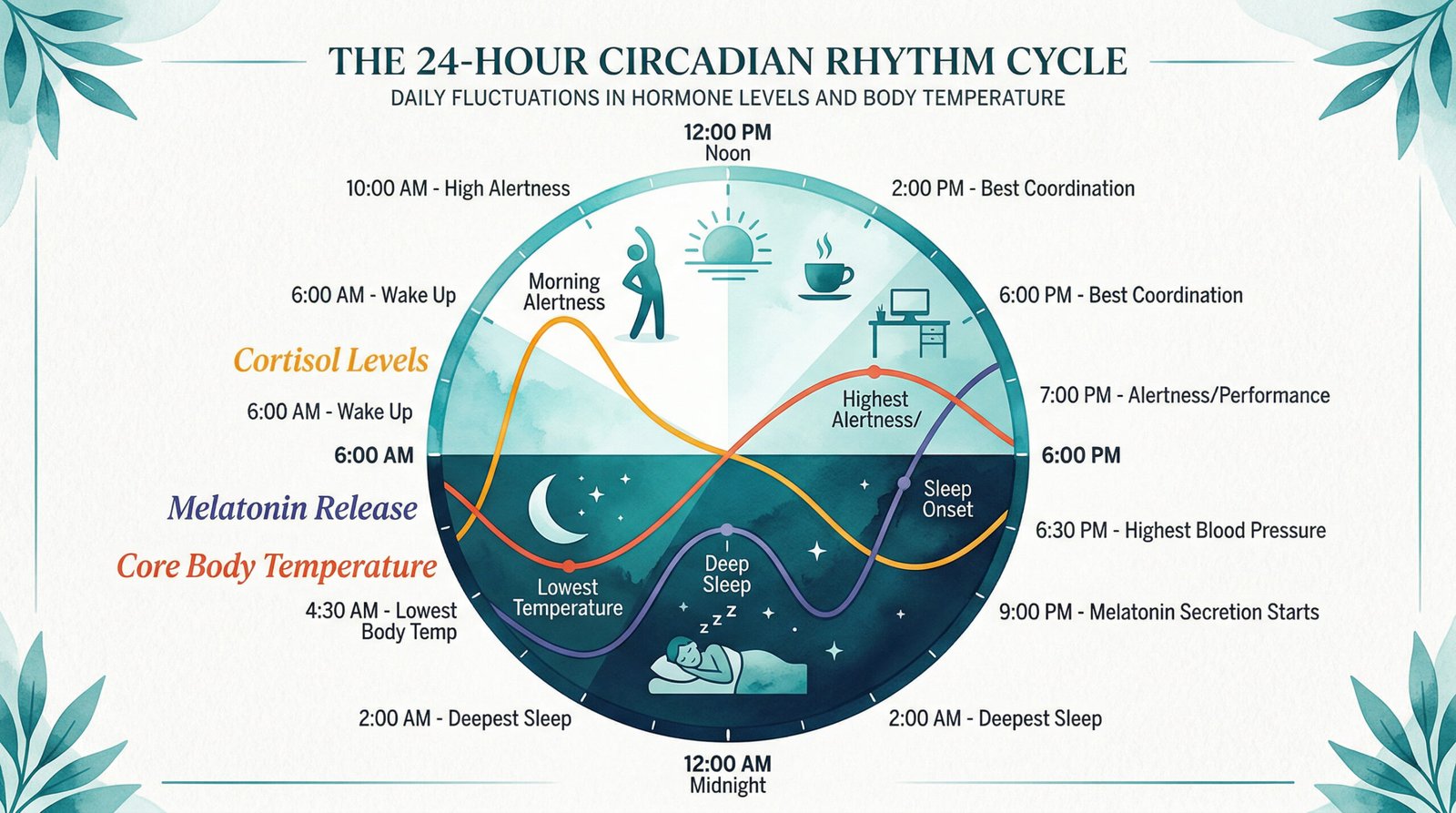
Cortisol and melatonin operate like a see-saw. Cortisol should be highest within 30–45 minutes of waking — this is called the Cortisol Awakening Response (CAR) — then gradually decline through the day. Melatonin does the opposite: near zero during daylight, rising sharply after dark to prepare your body for sleep.
When this rhythm breaks — through late nights, inconsistent wake times, or light exposure at the wrong hours — both hormones shift out of phase. You get cortisol too late in the day (wired at 11pm) and melatonin too early (crashing at 3pm). That’s the biology behind what you’re feeling.
Your body temperature drives your performance window
Core body temperature follows a circadian pattern: lowest in the early morning hours, rising through the morning, peaking around early afternoon, then declining toward evening. Your alertness, reaction time, and cognitive performance all track this curve closely.
A research from Harvard Medical School published in the American Journal of Physiology confirmed that the afternoon energy dip most people experience around 1–3pm corresponds directly to a natural trough in core body temperature — not blood sugar, not dehydration, not laziness. It’s built into your biology. The difference between people who manage it and people who get flattened by it is almost entirely about whether their clock is aligned.
The Fix: 5 Habits That Reset Your Body Clock
None of these require supplements or a new sleep schedule. They work by giving your internal clock the environmental signals it needs to synchronize — the same ones modern life has quietly removed.
1. Get bright light within 10 minutes of waking
Step outside or sit by a bright window for 5–10 minutes within the first 10 minutes of waking up. This triggers the Cortisol Awakening Response properly — setting the biological start of your day. On cloudy days, stay outside longer (20 minutes). This single habit has more impact on energy timing than almost anything else you can do.
Common mistake: checking your phone first. Indoor artificial light is 10–50 times weaker than outdoor light and doesn’t produce the same alerting signal. Phone first, light never — that’s how most people stay misaligned.
2. Keep your wake time consistent — even on weekends
Your body clock is anchored primarily by your wake time, not your sleep time. Varying it by more than 45 minutes on weekends — what researchers call ‘social jetlag’ — resets your clock by hours. You essentially give yourself mild jetlag twice a week.
Common mistake: sleeping in to ‘catch up.’ Sleeping in delays your clock. If you’re tired, go to bed earlier — don’t wake up later. Consistency of wake time is the single most powerful lever you have over your circadian rhythm.
3. Eat your first meal within an hour of waking
Food timing is a secondary clock signal — your digestive system has its own circadian rhythm. Eating within 60 minutes of waking tells your peripheral clocks (gut, liver, muscle) that the day has started and they should be producing energy, not storing it. Skipping breakfast or eating at noon effectively tells your body it’s still early morning.
Common mistake: intermittent fasting timed wrong. Fasting is fine — but push the window earlier, not later. Eating between 8am and 6pm works with your clock. Eating between noon and 8pm works against it for most people.
4. Block blue light after 8pm
Blue light from screens suppresses melatonin production by up to 50%, according to research from Harvard Medical School. After 8pm, use blue-light-blocking glasses or enable Night Shift/Night Mode on all screens. This isn’t about stopping screen use — it’s about giving your melatonin system the darkness signal it needs to start the wind-down on time.
Common mistake: dimming the screen but keeping the same blue spectrum. Dimmer isn’t darker to your retina. You need a warm (orange/amber) shift in color temperature, not just reduced brightness.
5. Take a short walk in the afternoon — don’t fight the dip
The 1–3pm energy trough is real and biological. Fighting it with caffeine after noon delays your melatonin production at night, making tomorrow worse. Instead, use it: a 10-minute walk outside during this window raises body temperature slightly, resets alertness, and gets you a second dose of light that reinforces your clock’s evening wind-down timing.
Common mistake: drinking coffee after 2pm to push through the dip. Caffeine’s half-life is 5–7 hours. A 3pm coffee still has half its stimulant effect at 8–9pm — right when you need melatonin to rise.
Abdellah’s Experience: What Changed for Me
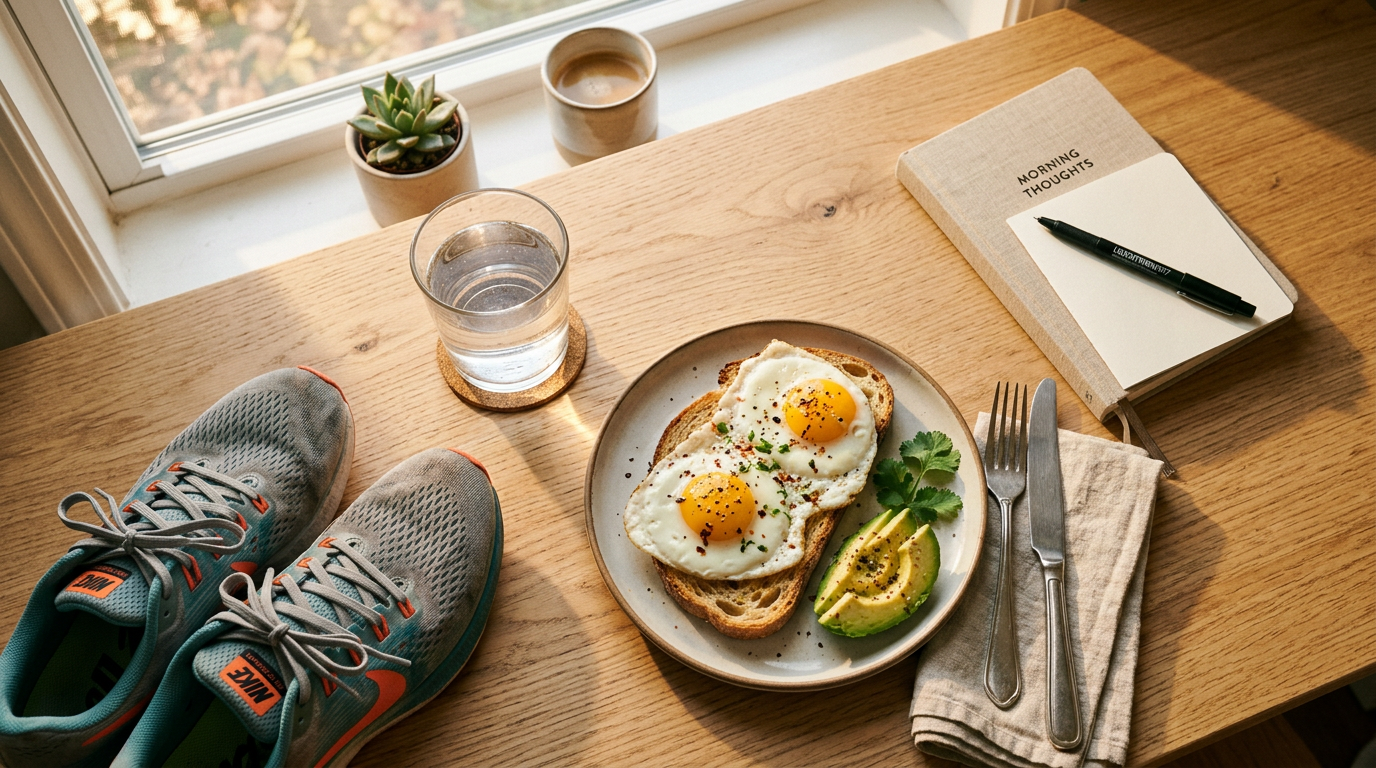
For most of my warehouse years I ran on a completely backwards schedule. I’d get home at 7pm, eat late, scroll until midnight, then wonder why 6am felt like punishment. My ‘solution’ was sleeping in on weekends — which made Mondays even worse than Fridays.
The thing that changed everything was embarrassingly simple: I started going outside within 5 minutes of waking up. Not a walk, not exercise — just standing in the daylight for a few minutes while I drank water. I did that for 5 days. By day 4, I was waking up before my alarm for the first time in years.
I didn’t change my sleep hours. I didn’t take supplements. I just stopped starting my days in the dark.
Your body already knows what time it is. You just stopped giving it the signals to act on it.

Try This for 7 Days (Then Tell Me I’m Wrong)
Don’t overhaul anything. Just add these five inputs to your existing routine for one week:
- Outside light within 10 minutes of waking — even just 5 minutes standing in your doorway
- Same wake time every day — including Saturday and Sunday (within 30 minutes max)
- First meal within 60 minutes of waking — protein preferred
- Blue-light glasses or Night Mode on all screens after 8pm
- A 10-minute walk between 1pm and 3pm — outside if possible
Track one thing each morning: how do you feel when the alarm goes off? Not after coffee — before it. By Day 5 most people notice a difference. Not because these are magic habits. Because they’re the environmental signals your clock was designed to run on — and hasn’t been getting.

The Real Reason You’re Tired Has Nothing to Do With How Much You Sleep
Sleep hours aren’t the problem. Timing is. You can get 8 hours at the wrong phase of your clock and still feel wrecked. And you can function well on 6.5 hours when your biology is actually aligned.
Modern life broke your body clock slowly, one late night and one dark morning at a time. The fix is just as slow — but it only takes one week of consistent signals before your body starts responding.
Want to go deeper? Read: Why You Feel Tired Every Day Even After Rest — it covers the other side of energy management that works hand-in-hand with your body clock.
Table of Contents
Medical disclaimer
This content is for informational purposes only and does not constitute medical advice. Always consult a qualified healthcare professional for personal health concerns.