



You think you’re just lazy. But what if that’s not true at all?
Laziness would explain it if you’d always been this way. But you haven’t. There was a time when things excited you — when you’d stay up late working on something you cared about, or wake up actually wanting to start the day. That person didn’t disappear. Something changed in your brain chemistry.
That something is dopamine. And the way most people are living right now — the phones, the processed food, the screen time, the broken sleep — is quietly draining it every single day.
If you’ve been waking up flat, struggling to care about things you used to enjoy, or feeling like you’re just going through the motions — this article will explain exactly why. And what you can actually do about it.
Why So Many People Feel Unmotivated Every Day
A 2021 review published in Frontiers in Behavioral Neuroscience found that chronic low motivation — the kind where you can’t get yourself to start tasks, where nothing feels exciting anymore — is strongly linked to disrupted dopamine signaling. Researchers noted the condition is increasingly common in modern, high-stimulation environments.
But most people don’t know that. They blame themselves. They try harder. They drink more coffee. And the problem gets worse.
Here’s what low dopamine actually looks like day to day:
- You can start tasks but can’t sustain effort — you quit before finishing
- Things you used to enjoy feel flat or pointless
- You procrastinate even on things you want to do
- You rely on dopamine spikes — junk food, social media, porn — to feel anything
- Your mood is low but not obviously depressed — just… grey
Sound familiar? This isn’t a character flaw. It’s a neurochemistry problem. And it’s fixable.

What’s Actually Happening Inside Your Brain
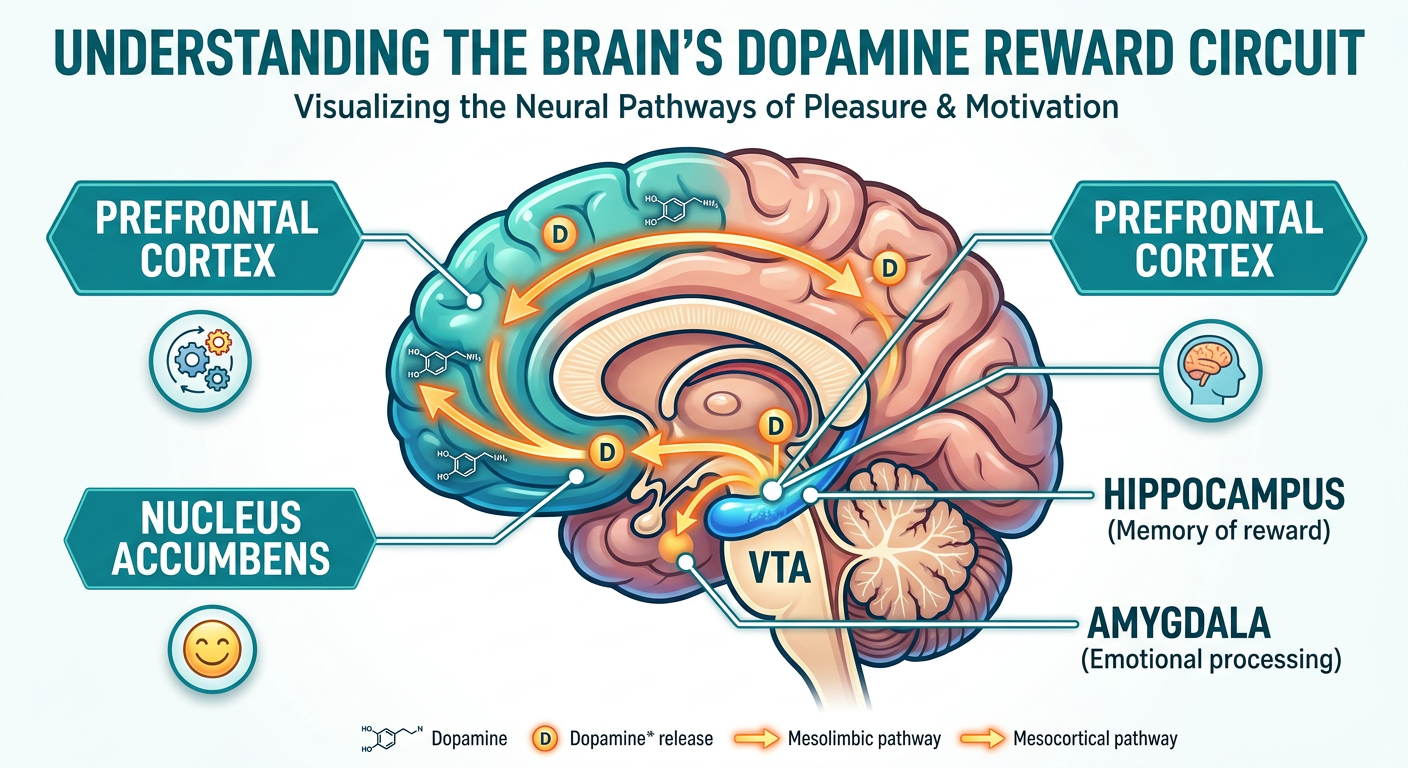
Dopamine is often called the “pleasure chemical.” That label is wrong — and it matters that you understand why. Dopamine isn’t about pleasure. It’s about anticipation and drive. It’s the chemical that makes you want to pursue things. Without it, nothing feels worth the effort.
The dopamine reward loop — and how it breaks
When you do something meaningful — finish a task, eat after hunger, exercise — your brain releases dopamine into a region called the nucleus accumbens. That release reinforces the behavior. Do it again and you get rewarded again. Over time, your brain builds a drive to repeat those actions.
But here’s the problem: dopamine spikes from cheap sources — scrolling, junk food, binge-watching — are bigger and faster than the natural kind. Your brain adapts. It lowers baseline dopamine to compensate. Now normal activities feel boring, and the cheap spikes feel necessary just to feel okay. That’s the loop breaking down.
The prefrontal cortex loses its grip
Dopamine doesn’t just drive motivation — it powers the prefrontal cortex, the part of your brain responsible for planning, focus, and starting tasks. When dopamine is chronically low, the prefrontal cortex goes offline first. That’s why you can’t start things. It’s not weakness. Your brain literally doesn’t have the fuel for forward-thinking action.
A research published in PNAS by Princeton neuroscientists showed that reduced dopamine availability in the prefrontal cortex directly impaired goal-directed behavior — even in subjects with no psychiatric history. You can read more about this mechanism on PubMed.
Chronic stimulation depletes your dopamine baseline
Every time you check your phone hoping for a notification, your brain releases a tiny burst of dopamine. Do that 200 times a day — which most smartphone users do — and your baseline drops because your receptors downregulate to cope with the constant hits. I’m not 100% sure this affects everyone at the same rate, but the mechanism is well-documented.
The result: real-world things — work, relationships, exercise — feel grey and effortless compared to the artificial spikes. Your motivation system isn’t broken. It’s been hijacked.
The Fix: 5 Habits That Rebuild Your Dopamine Naturally
None of these require a prescription. They don’t cost anything. They work because they address the root — not the symptoms.
1. Do a dopamine fast from cheap sources
For 48–72 hours, remove the things giving you fast, easy dopamine hits: social media, video games, junk food, Netflix binges. This isn’t about willpower — it’s about letting your downregulated receptors recover their sensitivity. You’ll feel worse before you feel better. That discomfort is the withdrawal. It passes by day 2.
Common mistake: trying to replace one screen with another. No YouTube ‘as a break.’ Nothing that delivers stimulation passively. Read, walk, cook — boring is the point.
2. Exercise before your first dopamine spike of the day
A 20-minute walk or workout — before you check your phone — produces a dopamine release plus BDNF (brain-derived neurotrophic factor), which literally grows new dopamine receptor connections. You’re not just boosting dopamine; you’re rebuilding the system that produces it. Do this before any screens.
Common mistake: exercising after hours of scrolling. At that point your baseline is already suppressed. Morning first is what makes the difference.
3. Build a completion loop with small wins
Dopamine releases most powerfully in anticipation of a reward — and again when you complete something. Set tiny, finish-able tasks first thing: make your bed, write 3 sentences, complete one email. Each completion triggers a small release. Stack 3–4 of these and your brain is primed for harder tasks.
Common mistake: starting with your hardest task when motivation is zero. You’ll quit and feel worse. Small wins first, always.
4. Eat for dopamine production — not just calories
Dopamine is synthesized from tyrosine and phenylalanine, two amino acids found in protein. Eggs, chicken, fish, beef, dairy, and legumes are all solid sources. If your breakfast is a pastry and a coffee, your brain has almost no raw material to produce dopamine by 10am.
Common mistake: high-sugar breakfasts. The blood sugar spike crushes dopamine sensitivity for 2–3 hours afterward. Protein first, every morning.
5. Use sunlight and cold exposure as natural primers
Ten minutes of morning sunlight increases dopamine receptor density over time — not just serotonin. Cold showers produce a significant dopamine spike that lasts 2–3 hours, according to research from the Huberman Lab at Stanford. Neither of these is comfortable. That’s exactly why they work: the mild stress triggers the dopamine response.
Common mistake: doing cold exposure after your warm shower out of habit. Cold-only or cold-finish. The shock is the mechanism.
Abdellah’s Experience: What Changed for Me
I spent nearly a year in a weird grey zone — not depressed, just completely flat. Every morning I’d scroll for 40 minutes before getting up. Every evening I’d eat whatever and watch something until 1am. I wasn’t lazy. I was just never really present for my own life.
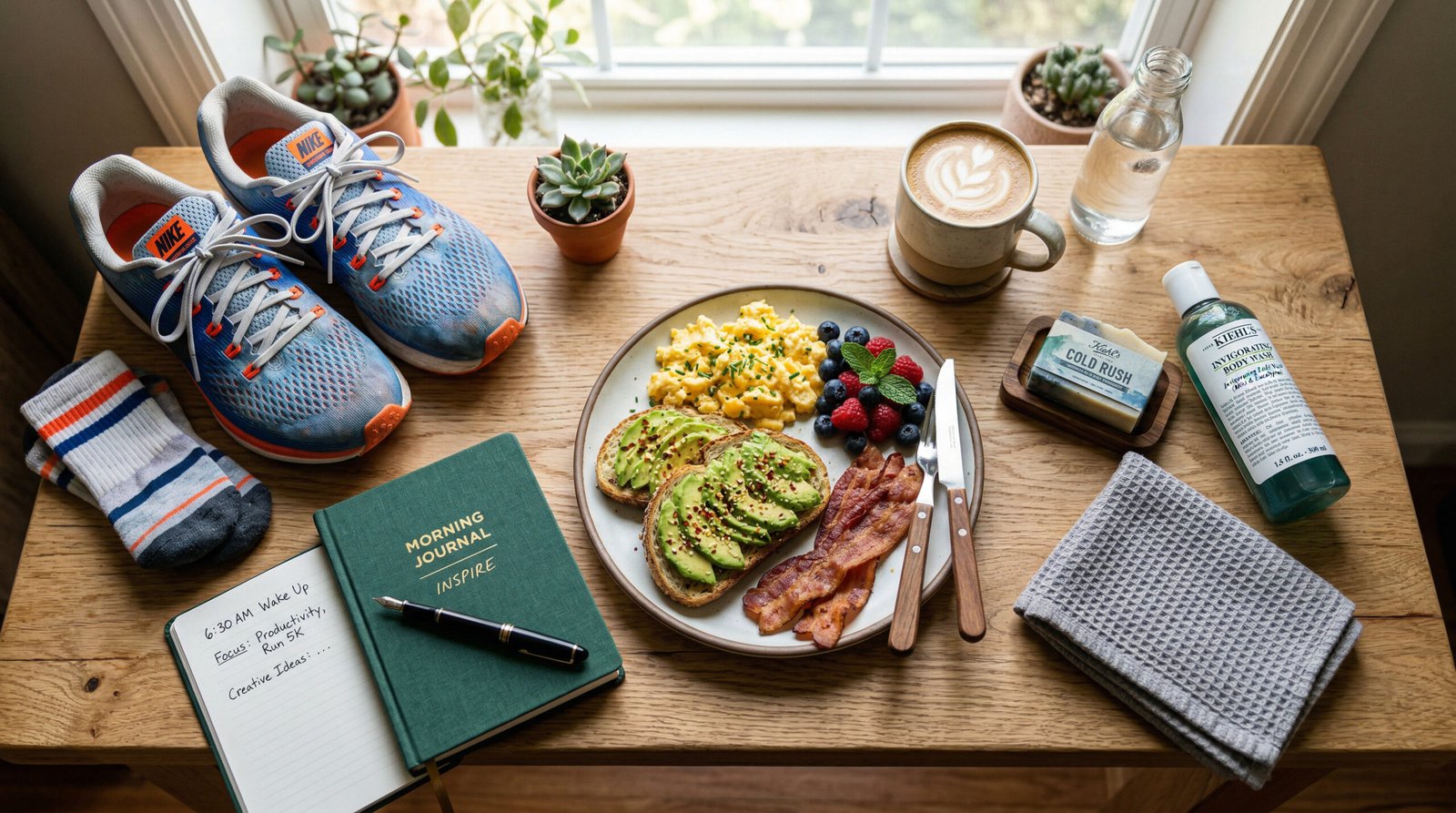
The change started when I cut social media from 7am–12pm and added a 15-minute walk before looking at anything. Within 4 days, I noticed I was actually looking forward to the walk. That hadn’t happened in months. Then I swapped my sugary breakfast for eggs, and by day 6 I was starting work tasks without dreading them.
It wasn’t one big thing. It was closing the leaks one by one.
My motivation didn’t come back. I stopped stealing it from my future self every morning.
Try This for 7 Days (Then Tell Me I’m Wrong)
Don’t change everything. Just run this protocol for one week and track how you feel on Day 1 vs Day 7:
- No social media, YouTube, or streaming until noon — every day
- 20-minute walk or workout before touching your phone — every morning
- Protein breakfast — eggs, Greek yogurt, anything with 20g+ protein
- 3 small completion tasks before starting your main work
- 10 minutes of sunlight within 30 minutes of waking
Note how you feel each morning when you wake up. Specifically: is there any pull toward starting the day? That feeling — even faint — is your dopamine baseline rising.

The Real Reason You Feel Unmotivated Has Nothing to Do With Willpower
You were never missing discipline. You were missing dopamine — and you were unknowingly draining it every morning before the day even started. The hard truth is that modern life is perfectly designed to keep your baseline low and your dependency on cheap spikes high.
Change the inputs, and the drive comes back. It’s not magic — it’s neurochemistry. And it’s in your control.
Want to go deeper? Read: How to Sleep Better Naturally (Without Medication) — it covers how sleep debt crushes dopamine production overnight, and how 2 changes fixed mine.
Table of Contents
Medical disclaimer
This content is for informational purposes only and does not constitute medical advice. Always consult a qualified healthcare professional for personal health concerns.