



You think you’re just tired.
But what if tired is only half the story? What if the six hours you’ve been sleeping most nights isn’t just leaving you groggy — it’s actively dismantling your ability to focus, remember things, and make clear decisions?
Most people accept mental fog as the price of a busy life. They drink more coffee, push through, and assume the weekend will fix it. It won’t. And the longer this goes on, the worse the damage gets — not metaphorically, but physically, inside your brain.
Why So Many People Are Running Their Brain on Empty
Sleep deprivation is not a badge of hustle. It’s a public health crisis hiding in plain sight. According to the CDC, more than one in three adults in the US regularly sleep less than the recommended 7 hours per night. And a 2023 Gallup survey found that nearly 1 in 4 Americans say they rarely or ever wake up feeling rested.
The problem is that the effects creep in slowly. You don’t notice your thinking getting worse day by day. You just start making worse decisions, forgetting more things, and feeling less sharp — and you assume that’s just what adult life feels like.
It doesn’t have to. Check how many of these apply to you:
- You forget what you were doing within seconds of being interrupted
- Simple decisions feel harder than they should — even small ones
- You read a paragraph and immediately have no idea what it said
- Your mood drops fast and your patience runs thin by mid-afternoon
- You feel mentally sluggish even on days when you’re not physically tired
If three or more of those hit home, sleep quality — not workload, not stress — is likely the primary culprit. And this is fixable.

What’s Actually Happening Inside Your Brain
Sleep isn’t downtime. While you’re unconscious, your brain is running a maintenance cycle that determines how well you think the next day — and every day after that. Skip it, and the consequences aren’t just about feeling tired.
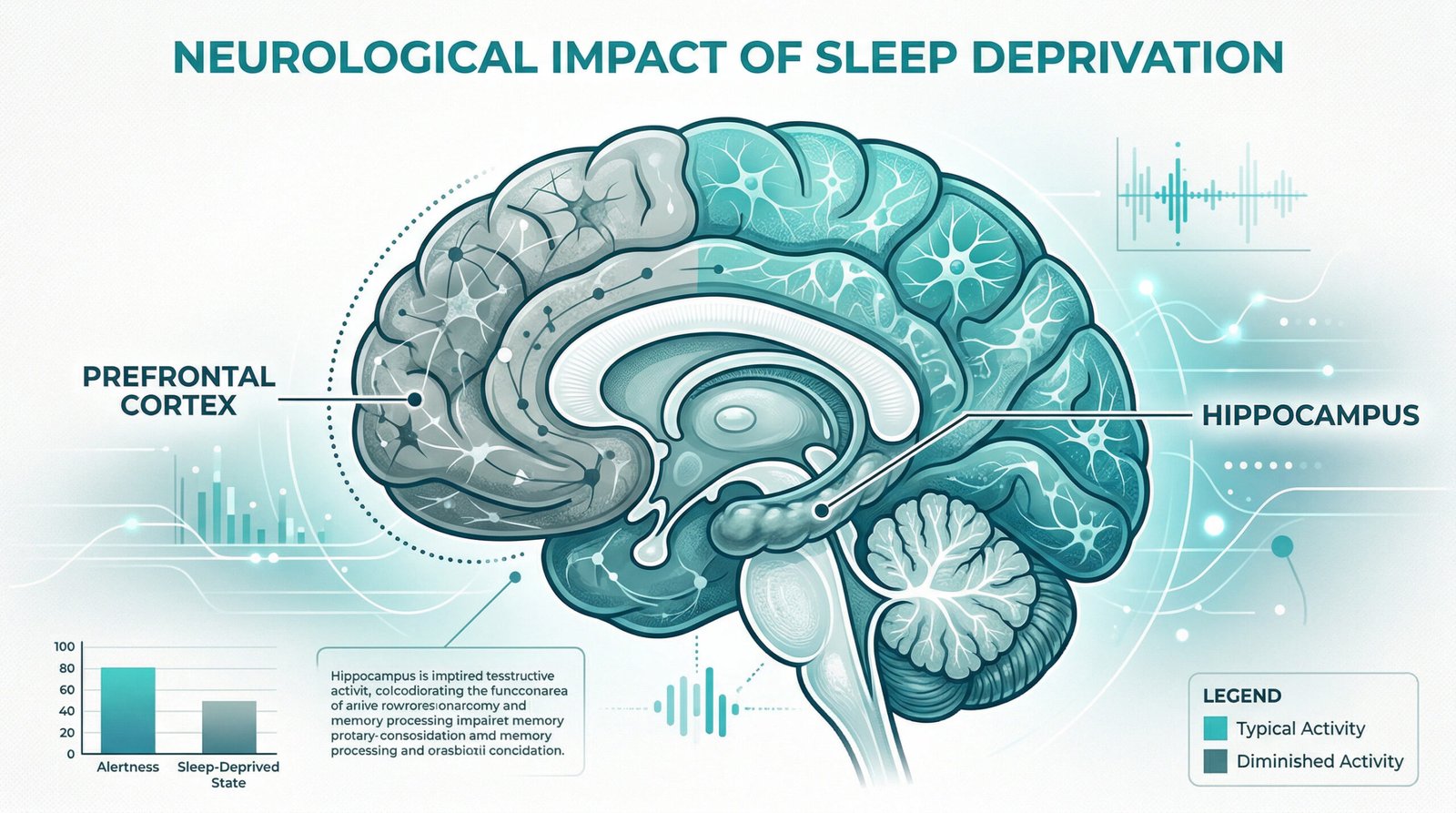
Your prefrontal cortex shuts down first
The prefrontal cortex is the part of your brain responsible for reasoning, decision-making, impulse control, and planning. It’s also the region most sensitive to sleep loss.
A 2025 review published in PMC (National Institutes of Health) found that even partial sleep deprivation measurably reduces prefrontal cortex activity — impairing sustained attention, cognitive flexibility, and the ability to inhibit impulsive responses. In plain terms: less sleep means your brain’s command center goes offline before the rest of you does.
And here’s what most people miss: this doesn’t only happen after an all-nighter. Sleeping 6 hours instead of 8 for just five consecutive nights produces the same level of cognitive impairment as 24 hours of total sleep deprivation.
Memory consolidation happens only while you sleep
Everything you learn and experience during the day gets stored as a temporary file. During sleep — specifically during deep NREM and REM stages — your brain transfers those files into long-term memory. Miss the sleep, miss the transfer.
A 2024 study published in PNAS (Proceedings of the National Academy of Sciences) found that sleep deprivation disrupts the prefrontal cortex’s ability to suppress and manage unwanted memories — meaning your brain not only stores new information less effectively, it also loses control over which memories resurface and when.
That’s why a poorly slept version of you can’t remember your colleague’s name from yesterday’s meeting — but keeps replaying an argument from three years ago.
Your brain builds up toxic waste when you skip sleep
This one surprised me the most when I first read it. During sleep, your brain activates a waste-clearance system called the glymphatic system. It flushes out metabolic byproducts that build up during waking hours — including beta-amyloid, the same protein linked to cognitive decline in Alzheimer’s disease. When you cut sleep short, this cleaning cycle gets interrupted. Waste accumulates. And while a single bad night won’t cause lasting damage, chronic short sleep means chronic incomplete cleaning. Over months and years, that adds up to a brain that’s slower, foggier, and more prone to cognitive errors.
The Fix: Four Habits That Actually Improve Sleep Quality
None of these are about sleeping more hours. They’re about sleeping better in the hours you have — and removing the most common things that silently destroy sleep quality without you realizing it.
1. Stop using your phone for 45 minutes before bed
This is the single most impactful change most people can make right now. Blue light from screens suppresses melatonin production — the hormone that signals to your brain it’s time to sleep. But the bigger issue isn’t the light. It’s the mental stimulation.
Reading or scrolling before bed keeps your prefrontal cortex active at exactly the moment it needs to wind down. Swapping 45 minutes of screen time for reading a physical book, stretching, or just lying in the dark cuts sleep onset time and dramatically increases deep sleep duration for most people.
Common mistake: switching to ‘night mode’ or lowering screen brightness and thinking that fixes it. The light is a secondary issue. It’s the stimulation that’s the real problem.
2. Keep your wake time the same every day — including weekends
Your body runs on a circadian clock — a biological timer that regulates when you feel alert and when you feel drowsy. That clock is anchored to your wake time, not your bedtime. When you sleep in on weekends, you shift the clock forward and create what sleep researchers call social jetlag.
Pick a wake time and hold it every single day, including Sundays. Within 7–10 days, you’ll find that you start feeling genuinely tired at a consistent bedtime — because your body has locked on to the rhythm. I’m not 100% sure this feels easy for everyone at first, but the shift in sleep quality once it clicks is significant.
Common mistake: sleeping in on weekends to ‘catch up’ on sleep. You can’t bank sleep in advance and you can’t meaningfully repay a sleep debt this way — you only delay the problem.
3. Keep your bedroom below 19°C (66°F)
Your core body temperature needs to drop by 1–2°C to initiate deep sleep. A warm room fights that process directly. Most people sleep in rooms that are 2–4 degrees too warm without realizing it.
Open a window, use a fan, or turn down the heating an hour before bed. If you share a bed with someone who runs warm, try a lighter duvet and let the room do the work. A cool room is one of the fastest, no-cost improvements most people can make to their sleep quality.
4. Cut caffeine after 1pm — not after 3pm
Caffeine has a half-life of 5–7 hours. A coffee at 3pm still has half its caffeine in your system at 9pm. But most people don’t realize that caffeine also blocks adenosine receptors — adenosine is the chemical that builds up during the day to create sleep pressure.
Blocking it with afternoon coffee means you fall asleep fine but get less slow-wave deep sleep — the most restorative stage. You don’t feel the difference in how fast you fall asleep. You feel it in how sharp you are the next morning. Shifting the caffeine cutoff to 1pm is the most underrated sleep fix there is.

Abdellah’s Experience: What Changed for Me
I used to do rotating shifts. Early starts, late finishes, the occasional overnight. Sleep was something I grabbed in whatever gap appeared — 5 hours here, 9 hours there, phone in hand until I passed out.
I assumed I just had a bad memory and was naturally disorganized. I’d walk into a room and forget why. I’d lose the middle of a sentence while I was still speaking it. I blamed stress, screen time, everything except the obvious thing.
Two changes made the biggest difference: a fixed 6am wake time every day without exception, and no phone after 9:30pm. That’s it. Within two weeks, the mental fog lifted. Not fully — but enough to notice that thinking clearly was actually possible for me.
The problem was never my brain. It was never giving my brain the conditions it needed to work.

Try This for 7 Days (Then Tell Me I’m Wrong)
Don’t overhaul your life. Just run these four rules for one week:
- Set a fixed wake time and hold it every day — including the weekend. Pick a time that’s realistic, not aspirational.
- No phone or screen 45 minutes before bed. Replace it with anything analog: a book, a stretch, sitting in the dark.
- Last caffeine of the day: 1pm. Not 2pm. Not 3pm. 1pm.
- Cool your bedroom down by at least 2 degrees before you sleep. Open a window or use a fan.
Keep a two-line note each morning: how did you sleep and how sharp does your thinking feel? Compare Day 1 vs Day 7. Most people notice a measurable shift before the week is done — not because these habits are complicated, but because most sleep problems come from just a few consistent, fixable mistakes.

The Real Reason Your Brain Feels Like It’s Working Against You
It’s not age. It’s not how demanding your job is. It’s not your phone — at least not in the way you think. It’s that you’ve been giving your brain a fraction of the maintenance it needs, consistently, for a long time.
Sleep and cognitive performance aren’t two separate topics. Your thinking ability is a direct output of your sleep quality. Fix the sleep, and the sharpness follows. Want to go deeper on the fuel side? Read: protein and cognitive performance — it covers exactly what to eat before your most demanding hours to give your brain the raw materials it needs to run at full capacity.
Table of Contents
Medical disclaimer
This content is for informational purposes only and does not constitute medical advice. Always consult a qualified healthcare professional for personal health concerns.