



You think you’re tired because you’re getting older. And maybe that’s partly true. But here’s what most people don’t realize: the fatigue, the slower recovery, the brain fog that starts creeping in after your mid-30s — that’s not just age. That’s your cells running out of fuel.
There’s a molecule inside every single one of your cells called NAD+. It powers your mitochondria, repairs your DNA, and keeps the energy systems in your body running efficiently. And from around age 30, your body produces roughly 50% less of it every decade.
NMN — nicotinamide mononucleotide — is the compound your body uses to make NAD+. And in the last five years, it’s gone from obscure longevity research to one of the most studied supplements in cellular biology. This article explains the real mechanism, what the research actually shows, and what you can do about it — without spending a fortune or believing the hype blindly.
Why So Many People Feel Old Before Their Time
A large review published in Nature Metabolism confirmed that NAD+ levels decline consistently with age across multiple tissue types in humans — and that this decline correlates directly with reduced mitochondrial function, increased DNA damage, and slower cellular repair.
What makes this frustrating is that most of the symptoms feel like normal aging — so people accept them. They shouldn’t. The cellular decline driving these symptoms is measurable, and in many cases, it’s reversible.
Does any of this sound like your last 12 months?
- Energy that used to come easily now requires caffeine just to get started
- Recovery after exercise takes noticeably longer than it did 5 years ago
- Mental sharpness that fades faster — harder to focus, harder to retain information
- Sleep that doesn’t feel as restorative even when the hours are there
- A general sense that your body is working harder to do the same things
None of this is inevitable. And it starts at the cellular level — which means that’s where the fix has to start too.

What’s Actually Happening Inside Your Body
NAD+ isn’t a supplement trend. It’s a coenzyme that’s been essential to life for billions of years. Understanding what it does — and why losing it matters — requires a quick look at three biological processes that depend on it directly.
NAD+ is the fuel your mitochondria can’t work without
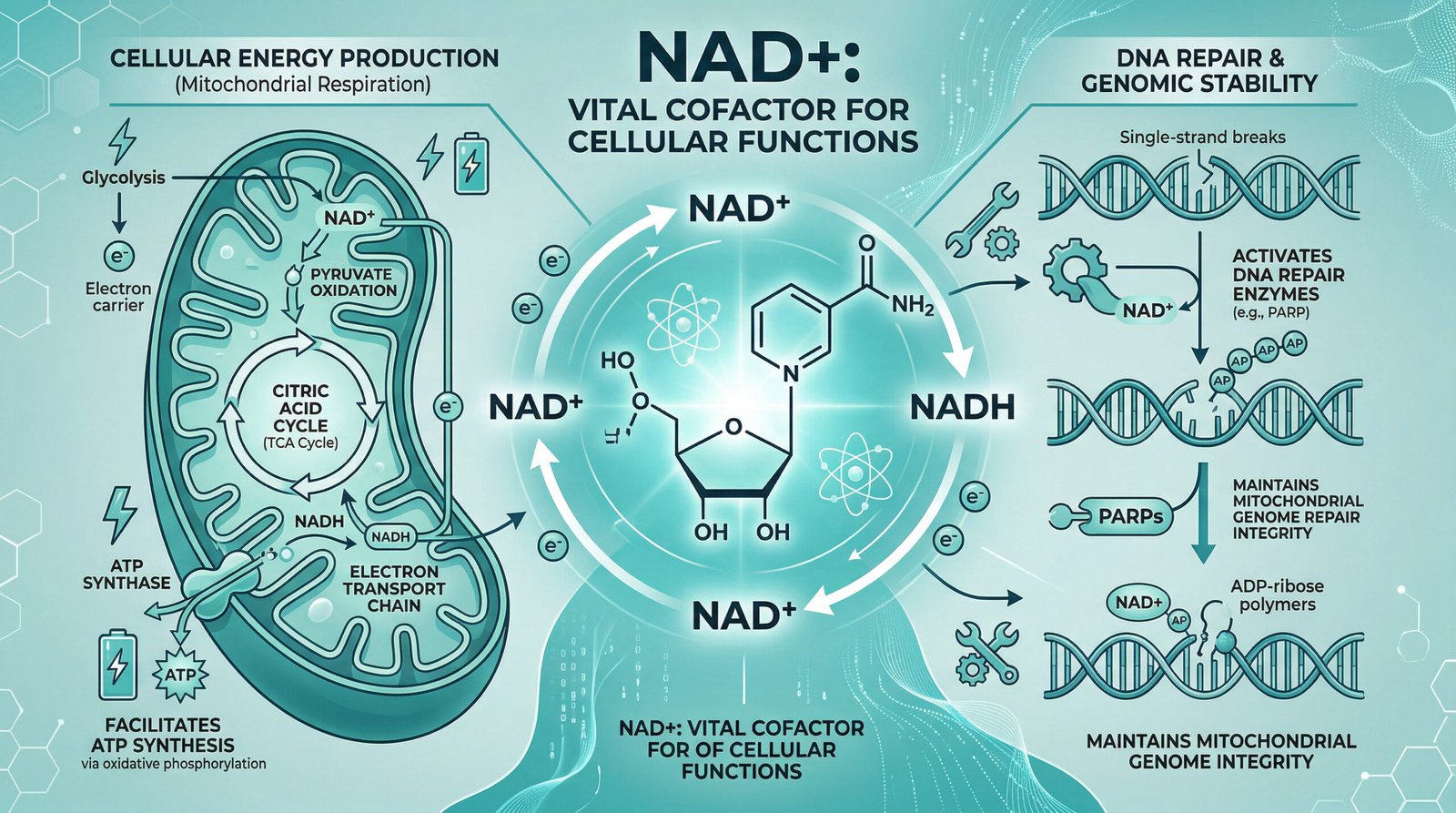
Your mitochondria — the energy-producing structures inside your cells — convert food into ATP, the actual currency of cellular energy. NAD+ is a critical electron carrier in this process. Without sufficient NAD+, the electron transport chain slows down, ATP production drops, and you feel it as physical fatigue and mental sluggishness.
This is not a subtle effect. A 2020 study in Cell Metabolism showed that restoring NAD+ levels in aged mice reversed mitochondrial dysfunction to levels comparable with much younger animals. The human research is earlier-stage, but the mechanism is identical — NAD+ is the rate-limiting factor in how well your cells produce energy.
NAD+ activates the proteins that repair your DNA every day
Every day, your DNA sustains thousands of small breaks and errors from UV exposure, oxidative stress, and normal metabolic activity. A group of proteins called sirtuins and PARPs are responsible for repairing this damage — and both require NAD+ to function.
When NAD+ levels fall, these repair proteins slow down. Damaged DNA accumulates faster than it gets fixed. This is one of the primary mechanisms behind accelerated cellular aging — and it’s directly linked to the NAD+ decline that starts in your 30s. A 2013 paper in Science by David Sinclair’s lab at Harvard first demonstrated this NAD+-sirtuin-DNA repair connection, and it’s been replicated multiple times since.
NMN is the precursor — and why it matters more than NAD+ supplements
Here’s the part most supplement marketing gets wrong. You can’t just take a NAD+ supplement and expect it to raise your cellular NAD+ levels — NAD+ molecules are too large to cross cell membranes directly. Your cells have to synthesize NAD+ from smaller precursors inside the cell. NMN is one of those precursors. It enters cells via a specific transporter (recently identified in a 2019 paper in Nature Metabolism) and gets converted to NAD+ inside the cell where it’s actually needed. NR (nicotinamide riboside) works similarly. Both are more bioavailable routes to raising intracellular NAD+ than NAD+ itself. I’ll be honest — the human research is still catching up to the animal studies, but the early clinical trials are directionally consistent.
The Fix: 4 Ways to Raise Your NAD+ Levels That Actually Work
There’s a spectrum here from free to expensive. The good news is the free options work — and they should come before any supplement. But if you want to go further, NMN supplementation has earned enough clinical evidence to be worth discussing honestly.
1. Exercise — especially resistance training and HIIT
Exercise is the most potent free NAD+ booster available. Both resistance training and high-intensity interval training activate AMPK, an enzyme that upregulates NAD+ biosynthesis pathways — specifically the salvage pathway that recycles NAD+ precursors already in your cells.
A 2022 study in Cell Reports Medicine found that 12 weeks of exercise significantly raised NAD+ levels in skeletal muscle in middle-aged adults, independent of any supplementation. Three sessions per week of 30–45 minutes is sufficient to produce measurable effects within 8–10 weeks.
Common mistake: doing only cardio. Resistance training produces a stronger NAD+ biosynthesis signal than steady-state aerobic exercise. You need both, but don’t skip the weights.
2. Eat foods that contain NAD+ precursors
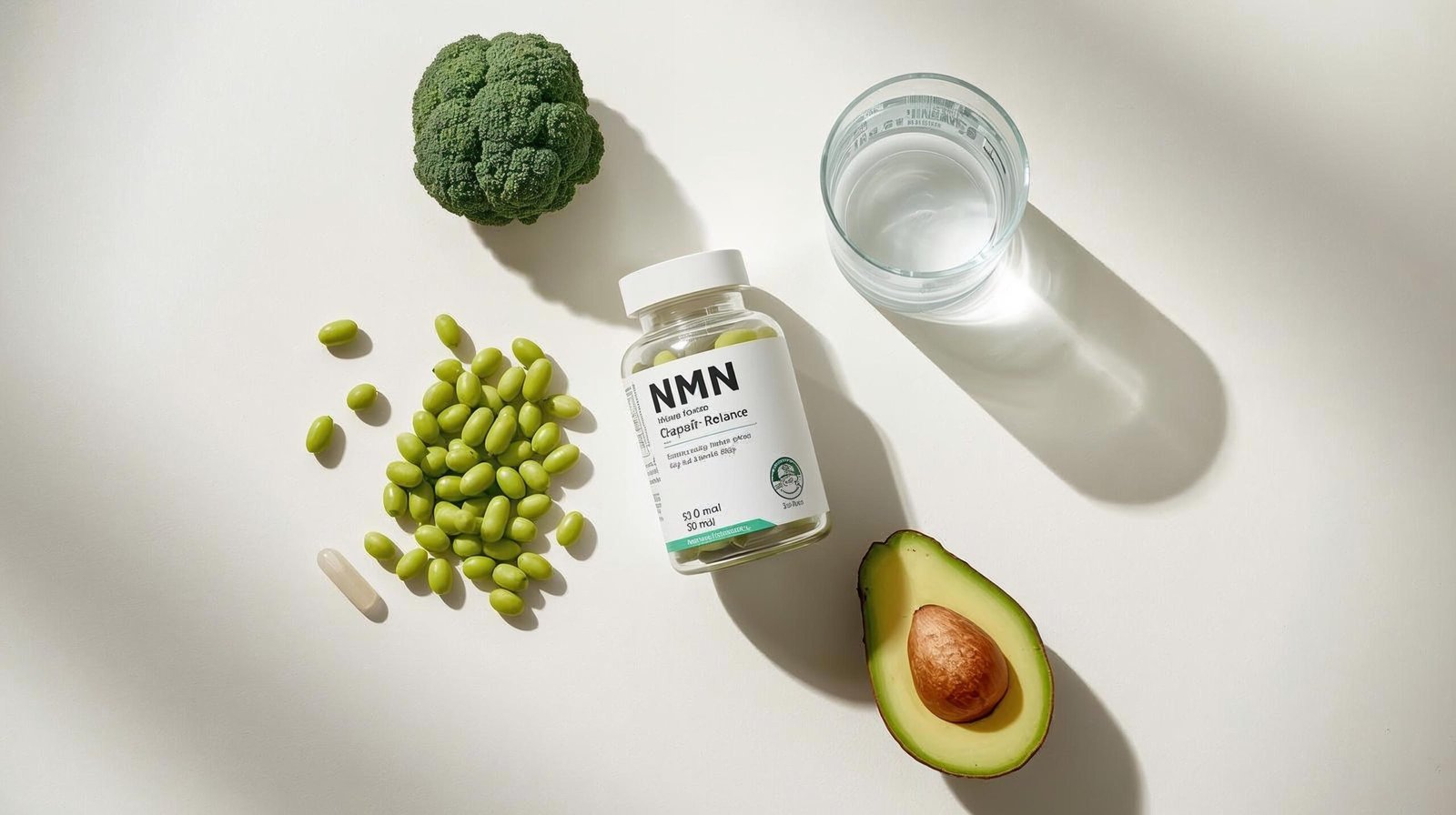
Several whole foods are meaningful dietary sources of NAD+ precursors — specifically niacin (vitamin B3) and tryptophan, both of which feed into NAD+ synthesis pathways. The richest sources are edamame, broccoli, avocado, mushrooms, chicken, tuna, and beef.
These aren’t magic doses — you won’t raise NAD+ dramatically through food alone. But a diet consistently rich in these foods maintains the baseline your cells work from. Deficiency in B3 specifically is a fast route to accelerated NAD+ decline at any age.
Common mistake: ignoring diet and relying on supplements. Supplements work better when your nutritional baseline is already solid. They amplify what’s there — they don’t replace what’s missing.
3. Reduce alcohol and ultra-processed food intake
Alcohol is one of the most efficient NAD+ depleting substances in common use. The enzyme that metabolizes alcohol — alcohol dehydrogenase — consumes NAD+ as a cofactor. Heavy or regular drinking can reduce intracellular NAD+ by up to 30–40% in liver cells, which then cascades into systemic effects.
Ultra-processed foods cause similar downstream damage through oxidative stress and chronic low-grade inflammation — both of which increase PARP activation, consuming NAD+ for DNA repair faster than your cells can replenish it. Reducing these two inputs is, mechanistically, identical to supplementing — it stops the unnecessary drain.
Common mistake: taking NMN while continuing to drink regularly. The supplement is trying to fill a bucket that has a hole in it. Fix the hole first.
4. Consider NMN supplementation — but understand what you’re actually buying
The human clinical evidence for NMN is early but directionally positive. A 2021 randomized controlled trial published in npj Aging and Mechanisms of Disease found that oral NMN supplementation raised blood NAD+ metabolite levels significantly compared to placebo in healthy adults aged 65+, with improvements in gait speed and muscle strength as secondary outcomes.
A typical studied dose is 250–500mg per day, taken in the morning with or without food. Sublingual forms may have slightly higher bioavailability than capsules, though the evidence on this is mixed. Expect to spend 6–8 weeks before noticing anything measurable — this is cellular repair, not a stimulant.
Common mistake: buying cheap NMN from unknown manufacturers. Third-party testing matters here. Look for brands that publish a Certificate of Analysis (COA) from an independent lab — purity and dosage accuracy in NMN supplements varies enormously.
Abdellah’s Experience: What Changed for Me
I started looking into NMN after a rough stretch at the warehouse — I was 32, physically active, but recovering from shifts like I was 50. Sleep didn’t restore me the way it used to. I’d finish a week and feel genuinely depleted for two days after.
I added 300mg of NMN every morning for 60 days, alongside cutting alcohol to weekends only and adding two resistance sessions per week. I didn’t change my diet dramatically or sleep schedule.
By week 5, recovery between shifts improved noticeably. By week 8, I was finishing back-to-back days without the same crash. Was it the NMN alone? Honestly, I can’t say. The resistance training almost certainly helped. But the combination felt different from anything I’d tried before.
Your cells don’t care what you believe. They respond to what you actually give them.

Try This for 30 Days (Then Tell Me I’m Wrong)
This one needs a longer window than 7 days — cellular repair is slow. But 30 days is enough to notice a measurable shift if you do all four together:
- Exercise 3x per week — at least 2 sessions must include resistance training (bodyweight counts)
- Add one NAD+ precursor food to at least 2 meals per day: edamame, broccoli, avocado, mushrooms, or tuna
- Cut alcohol to a maximum of 2 drinks per week for the full 30 days
- Optional: 250–300mg NMN each morning from a third-party tested brand
Track two things at Day 1 and Day 30: your subjective energy level during work (1–10), and how many days per week you feel genuinely recovered after sleep. Don’t track weight or aesthetics — those aren’t the signals here. You’re looking for cellular energy output. And that feeling is distinct once you know what you’re looking for.

The Real Reason You Feel Older Than You Should
It’s not the years. It’s the fuel. Your cells are running low on a molecule that controls energy production, DNA repair, and mitochondrial function — and most people have no idea it’s even happening, let alone that it’s addressable.
NMN and NAD+ aren’t magic. They’re biology. The research is real, the mechanism is real, and the interventions are specific enough that you can test them on yourself in 30 days and know whether they’re working.
But supplements come last. Exercise, diet, and removing the NAD+ drains come first. Stack in that order and the results are compounding — not just additive.
Want to understand how your gut connects to cellular energy? Read: Your Gut Is Running Your Brain —how the gut-brain axis affects your daily energy.
And if recovery and deep sleep are part of your energy problem: You’re Sleeping 8 Hours But Recovering Zero — how to get more deep sleep.
Table of Contents
Medical disclaimer
This content is for informational purposes only and does not constitute medical advice. Always consult a qualified healthcare professional for personal health concerns.