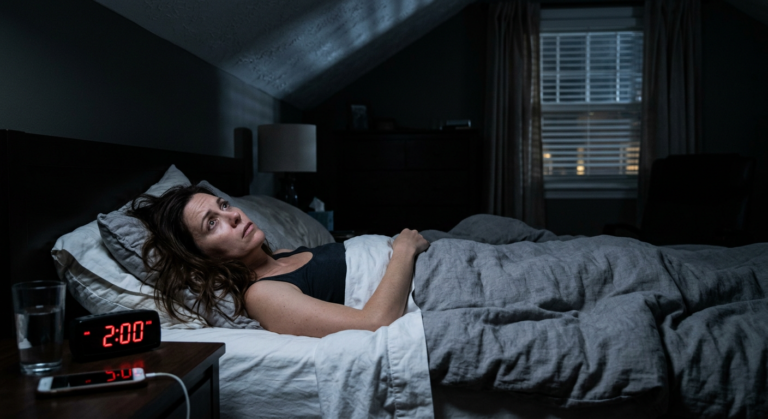



You already know that bad sleep makes you tired. That part’s obvious. But here’s what nobody mentions: every night you sleep poorly, you’re wiping out the bacteria responsible for your mood, your focus, and your emotional resilience.
You think the problem is in your head — the anxiety, the irritability, the flat feeling that won’t lift no matter how much coffee you drink. But what if the problem started 6 hours earlier, in your gut, while you were lying awake at 2am staring at the ceiling?
The connection between sleep, gut bacteria, and mood is one of the most underreported findings in modern health research. And once you understand the mechanism, you can’t un-see it. This article is going to be uncomfortable. It might also change how you think about sleep forever.
Why So Many People Feel Worse After a Bad Night Than They Expect
According to the Sleep Foundation, roughly 35% of adults don’t consistently get the recommended 7–9 hours of sleep per night. And most of them think the consequences stop at tiredness and low productivity.
They don’t. A 2019 study in the journal Molecular Metabolism found that even two consecutive nights of shortened sleep measurably reduced gut microbiome diversity in healthy adults. Less diversity means fewer bacteria producing serotonin, fewer bacteria fighting inflammation, and a gut that starts sending distress signals straight to your brain.
Here’s what that actually feels like day-to-day. How many of these sound familiar?
- Waking up already anxious — before anything has gone wrong
- Irritability that hits hard in the morning and won’t fully clear
- Cravings for sugar and junk food that feel impossible to fight
- Digestive discomfort — bloating, urgency, or an unsettled stomach in the morning
- Mood that’s flat or unstable with no obvious emotional cause
These aren’t random. They’re symptoms of a destabilized gut-brain axis — and they’re all fixable.

What’s Actually Happening Inside Your Body
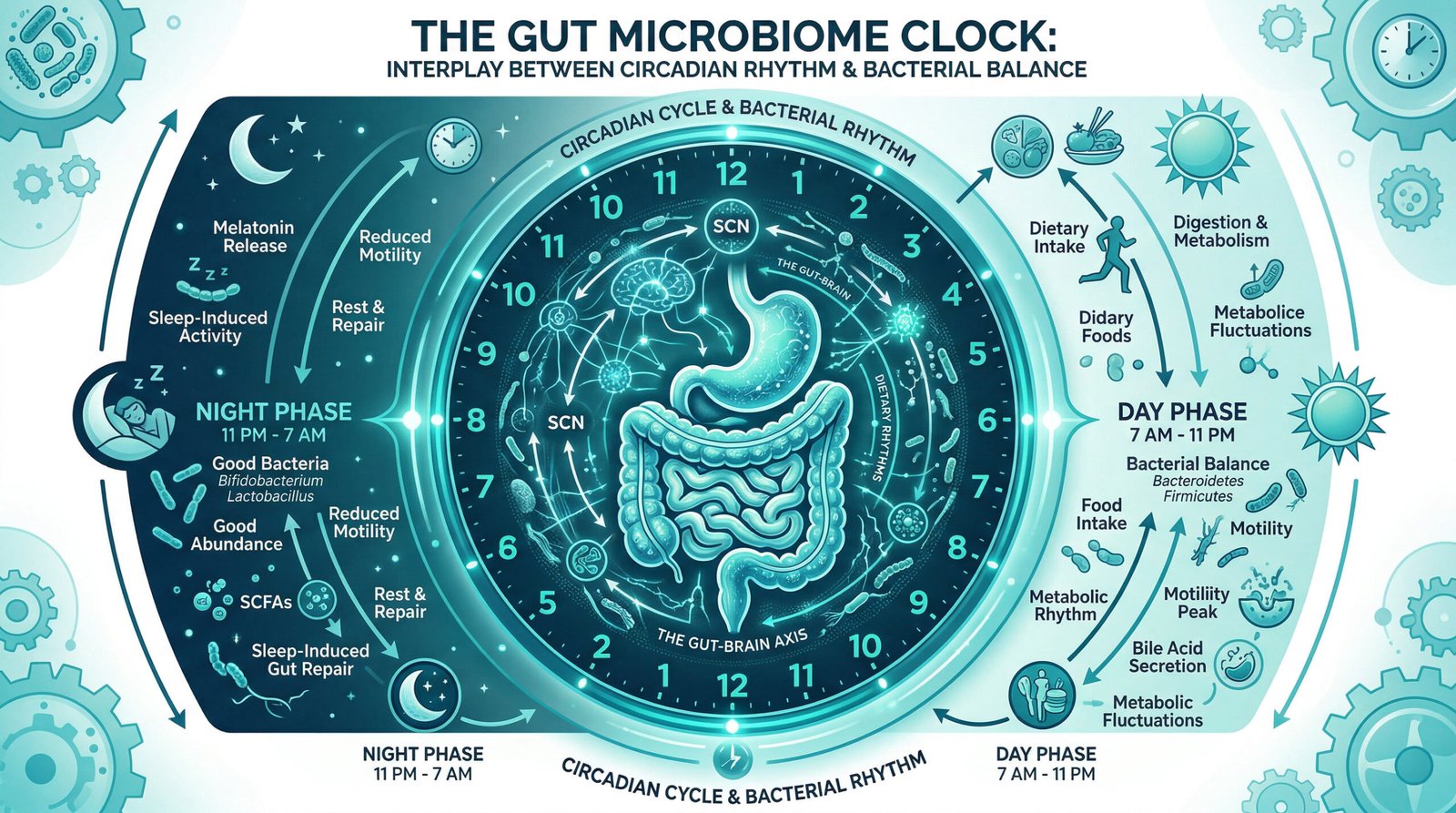
Sleep isn’t a passive rest state for your gut. It’s an active repair window. While you sleep, your gut microbiome follows its own circadian rhythm — certain bacteria multiply, others reduce inflammation, and the gut lining regenerates. Disrupt that window and the whole system goes off schedule.
Your gut bacteria run on a clock — and sleep breaks it
Your microbiome has its own circadian rhythm, tightly synced to your sleep-wake cycle. A 2016 landmark study in Cell showed that gut bacteria shift composition, location, and function in 24-hour cycles. They move toward the gut wall at night to repair the lining, then retreat in the morning.
When you sleep late, sleep poorly, or shift your sleep schedule across the week, that bacterial rhythm falls out of sync. The repair process gets interrupted mid-way. The gut lining — which is only one cell thick — ends up more permeable than it should be. This is the starting point of leaky gut, and it begins with nothing more than irregular sleep.
Sleep loss directly reduces the bacteria that produce serotonin and GABA
Two of the most important mood-regulating neurotransmitters — serotonin and GABA — are heavily influenced by gut bacteria. Specific strains like Lactobacillus and Bifidobacterium stimulate their production. And these exact strains are among the most sensitive to sleep disruption.
A 2021 meta-analysis in Brain, Behavior, and Immunity found that sleep-deprived individuals showed significantly lower populations of these strains compared to good sleepers — even after controlling for diet. Lower GABA means more anxiety. Lower serotonin means flatter mood and weaker emotional regulation. I’m not 100% sure this explains every mood crash after a bad night, but the evidence linking these strains to sleep quality is consistent.
Cortisol from bad sleep triggers inflammation that reaches your brain
Poor sleep spikes cortisol — your stress hormone. And elevated cortisol is one of the fastest ways to damage the intestinal barrier. When that barrier weakens, bacterial fragments and toxins leak into the bloodstream and trigger a systemic inflammatory response.
That inflammation travels to the brain — neuroinflammation — and shows up as brain fog, low motivation, and mood instability. It’s the same inflammatory pathway linked to depression and anxiety. The gut isn’t just being affected by your bad sleep. It’s actively amplifying the damage.
The Fix: 4 Habits That Protect Your Gut While You Sleep
You don’t need to overhaul your entire sleep routine. These four habits work directly on the sleep-gut connection — targeting the biological mechanisms above, not just general sleep hygiene advice you’ve already heard.
1. Keep your sleep and wake times consistent — even on weekends
Your gut bacteria’s circadian rhythm is anchored to your consistent sleep schedule. Sleeping at wildly different times on weekdays vs weekends — what researchers call social jetlag — disrupts the microbial clock just like crossing time zones.
A 2017 study in Current Biology found that people with irregular sleep schedules had less diverse gut microbiomes than those who kept consistent timing, even when total sleep hours were the same. Pick a wake time and hold it 7 days a week — within a 30-minute window if possible.
Common mistake: sleeping in on weekends to ‘catch up.’ It doesn’t restore microbiome diversity and pushes your bacterial clock out of sync by up to 2 days.
2. Stop eating 2–3 hours before bed
Late-night eating forces your gut to run digestion and repair simultaneously during your sleep window. These two processes compete. When digestion wins, the overnight bacterial repair cycle — particularly gut lining regeneration — gets deprioritized.
Eating a heavy meal within 2 hours of sleep also spikes insulin and cortisol, which suppresses the beneficial bacteria that thrive in a low-cortisol sleep environment. Your gut needs that quiet window just as much as your brain does.
Common mistake: thinking a ‘light snack’ doesn’t count. Even a small amount of food restarts the digestive clock and can delay bacterial repair cycles by 45–90 minutes.
3. Dim your lights and kill your screens 60 minutes before sleep
Blue light from screens suppresses melatonin — that’s well known. What’s less known is that melatonin is also produced in the gut, and gut-derived melatonin plays a direct role in regulating the intestinal barrier overnight.
When you suppress melatonin with screen exposure before bed, you’re not just delaying sleep — you’re reducing the chemical your gut needs to maintain its protective lining while you sleep. A dim lamp, a book, or even just a dark room does more for your gut health than any probiotic supplement.
Common mistake: switching from your phone to TV thinking that’s better. Any bright screen suppresses melatonin. The source doesn’t matter — the light does.
4. Take magnesium glycinate 30–60 minutes before bed
Magnesium glycinate is one of the few supplements with solid evidence for both sleep quality and gut health. It calms the nervous system, promotes GABA activity, reduces cortisol, and supports the tight junction proteins that hold your gut lining together.
A standard dose of 200–400mg taken 30–60 minutes before sleep is what most studies use. It’s not a sedative — it just reduces the neurological noise that prevents deep sleep. And deeper sleep means longer repair windows for your gut bacteria.
Common mistake: taking magnesium oxide, which is cheap but poorly absorbed. Glycinate or malate forms are significantly more bioavailable.

Abdellah’s Experience: What Changed for Me
When I was doing rotating shifts at the warehouse, my sleep schedule was a disaster. Some weeks I’d start at 6am, others at 10pm. My gut was a mess — bloated most mornings, anxious for no reason by midday, and craving sugary things I didn’t even like that much.
I read about social jetlag and tried one thing first: I locked my wake time at 6:30am, every single day, even on days off. No exceptions for 3 weeks. I didn’t change my diet. I didn’t add supplements. Just that one thing.
By week two, the morning bloating had dropped noticeably. By week three, the random anxiety was milder. My gut wasn’t fixed — but it was quieter. And quieter gut, I learned, means clearer head.
I didn’t sleep more. I just stopped confusing my bacteria every four days.

Try This for 7 Days (Then Tell Me I’m Wrong)
One week. Four rules. Nothing expensive, nothing complicated:
- Pick one wake time and hold it — same time every day, including weekends. Within 30 minutes maximum.
- Stop eating 2.5 hours before your sleep time. Water and herbal tea are fine.
- No screens 60 minutes before bed. Lamp, book, or darkness only.
- Take 300mg magnesium glycinate 45 minutes before sleep.
Track three things on Day 1 and Day 7: morning anxiety level (1–10), digestive comfort in the morning (1–10), and general mood stability across the day. Most people see a measurable shift by Day 4 or 5 — not because the gut has fully healed, but because the bacterial repair cycle is finally getting uninterrupted nights to do its job.

The Real Reason Sleep Feels Like a Mental Health Issue
Because it is one — just not in the way most people think. The mood crashes, the anxiety, the flat, unfocused days after a bad night aren’t just tiredness. They’re your gut bacteria telling your brain that the repair window got cut short again.
Sleep isn’t rest. It’s maintenance. And every night you shortchange it, you’re pushing the gut-brain conversation further into chaos — one disrupted bacterial clock at a time.
The fix isn’t complicated. It’s just consistent. And consistent is harder than complicated, which is probably why most people never actually do it.
Want to understand the full gut-brain connection? Read: Your Gut Is Running Your Brain — the gut-brain axis explained — it builds directly on everything here.
And if you want to go deeper on sleep quality specifically: You’re Sleeping 8 Hours But Recovering Zero — how to get more deep sleep.
Table of Contents
Medical disclaimer
This content is for informational purposes only and does not constitute medical advice. Always consult a qualified healthcare professional for personal health concerns.